
If you have ever wondered why your car tracks straight on the highway but still turns smoothly into corners, the answer is caster angle — one of three critical wheel alignment parameters that determine how your vehicle steers, handles, and wears its tires.
Caster is the least understood of the three alignment angles (caster, camber, and toe), yet it has the most direct impact on steering feel and straight-line stability. A few degrees of caster misalignment can make your car pull to one side, vibrate the steering wheel, or wear front tires unevenly.
This guide explains what caster is in simple terms, how positive and negative caster differ, what symptoms indicate bad caster alignment, and how caster compares to the other two alignment angles.
Caster Angle Definition — What Exactly Is It?
The caster angle is the angle between the steering axis and a vertical line drawn through the wheel center, viewed from the side of the vehicle.
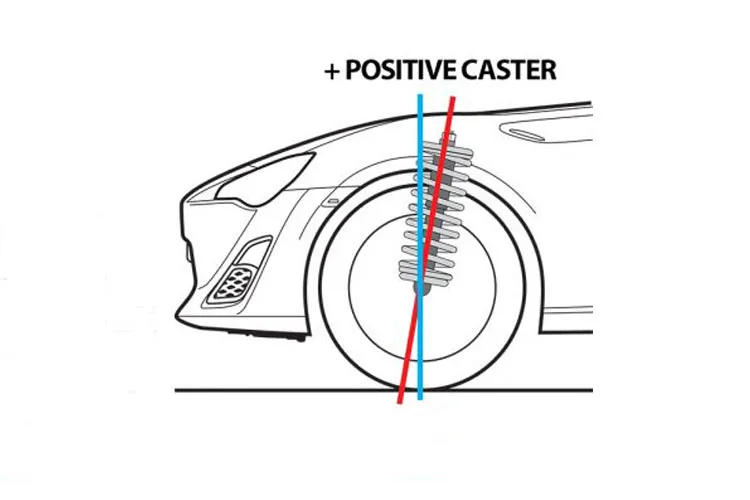
To understand this, imagine standing next to your car and looking at the front wheel from the side:
- The steering axis is an imaginary line drawn through the upper and lower steering pivot points (the upper and lower ball joints on a double-wishbone suspension, or the strut mount and lower ball joint on a MacPherson strut).
- If this axis tilts backward (toward the rear of the car at the top), you have positive caster.
- If this axis tilts forward (toward the front of the car at the top), you have negative caster.
- If the axis is perfectly vertical, you have zero caster.
Everyday analogy: Look at the front fork of a bicycle. The fork does not point straight down — it angles backward. This backward tilt is positive caster. It is the reason your bicycle wheel naturally straightens itself after you turn. The same principle applies to your car’s steering geometry, just at a much smaller angle.
Most modern passenger vehicles use a positive caster angle between +3° and +5°. Performance vehicles and trucks may use +6° or higher for enhanced high-speed stability.
Positive Caster vs Negative Caster
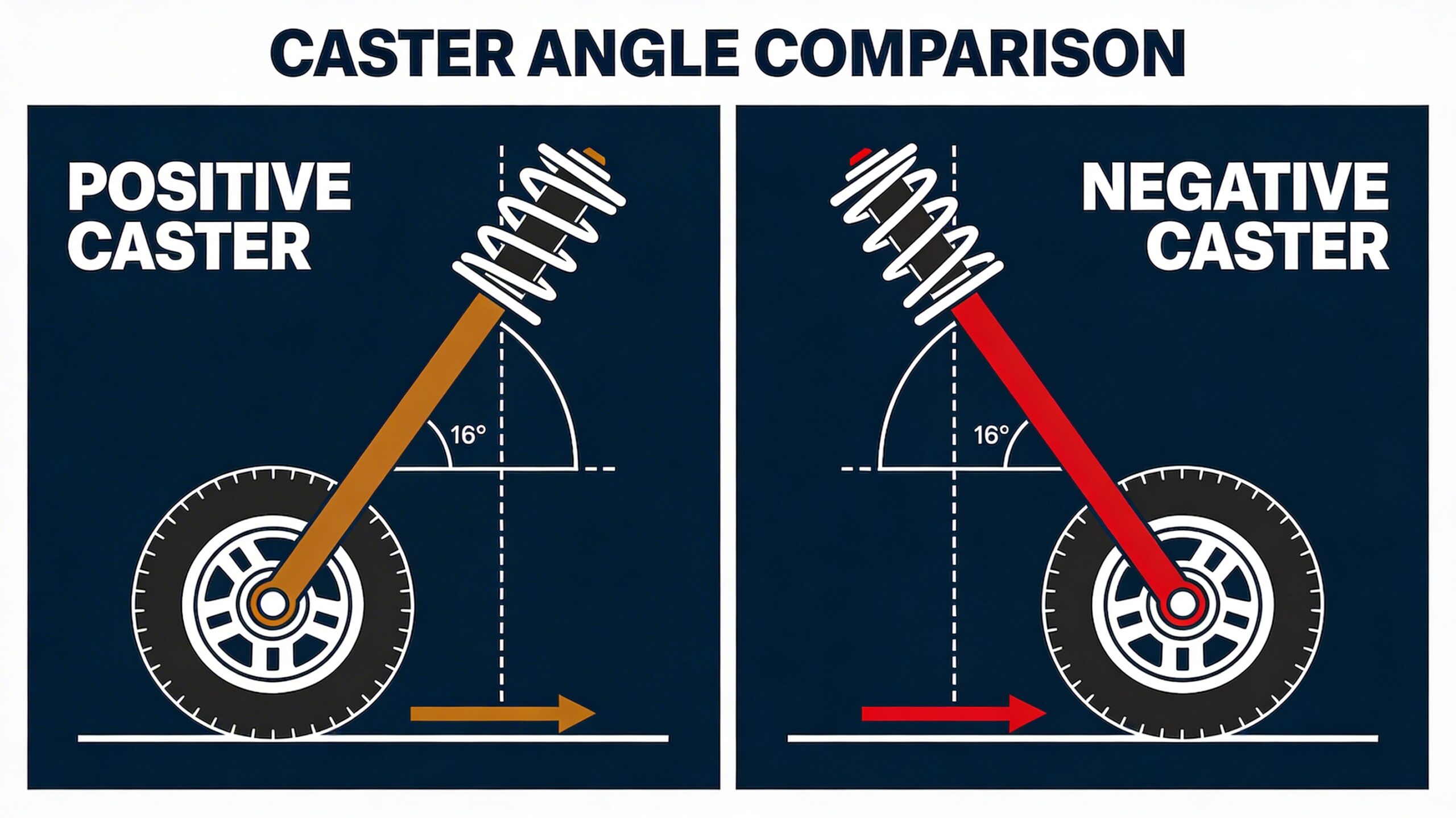
Understanding the difference between positive and negative caster is essential for diagnosing alignment problems:
Positive Caster (Most Common)
When the steering axis tilts backward (top of the axis behind the bottom), the vehicle has positive caster. This is the standard configuration for virtually all modern cars and trucks.
Benefits of positive caster:
- Straight-line stability — The wheels naturally return to center after turning, keeping the vehicle tracking straight on highways.
- Steering returnability — After making a turn, the steering wheel returns to the center position on its own when you loosen your grip.
- High-speed confidence — At highway speeds, positive caster prevents wandering and reduces sensitivity to crosswinds and road irregularities.
- Better cornering feel — The driver receives more road feedback through the steering wheel, improving control during turns.
Trade-offs:
- Higher positive caster increases steering effort at low speeds (parking). This is largely mitigated by modern power steering systems.
- Excessively high positive caster (above manufacturer specification) can make steering feel heavy and reduce maneuverability in tight spaces.
Negative Caster (Rare in Modern Vehicles)
When the steering axis tilts forward (top of the axis ahead of the bottom), the vehicle has negative caster. This configuration is uncommon in modern vehicles but was used in some older designs.
Characteristics of negative caster:
- Lighter steering effort — Requires less force to turn the wheel, which was useful before power steering became standard.
- Poor straight-line stability — The wheels tend to wander and do not self-center after turning.
- Reduced high-speed confidence — The vehicle feels unstable and requires constant steering correction at highway speeds.
Where negative caster is still used:
- Some heavy agricultural equipment where steering effort must be minimized.
- Certain off-road vehicles designed for very low-speed operation on rough terrain.
- Forklifts and warehouse vehicles that prioritize maneuverability over stability.
Symptoms of Bad Caster Alignment
Caster misalignment produces distinct symptoms that are often confused with other alignment or suspension issues. Here is how to identify caster problems:
1. Vehicle Pulls to One Side
This is the most common symptom. When the caster angle is different between the left and right wheels (called cross-caster imbalance), the vehicle pulls toward the side with the less positive (or more negative) caster. A cross-caster difference of more than 0.5° is typically enough to cause noticeable pulling.
Important note: A pull can also be caused by tire pressure differences, camber misalignment, or brake drag. Caster pull is specifically characterized by the pull being consistent at all speeds, whereas brake-related pulls usually occur only during braking.
2. Steering Wheel Does Not Return to Center
After completing a turn, the steering wheel should smoothly return to the center position when you release it. If it stays turned or returns sluggishly, insufficient positive caster is a likely cause. This symptom is most noticeable on vehicles without electronic power steering that adds artificial return-to-center force.
3. Wandering at Highway Speed
If the vehicle feels unstable at highway speeds — requiring constant small steering corrections to maintain a straight line — reduced positive caster may be the cause. This symptom is particularly dangerous and should be addressed immediately.
4. Uneven Front Tire Wear
While camber misalignment causes inside or outside edge wear, caster misalignment tends to cause a more complex wear pattern. Unequal caster left-to-right can cause one front tire to develop a feathered wear pattern (smooth in one direction, rough in the other when you run your hand across the tread).
5. Steering Wheel Vibration
Severe caster misalignment, particularly when combined with worn suspension components, can produce steering wheel vibration that is speed-dependent. This vibration is typically felt through the steering column rather than through the vehicle body.
What Causes Caster Misalignment?
Caster angles rarely change on their own. The most common causes include:
- Worn suspension components — Ball joints, control arm bushings, and strut mounts wear over time, allowing the steering axis to shift.
- Impact damage — Hitting a pothole, curb, or road debris at speed can bend control arms or damage subframe mounting points.
- Lifted or lowered vehicles — Suspension modifications change the geometry of the steering axis, altering caster angle.
- Spring sag — As springs age and lose height, particularly on one side, caster angle changes.
- Collision damage — Even minor front-end impacts can shift subframe or control arm positions enough to alter caster.
Caster vs Camber vs Toe — Key Differences
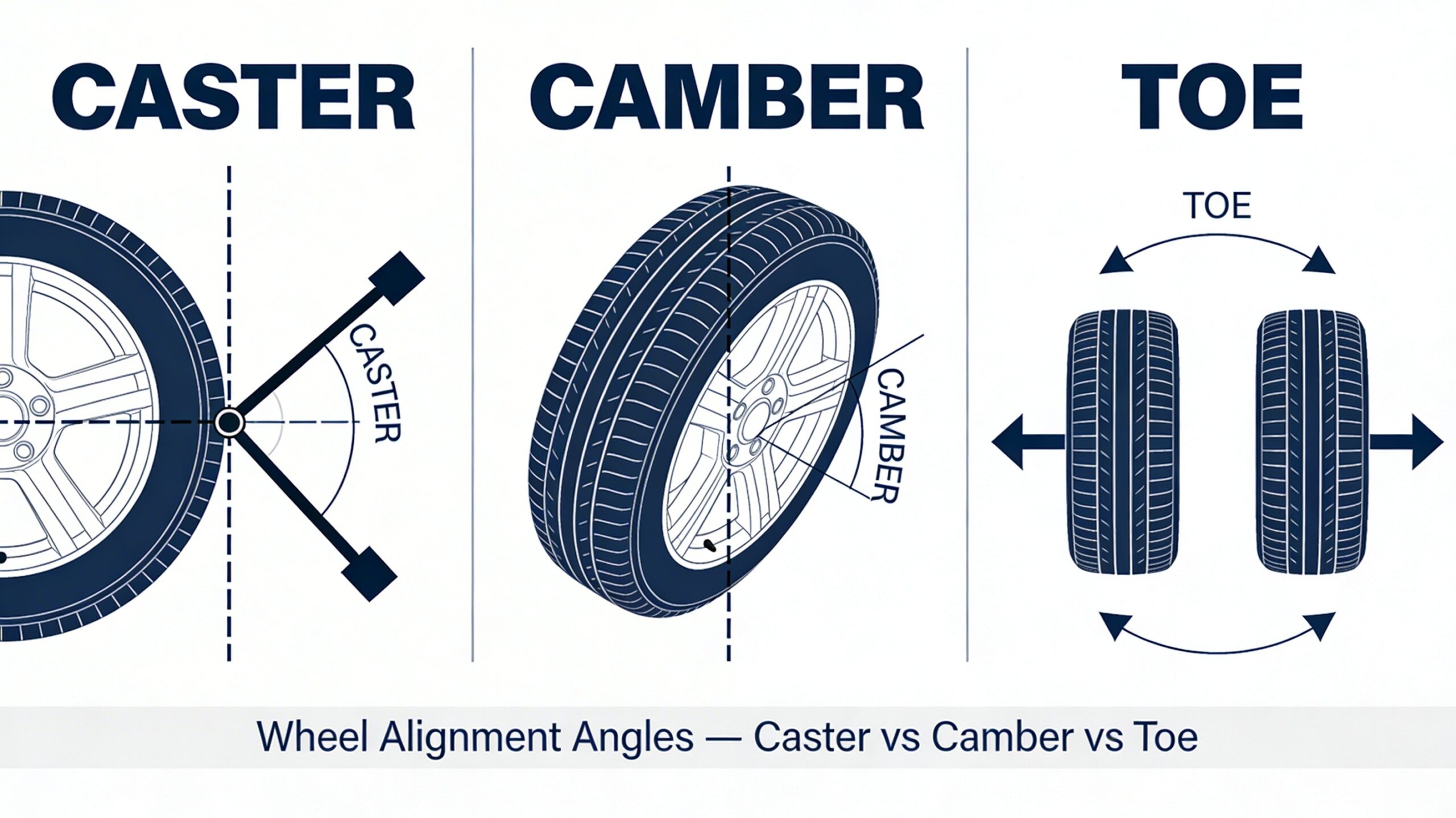
These three alignment angles work together but control different aspects of vehicle behavior:
| Parameter | What It Controls | Viewed From | Typical Spec | Primary Symptom When Off |
|---|---|---|---|---|
| Caster | Steering stability & returnability | Side of vehicle | +3° to +5° | Pulling, wandering, poor steering return |
| Camber | Tire contact patch & vertical wear | Front of vehicle | −0.5° to +0.5° | Inside/outside tire edge wear |
| Toe | Straight-line tracking & tire scrub | Above the vehicle | 0° to +0.3° | Feathered tire wear, rapid tire consumption |
How they interact:
- Caster affects dynamic camber — as you turn the steering wheel, positive caster causes the outside wheel to gain negative camber and the inside wheel to gain positive camber. This is called camber gain and improves cornering grip.
- Toe compensates for suspension flex — slight toe-in prevents the wheels from splaying outward under acceleration loads.
- All three must be within specification simultaneously for optimal tire wear and handling.
How Caster Is Measured and Adjusted
Measurement:
Caster angle is measured using a computerized alignment machine. The technician turns the steering wheel to specific angles (typically 10° left and 10° right of center) while the machine calculates the caster angle from the camber change between these two positions. This is called the SAI (Steering Axis Inclination) measurement method.
Adjustment:
Caster adjustment methods vary by suspension design:
- Shimmed alignment — Adding or removing shims between the control arm and the frame (common on trucks and older vehicles).
- Eccentric cam bolts — Rotating cam-style bolts at the control arm-to-subframe mounting point (common on modern vehicles with MacPherson struts).
- Slotted mounting holes — Some aftermarket control arms include elongated mounting holes for caster adjustment.
- Non-adjustable designs — Many modern economy cars have no factory caster adjustment. If caster is out of spec, worn components must be replaced.
Cost: A professional four-wheel alignment that includes caster adjustment typically costs $80–$150 at U.S. service centers (2026 pricing). Replacing worn components (ball joints, control arm bushings) that caused the misalignment adds additional parts and labor costs.
Frequently Asked Questions
Q: What is caster in wheel alignment in simple terms?
Caster is the angle of the steering axis when viewed from the side of the vehicle. If the top of the steering axis tilts backward (toward the trunk), you have positive caster, which helps your car drive straight and self-center after turns. Most modern cars use positive caster between +3° and +5°. Performance vehicles may use +6° or higher.
Q: Does caster affect tire wear?
Yes, but less directly than camber or toe. Unequal caster between left and right wheels causes the vehicle to pull, which leads to the driver constantly correcting — this constant correction creates uneven tire wear. Extreme caster misalignment can also produce a feathered wear pattern on front tires.
Q: What happens if caster is too positive?
Excessively positive caster makes the steering feel heavy at low speeds (parking lots, tight turns). At highway speeds, the vehicle may feel too “locked in” — resistant to turning inputs. Modern power steering mostly compensates, but caster beyond manufacturer specification should be corrected.
Q: Can I drive with bad caster alignment?
You can, but it is unsafe and costly. A pulling vehicle requires constant steering correction, which is fatiguing on long drives and dangerous in emergency maneuvers. Bad caster also accelerates front tire wear, increasing replacement costs. Have the alignment checked promptly.
Q: How is caster different from a caster wheel?
Despite sharing the same name, automotive caster angle and caster wheels (swivel wheels used on furniture, carts, and equipment) are related concepts. Both involve an angled axis that enables self-centering and directional stability. On a swivel caster wheel, the offset between the swivel pivot and the wheel contact point creates the same self-straightening effect as positive caster angle on a car.
Key Takeaways
- Caster angle is the tilt of the steering axis viewed from the side — backward tilt (positive) provides stability; forward tilt (negative) reduces steering effort.
- Most modern vehicles use +3° to +5° positive caster for optimal straight-line tracking and steering return. Performance vehicles may use +6° or higher.
- The most common symptom of bad caster is the vehicle pulling to one side — specifically toward the side with less positive caster.
- Caster, camber, and toe are three separate alignment parameters that must all be within specification for proper handling and tire wear.
- Worn ball joints, bushings, or impact damage are the most common causes of caster misalignment.
Learn More About Caster Wheels & Mobility Solutions
While automotive caster alignment keeps your vehicle tracking straight, caster wheels keep industrial equipment, furniture, and medical carts rolling smoothly. Inford has been engineering precision caster wheels for over 30 years.
→ What Is a Caster Wheel? | → Explore Our Caster Wheel Solutions | → Contact Us