
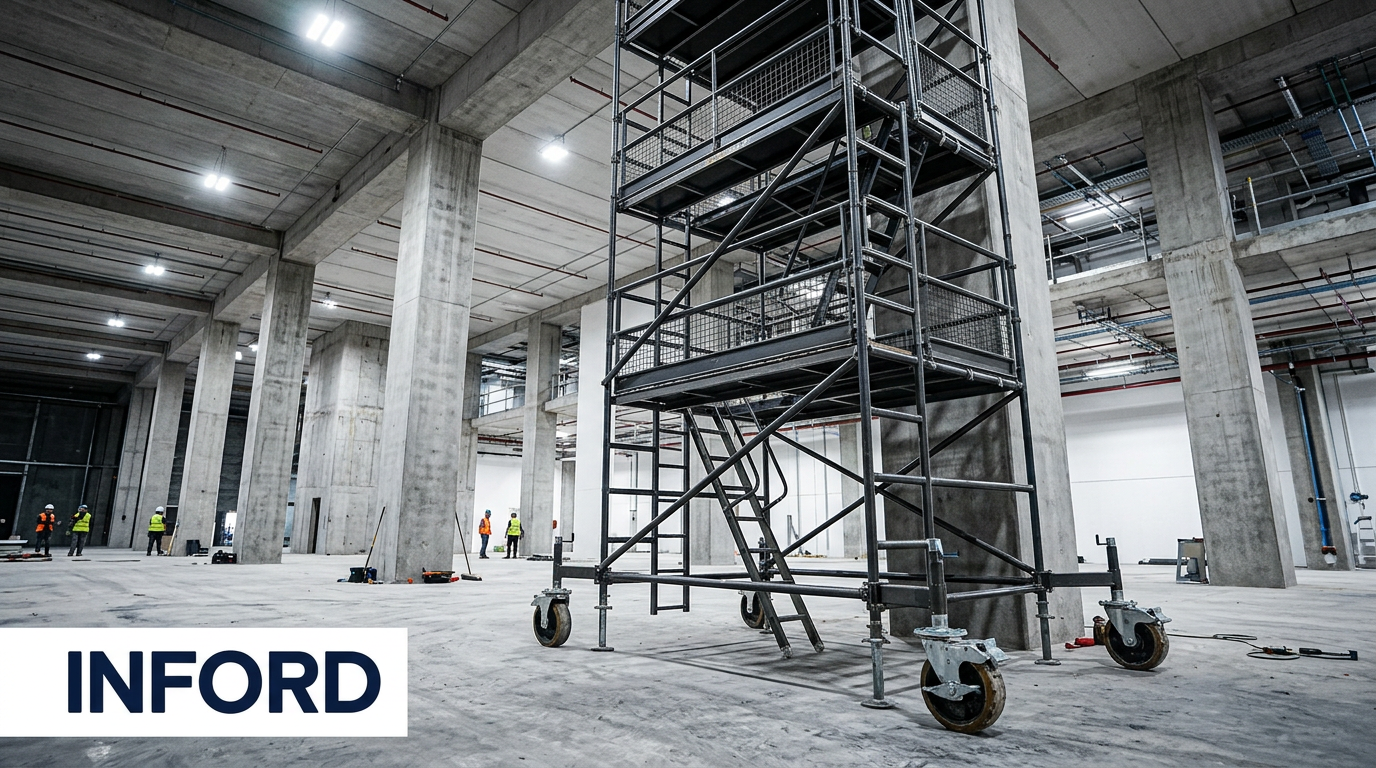
Scaffolding caster wheels should be selected around the actual scaffold frame, worksite surface, load plan, brake requirement, and local safety rules. A caster that works on a smooth indoor floor may not be suitable for rough concrete, ramps, debris, wet ground, or outdoor construction conditions.
The goal is not only to make a scaffold easier to reposition. The caster also has to fit the scaffold leg, support the intended load, lock reliably before work begins, and remain inspectable after repeated movement across a jobsite.
This guide explains scaffolding caster types, brake options, load planning, material choices, installation checks, and maintenance points. It is a product-selection guide; final scaffold use should always follow the site safety plan and the regulations that apply in the project location.
Types of Scaffolding Casters
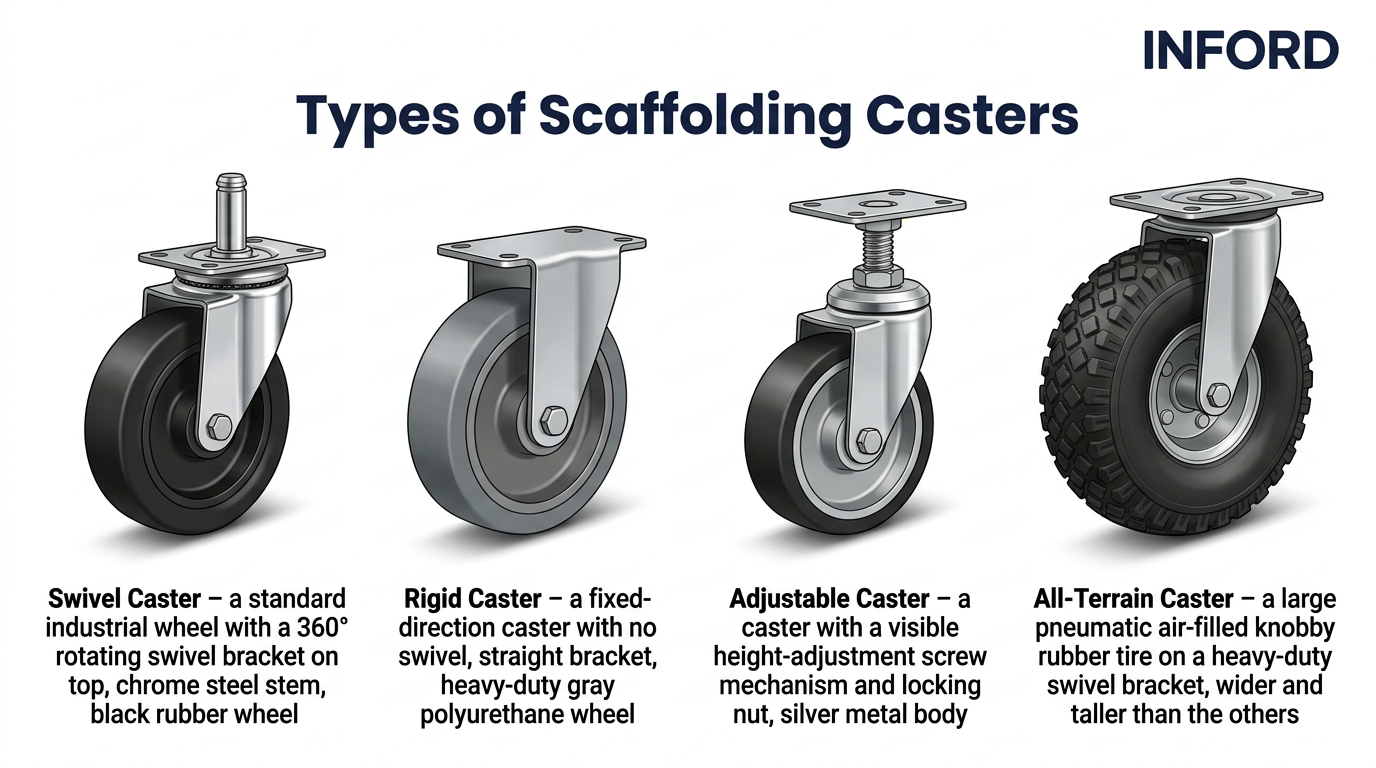
Scaffolding caster wheels are not the same as ordinary furniture or commercial casters. They are usually selected with the scaffold frame, tube size, brake design, ground condition, and inspection process in mind.
Swivel Casters with Brake
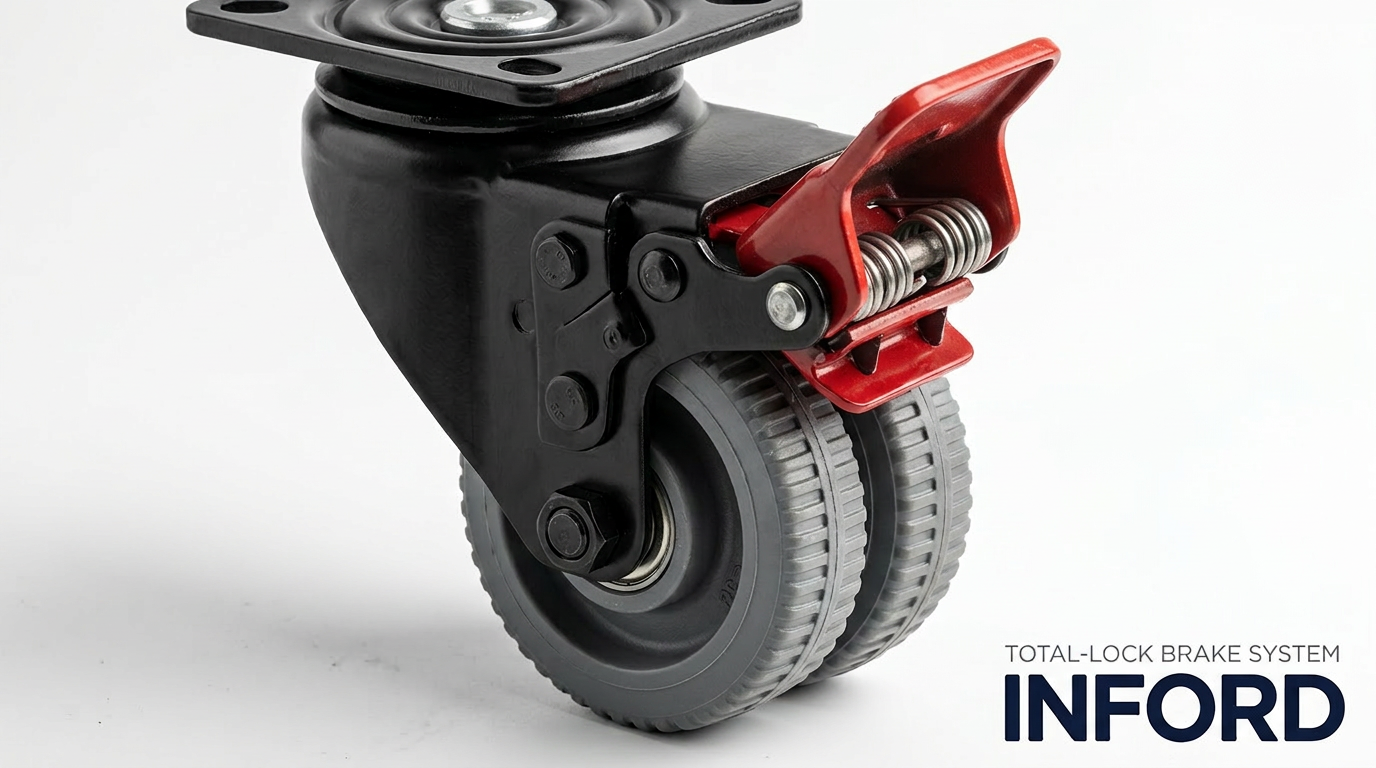
Swivel casters allow a mobile scaffold to be repositioned in more directions. The brake design should be checked carefully because a simple wheel brake and a total-lock brake do not solve the same problem.
- Best for: indoor maintenance, painting platforms, renovation work, and areas where turning is frequent.
- Movement: easier positioning in tight spaces and around obstacles.
- Brake review: confirm whether the brake locks only the wheel or both wheel rotation and swivel movement. See Inford’s swivel caster with brake guide for brake terminology.
- Key check: brakes should be tested on the actual work surface before the scaffold is loaded or used.
Rigid or Fixed Casters
Rigid casters roll in one direction. Some scaffold layouts use fixed casters together with swivel casters when straight-line tracking matters more than turning in place.
- Best for: straight movement along walls, corridors, or predictable travel routes.
- Advantage: better tracking than a four-swivel layout in some routes.
- Tradeoff: less maneuverable when turning around obstacles.
Adjustable Height or Leveling Casters
Leveling casters help compensate for uneven surfaces, but the adjustment mechanism adds another point that should be inspected.
- Best for: renovation sites, sloped floors, uneven concrete, and outdoor work areas.
- Advantage: helps bring the platform closer to level before work starts.
- Key check: inspect threads, locking hardware, and adjustment travel for dirt or damage.
All-Terrain Scaffolding Casters
All-terrain caster wheels are considered when the scaffold crosses rough concrete, compacted ground, gravel, or outdoor surfaces.
- Best for: exterior work, rough floors, and jobsites with surface debris.
- Wheel review: compare wheel diameter, tread width, material, and bracket strength.
- Related reading: for outdoor material and corrosion considerations, review Inford’s outdoor caster wheels guide.
Safety and Compliance Checks for Scaffolding Casters
Scaffolding is a safety-controlled application. A caster supplier can help with product information, but the final acceptance of a mobile scaffold should follow the project location, scaffold design, worksite rules, and the competent safety authority for that job.
Instead of treating a blog article as a compliance document, use the following checks before selecting scaffolding caster wheels:
- Applicable rule set: identify the local scaffolding or mobile access tower rules before choosing a caster.
- Locking requirement: confirm whether the scaffold needs wheel locks, total locks, directional locks, or a central locking arrangement.
- Stem retention: verify that the caster stem, pin, adapter, or mounting plate matches the scaffold leg and prevents unintended detachment.
- Load documentation: request the model-specific load rating and the conditions under which that rating applies.
- Surface condition: check whether the caster is intended for smooth indoor floors, rough concrete, outdoor ground, ramps, or mixed routes.
- Inspection routine: make sure brakes, stems, wheels, fasteners, and height adjusters can be inspected before use.
Load Rating and Capacity Planning
Load planning for scaffolding caster wheels should be based on the actual scaffold configuration, platform materials, workers, tools, carried materials, movement route, and the safety factor required by the applicable rules.
Step 1: List the Real Operating Load
Include scaffold frame, platform deck, guardrails, outriggers if used, tools, materials, and the maximum planned occupancy. Avoid selecting a caster only from the empty scaffold weight.
Step 2: Confirm the Required Safety Factor
Different markets and scaffold designs may apply different safety requirements. Confirm the required factor from the scaffold system documentation, site safety plan, and applicable local rules before approving the caster rating.
Step 3: Calculate Per-Caster Requirement
After the total load and safety factor are defined, divide the required supported load across the actual number of load-bearing casters. For general load-calculation background, see Inford’s caster wheel load capacity guide.
Step 4: Consider Movement and Surface Impact
Rolling over debris, thresholds, ramps, or rough surfaces can increase stress on wheels, stems, bearings, and brackets. Select extra capacity and a suitable wheel material when the scaffold will be moved frequently or used on uneven routes.
Common mistake: using a household or furniture-caster shortcut for a scaffold. Scaffolding caster selection should be checked against the scaffold system and safety rules, not only a simple weight division.
Best Materials for Construction Site Casters
Construction sites expose caster wheels to dust, debris, moisture, uneven surfaces, impact, and outdoor weather. Material selection should balance load rating, floor condition, rolling effort, corrosion risk, and inspection needs. For a broader comparison, see Inford’s caster wheel material guide.
| Material | Where it often fits | Main checks before purchase |
|---|---|---|
| Solid rubber | General construction surfaces, mixed indoor/outdoor movement | Tread wear, load rating, brake grip, and debris resistance |
| Polyurethane | Indoor renovation, smoother concrete, floor-protection needs | Chemical exposure, surface roughness, and tread hardness |
| Nylon | Cleaner hard floors where easy rolling is important | Noise, floor marking, shock, and suitability for rough sites |
| Pneumatic or cushioned wheels | Rougher outdoor ground where shock absorption matters | Maintenance, puncture risk, load rating, and brake performance |
| Steel or coated bracket | Scaffold leg connection and structural support | Corrosion protection, pin retention, fasteners, and stem fit |
Selection note: The best wheel material depends on the route. A caster used on smooth indoor concrete may not be the best choice for wet outdoor ground or debris-heavy jobsites.
How to Install Scaffolding Caster Wheels
Proper installation matters as much as wheel material or load rating. A caster that does not match the scaffold leg can loosen, wobble, or fail inspection.
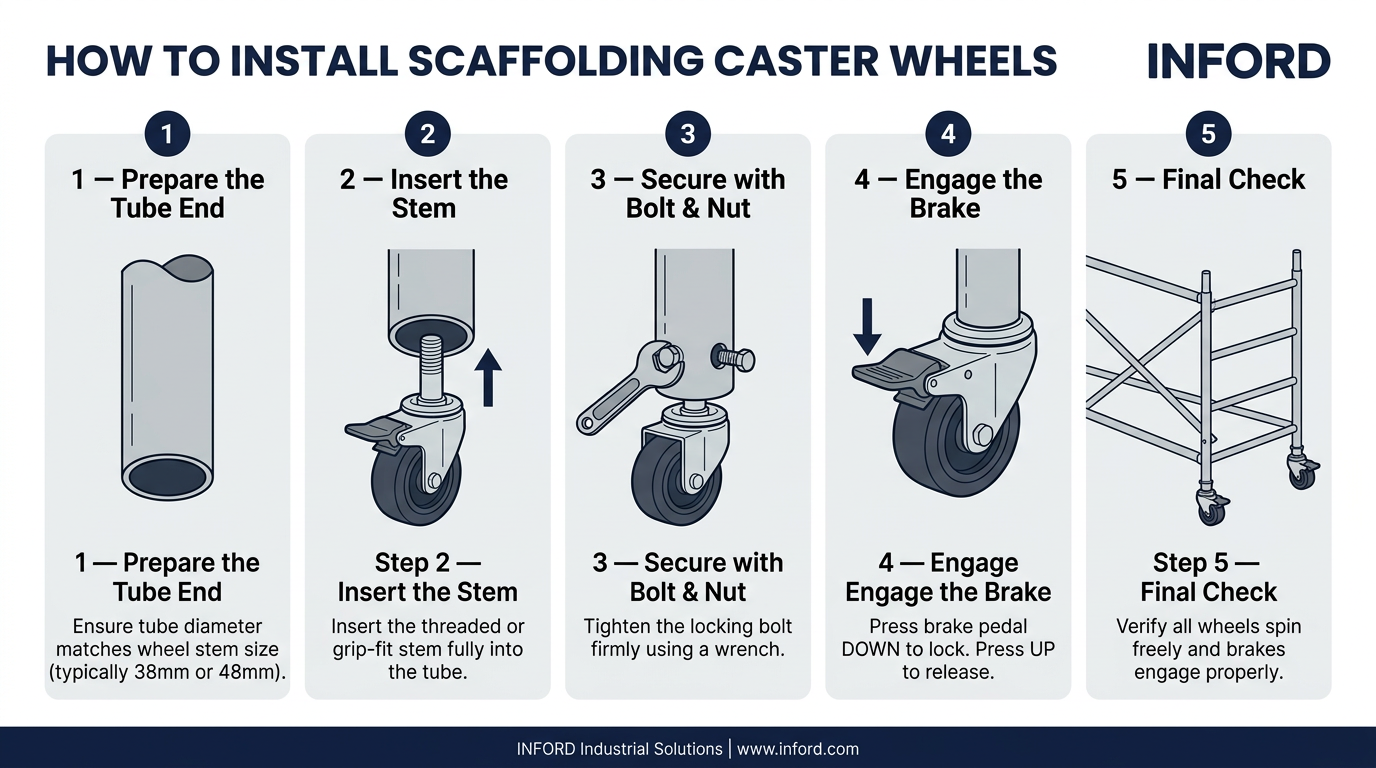
Step 1: Verify Compatibility
Check the scaffold leg tube, caster stem, adapter, mounting plate, pin location, and any required locking hardware. Do not assume two scaffold systems use the same caster connection.
Step 2: Seat the Caster Fully
Insert the caster stem or adapter fully into the scaffold leg according to the scaffold system instructions. If the caster has play or wobble, stop and use the correct adapter or model.
Step 3: Secure Retention Hardware
Install the specified pin, bolt, spring lock, or retaining hardware so the caster cannot pull out during movement or vibration. Missing or incorrect retention hardware should be treated as a failed setup.
Step 4: Test the Brakes
- Engage each brake and push gently on the unloaded scaffold to confirm it holds on the actual surface.
- If using total-lock casters, confirm both wheel rotation and swivel movement are controlled.
- Re-test after moving the scaffold to a different surface or after debris is cleaned from the wheels.
Step 5: Level and Recheck
If adjustable casters are used, level the platform according to the scaffold system instructions. Recheck after adding tools or materials, because load distribution may change.
Maintenance and Inspection Checklist
Construction site casters need regular inspection because dust, impact, moisture, and repeated movement can change how the caster performs.
- ☐ Wheels: check for flat spots, cracking, chunking, embedded debris, uneven wear, and tread separation.
- ☐ Brakes: confirm the brake engages fully and releases cleanly.
- ☐ Swivel section: check for grinding, sticking, looseness, or excessive play.
- ☐ Stem or mounting: inspect for bending, corrosion, looseness, missing pins, or damaged adapters.
- ☐ Height adjustment: clean threads and confirm the adjustment mechanism locks securely.
- ☐ Surface condition: remove dust, mud, stones, or debris that can reduce brake grip or block wheel rotation.
Record inspection findings according to the site’s safety process and remove damaged caster assemblies from service until they are reviewed or replaced.
Frequently Asked Questions
Q: What size caster wheels do I need for scaffolding?
The correct size depends on scaffold frame, platform height, surface condition, load, and the required ground clearance. Larger wheels can roll more easily over rough surfaces, but they may also change platform height and stability considerations.
Q: Can I use regular casters on scaffolding?
General furniture or light commercial casters should not be substituted for scaffold-specific casters. Scaffolding caster wheels should match the scaffold leg, retention method, brake requirement, load plan, and local safety rules.
Q: How much weight can scaffolding casters support?
The answer depends on the exact caster model and the scaffold setup. Confirm the model-specific load rating, the required safety factor, the number of load-bearing casters, and the worksite surface before selection.
Q: What type of brake is best for scaffolding casters?
Many mobile scaffold applications use total-lock or positive-locking designs because they help control both rolling and positioning. The required brake type should be confirmed against the scaffold system and worksite rule set.
Q: When should scaffolding caster wheels be replaced?
Replace or remove a caster from service when you find damaged tread, unreliable braking, bent stems, missing retention hardware, corrosion, excessive swivel play, or any condition that prevents safe inspection approval.
Key Takeaways
- Scaffolding caster wheels should be selected with the scaffold frame, worksite surface, load plan, brake requirement, and local safety rules in mind.
- Brake type matters: wheel brake, total lock, directional lock, and central locking do not provide the same control.
- Load rating should be confirmed from the real scaffold setup and applicable safety factor, not from a generic caster shortcut.
- Wheel material should match the route: smooth concrete, rough floor, outdoor ground, debris, moisture, or ramps.
- Installation and inspection are part of caster selection because stem fit, retention hardware, brake function, and wheel condition affect whether the scaffold can be used.
Procurement Checklist for Scaffolding Caster Wheels
- Confirm scaffold leg size, stem type, retention pin, and mounting method.
- Calculate the real operating load and confirm the required safety factor for the project.
- Choose brake type based on how the scaffold will be moved, positioned, and parked.
- Match wheel material to concrete, debris, ramps, outdoor ground, or wet conditions.
- Request model-specific drawings, load rating, material information, and maintenance instructions.
- Check whether the caster can be inspected and replaced easily on site.
Information to Provide When Requesting a Quote
The fastest way to get a useful scaffolding caster recommendation is to describe the real scaffold and route, not only the wheel diameter. Include the scaffold leg shape and size, preferred stem or plate mounting, number of casters, expected load, indoor or outdoor use, floor condition, debris level, brake requirement, and whether height adjustment is needed.
Photos of the scaffold leg, current caster, retaining pin, and work surface can also reduce selection errors. If the caster will be used on multiple jobsites, describe the harshest surface rather than the easiest one. This helps the supplier compare wheel material, tread width, bracket structure, stem retention, and brake design before sampling.
Need Scaffolding Casters for Your Construction Projects?
Inford can help compare wheel material, bracket structure, brake type, stem fit, load rating, and surface compatibility for scaffolding and construction mobility projects.
→ Get a Scaffolding Caster Quote | → Scaffolding Caster Products | → Scaffold Casters with Brakes