
A caster that rolls smoothly on a warehouse floor can seize, crack, or shatter within weeks inside a -20°F blast freezer. Cold chain, food processing, and pharmaceutical storage equipment demand a fundamentally different wheel specification than standard industrial casters, and getting this wrong leads to equipment downtime in exactly the environments where downtime is most expensive. This guide covers the material science, bearing lubrication, and hardware choices that separate a genuine cold-storage caster from a standard wheel that happens to be labeled “freezer-rated.”
Why Standard Casters Fail in Cold Storage
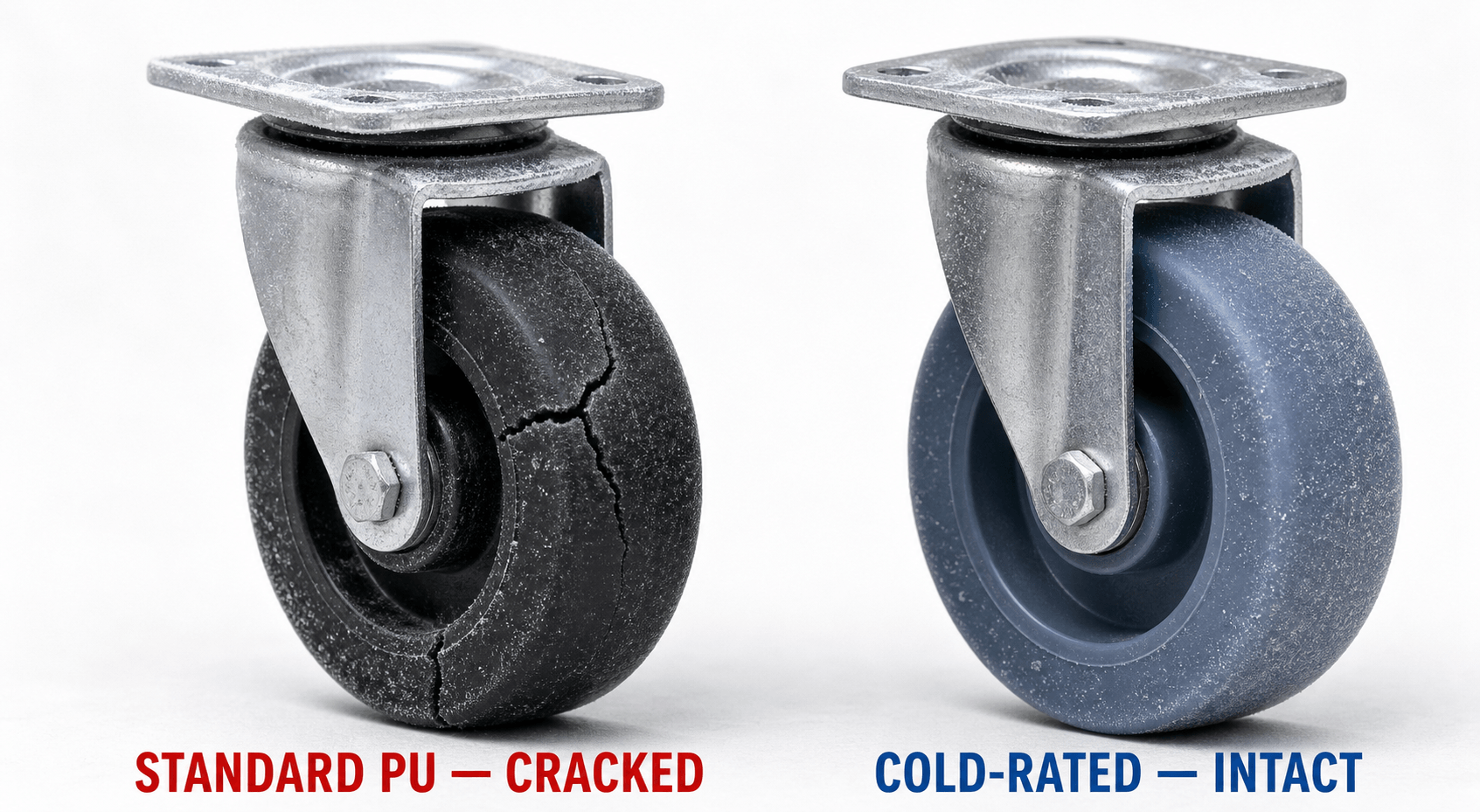
Standard polyurethane hardens dramatically below 32°F, losing the elasticity and grip that make it useful at room temperature, and at -20°F or lower it becomes brittle and prone to cracking under normal rolling loads. This isn’t a gradual performance dip — it’s a phase-change-like shift in the polymer’s mechanical behavior, which is why a wheel that performs flawlessly in a warehouse can fail outright inside a walk-in freezer within the first few weeks of service. Extreme cold also reduces the load-bearing capacity of the wheel tread itself, meaning a caster rated for 500 kg at room temperature may not safely carry that same load once ambient temperature drops.
Material Selection: What Actually Works Below Freezing
Nylon and Polyolefin: The Two Primary Options
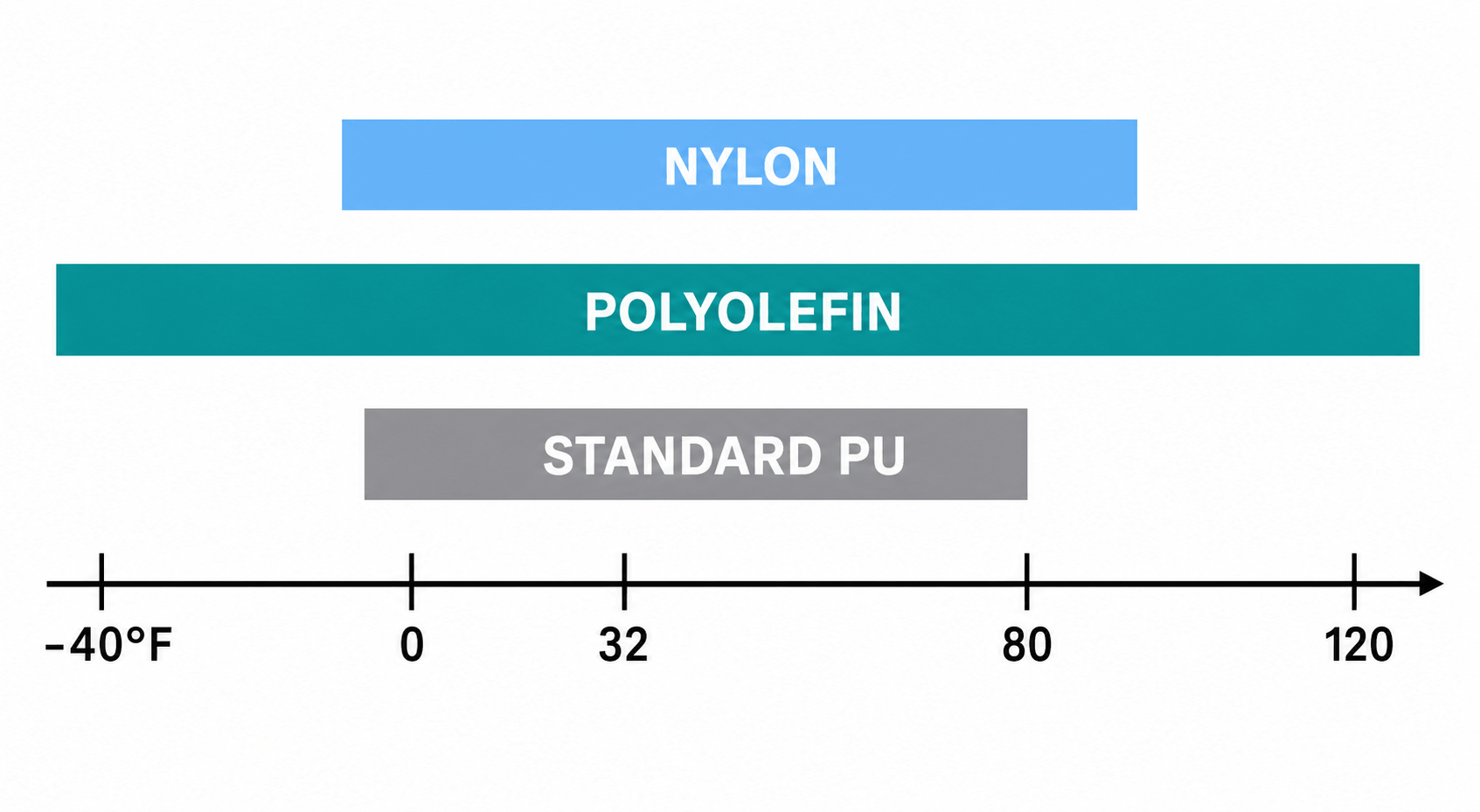
Cold-rated casters overwhelmingly use nylon or polyolefin compounds engineered to maintain flexibility and traction across a -40°F to 120°F range, rather than standard polyurethane or rubber. The two materials serve slightly different use cases within cold storage.
| Material | Hardness | Best For | Key Tradeoff |
|---|---|---|---|
| Nylon (cast/injection-molded) | Moderate-high | Stable walk-in coolers with infrequent door cycling | Excellent wear resistance, but noisier on frozen or defrost-slick floors |
| Polyolefin | Softer than nylon | Blast chillers and freezers with rapid thermal cycling | Better grip on icy surfaces, superior thermal shock tolerance |
Blast chillers and freezers that cycle rapidly between warm ingredient loading and rapid cooling put unusual thermal stress on wheel material, and polyolefin’s higher thermal stability and lower thermal expansion/contraction coefficient make it the better fit for that specific stress pattern, reducing internal cracking over repeated cycles. Stable walk-in coolers with infrequent temperature swings, by contrast, can generally run on nylon without issue. Both material families are typically NSF-certified and food-contact safe, which matters if your equipment operates in food processing or commercial kitchen settings.
Why Standard Polyurethane Specifically Fails
Polyurethane’s usable temperature range is typically -45°C to +90°C (-49°F to 194°F) for cast polyurethane elastomer, but bearing capacity drops once ambient temperature exceeds +35°C, and — more relevant to cold storage — the material’s rigidity actually increases as temperature drops below -10°C, with hardness settling around 75±5 Shore A. That increased rigidity is precisely the problem: a harder, less elastic tread loses its ability to absorb shock and impact loads, which is why polyurethane wheels crack at the core under normal rolling stress in sustained sub-zero conditions — a failure mode caster engineers see repeatedly when standard PU wheels are misapplied to cold environments. If you’re comparing PU against other tread families more broadly, our polyurethane vs rubber caster wheels guide covers the room-temperature tradeoffs that don’t apply once you’re below freezing.
Bearing Lubrication: The Overlooked Failure Point
Standard bearing grease thickens and can effectively solidify at freezer temperatures, causing bearings to seize or drastically increase rolling resistance — a caster with a perfectly cold-rated tread can still fail if the bearing lubrication wasn’t specified for the same environment. Low-temperature bearing greases rated to -73°C (-100°F) are available specifically for freezer cart casters and cold room conveyor equipment, using a lithium soap and phenylmethyl silicone oil base to remain soft (NLGI grade 1) at temperatures where standard grease would gum up entirely. When specifying cold storage casters, confirm the bearing lubrication rating explicitly — a supplier who can quote tread material temperature range but not grease specification has only solved half the problem.
Hardware and Corrosion Considerations
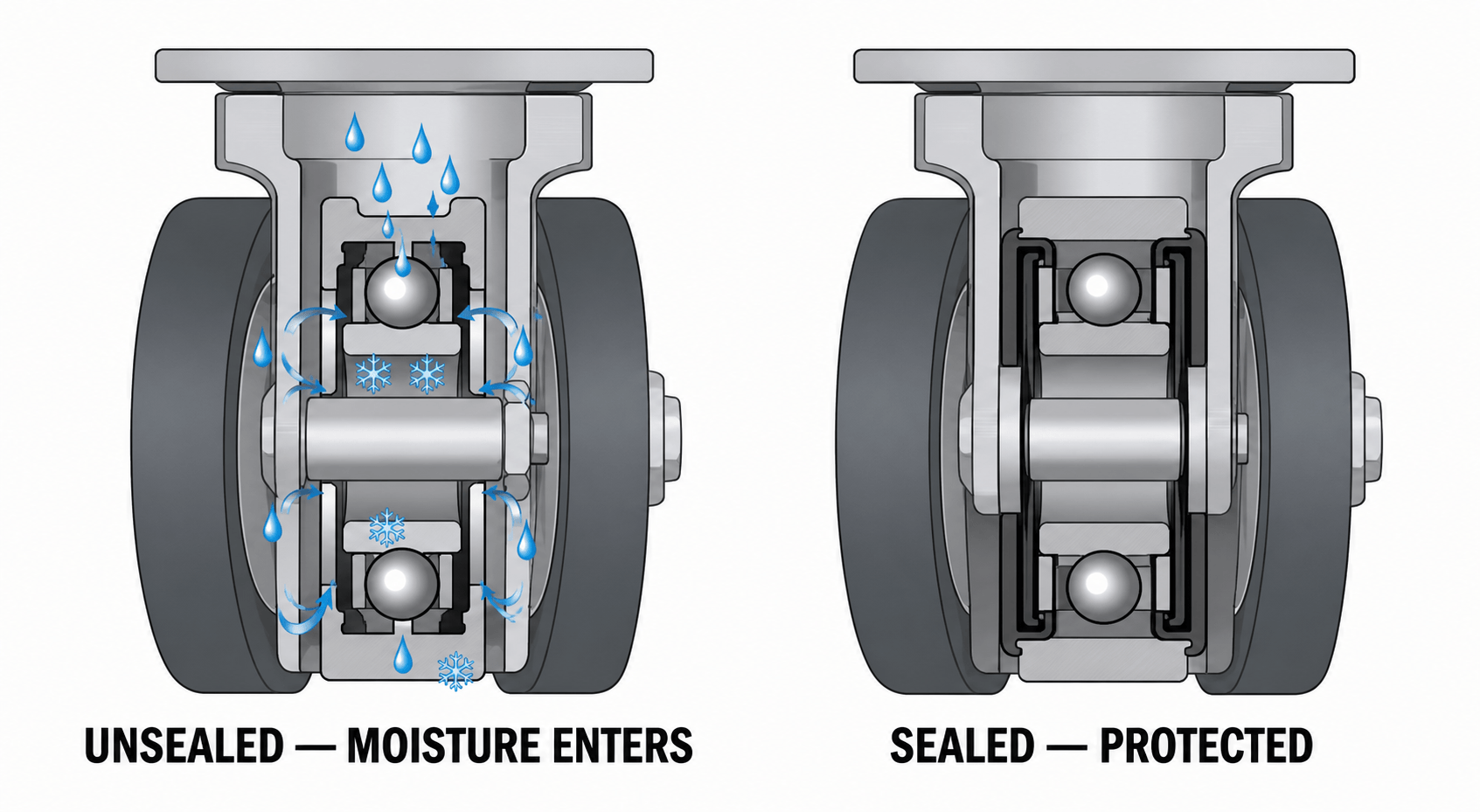
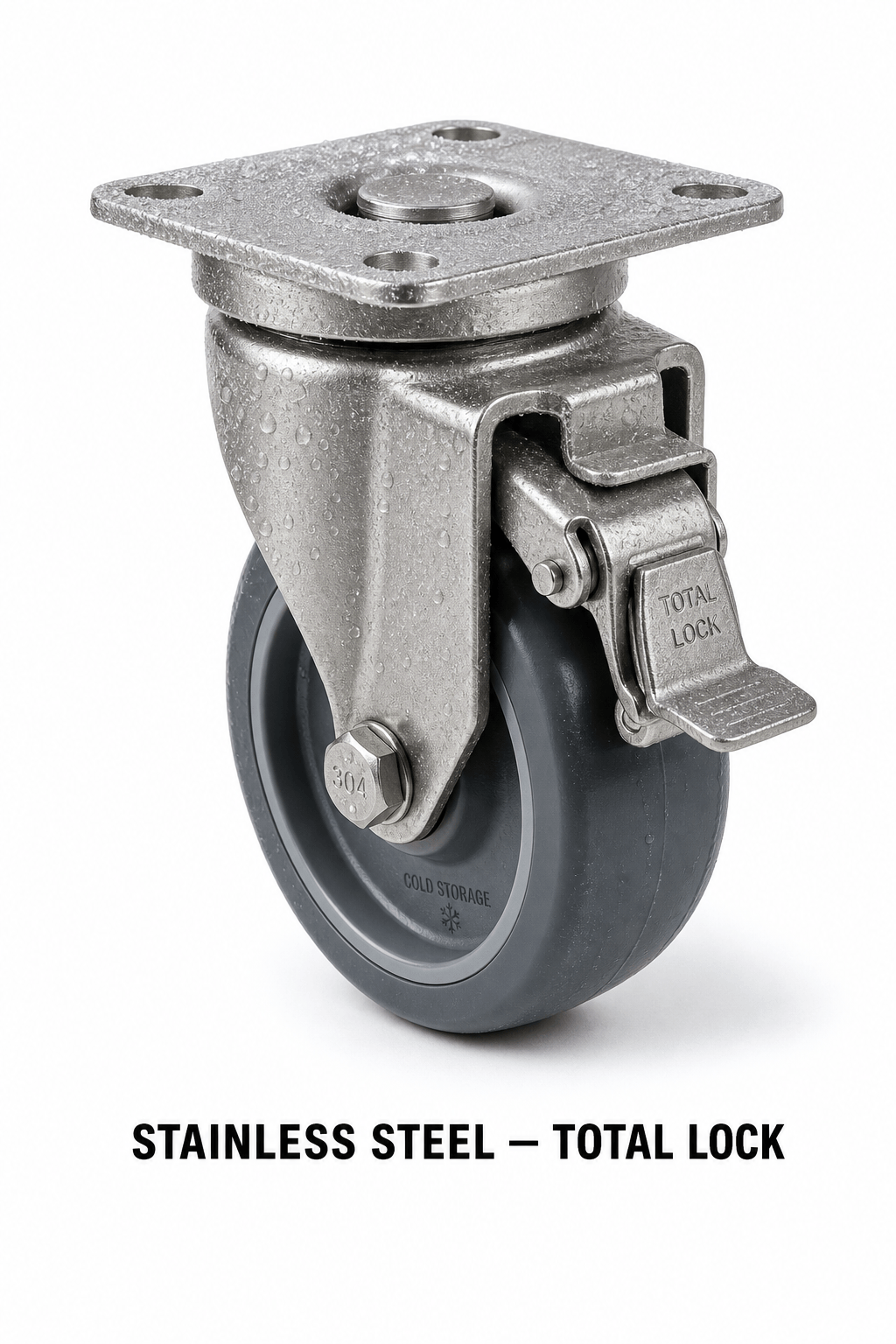
Stainless steel stems and mounting hardware are effectively mandatory in extreme cold storage applications to prevent fastener seizing when equipment cycles between ambient loading areas and deep-freeze storage, since standard plated steel hardware is prone to galling and corrosion under repeated condensation and thermal-gradient exposure. Sealed bearings are the other non-negotiable spec — cold storage environments generate significant condensation during defrost cycles and door openings, and an unsealed bearing will accumulate moisture that freezes and expands, damaging the bearing race over repeated cycles.
Wheel Diameter and Braking for Cold Storage Carts
Blast chiller and heavy cold-storage dolly casters typically use 5-inch diameter wheels to distribute load across ice- and condensation-slick floors more effectively than smaller wheels, and total-lock brakes are standard practice to prevent unexpected drift when loading or unloading heavy pans on a wet, sloped, or uneven cold-room floor. If your application also needs to satisfy strict load math for a multi-wheel cart, our caster wheel load capacity guide covers the standard per-wheel calculation, which should be applied using the cold-adjusted (lower) load rating rather than the room-temperature figure.
Temperature Range Reference Table
| Application | Typical Temp Range | Recommended Wheel Material | Recommended Bearing Grease |
|---|---|---|---|
| Standard walk-in cooler | 32°F to 40°F | Nylon | Standard low-temp grease (-20°F to -40°F rated) |
| Freezer storage room | 0°F to -10°F | Nylon or polyolefin | Low-temp synthetic grease (-40°F rated) |
| Blast chiller / flash freezer | -20°F to -40°F | Polyolefin | Extreme low-temp grease (-73°C / -100°F rated) |
| Cold chain / pharma storage | Varies, often with rapid cycling | Polyolefin, sealed bearing | Extreme low-temp grease |
Common Specification Mistakes in Cold Storage Procurement
- Ordering standard polyurethane casters because the room-temperature load rating “looks sufficient,” without accounting for reduced load capacity and increased brittleness at operating temperature.
- Specifying a cold-rated tread but leaving bearing grease unspecified, resulting in seized bearings even though the wheel material itself performs correctly.
- Using standard plated steel hardware, which corrodes and seizes under repeated condensation cycling — stainless steel stems and fasteners should be the default spec, not an upgrade option.
- Choosing unsealed bearings for cost savings, then experiencing bearing failure from moisture ingress during defrost cycles.
- Failing to distinguish between stable-temperature coolers (nylon is fine) and thermally-cycling blast freezers (which need polyolefin’s shock tolerance) — treating all cold storage as one category leads to premature failure in the more demanding application.
Cold Storage Caster Specification Checklist
- Confirmed actual operating temperature range, including any rapid thermal cycling (blast chiller vs stable cooler)
- Selected nylon (stable cold) or polyolefin (thermal cycling) tread material based on that duty pattern
- Verified bearing grease is rated for the same low-temperature range as the tread material, not just room-temperature grease
- Specified sealed bearings to prevent moisture ingress from condensation and defrost cycles
- Specified stainless steel stems and mounting hardware to prevent corrosion and fastener seizing
- Recalculated load capacity using the cold-adjusted rating, not the room-temperature nameplate figure
- Confirmed NSF certification if the equipment operates in food processing or food-contact environments
- Selected appropriate wheel diameter (5 inch+ for heavy dollies) and lock-brake configuration for slick cold-room floors
Get a Custom Quote for Cold Storage Casters
If you’re specifying casters for freezer, blast chiller, or cold chain equipment, share your temperature range and duty cycle with our team for a matched material and bearing recommendation — contact us to start your quote.