
Choose polyurethane (PU) when wear resistance and efficient movement under load are priorities; compare TPR and elastic rubber when cushioning and quieter travel matter; consider nylon or polypropylene (PP) when a hard wheel suits the floor and low rolling resistance is important. These are starting points—not interchangeable material specifications. Compound formulation, wheel construction, diameter, bearings, load, and floor conditions can change the result.
The compound, rather than the material name alone, determines many of the properties that matter in service. Two polyurethane wheels with the same hardness can have different rolling resistance, rebound resilience, and resistance to moisture-related degradation.
Caster Wheel Material Comparison Chart
The matrix below compares general material tendencies for indoor movement on reasonably smooth, hard floors. It is not a set of measured Inford product ratings. Starting and rolling effort must be compared at compatible wheel sizes, loads, bearing configurations, temperatures, and floor conditions.
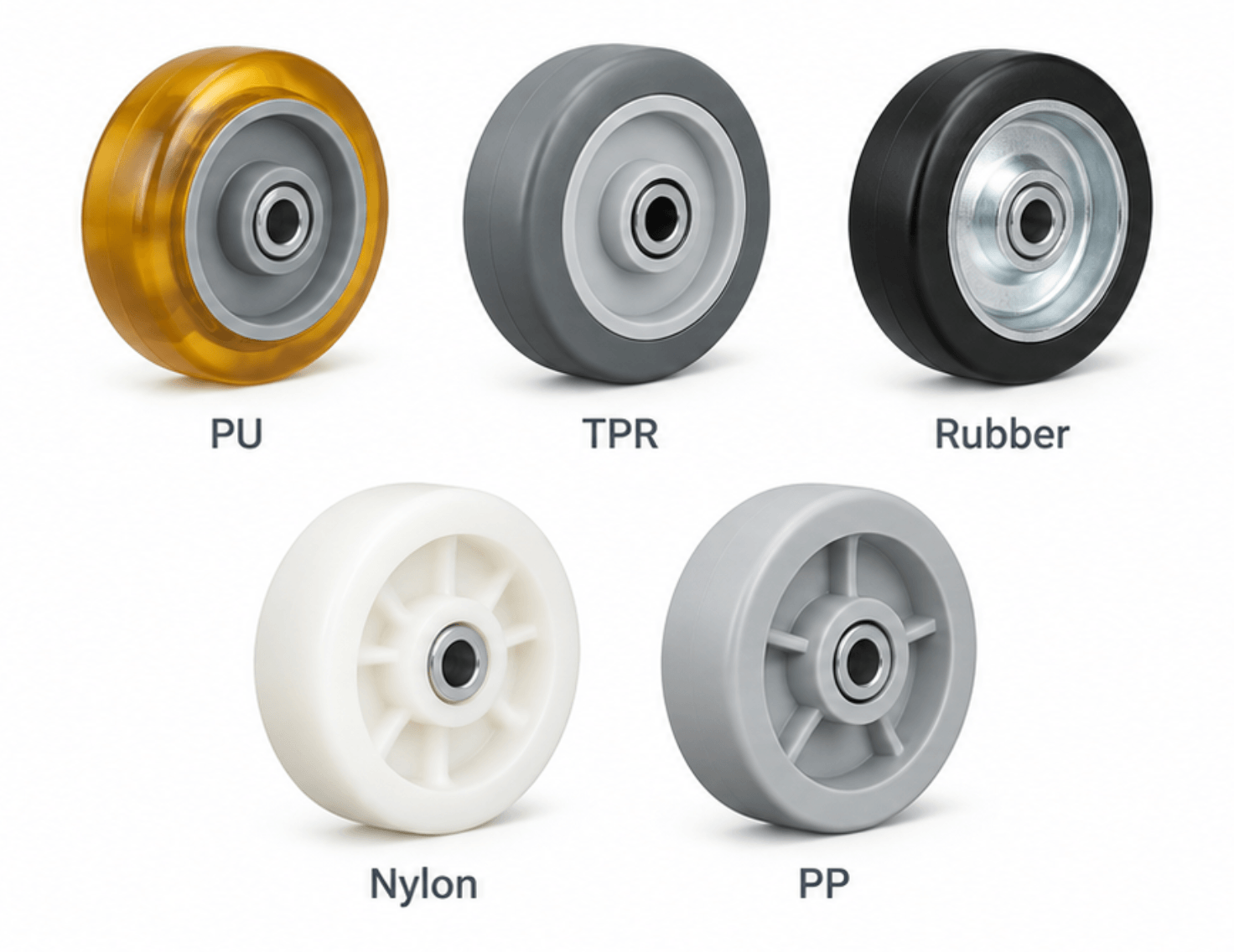
“Rubber” below means conventional solid rubber or elastic solid rubber, not pneumatic tires. TPR means thermoplastic rubber; manufacturers may use the broader term thermoplastic elastomer, or TPE, for related wheel compounds.
| Wheel tread or running-surface material | Starting and rolling effort | Noise and cushioning | Floor protection | Wear characteristics and main limitations |
|---|---|---|---|---|
| Polyurethane: firmer compounds | Often a useful choice for low effort under load on smooth floors; formulation and rebound matter as well as hardness | Less cushioning than softer compounds; joints and roughness can transmit vibration | A candidate for finished floors, but contact pressure, debris, and the specific compound still need checking | Commonly selected for abrasion resistance; cuts, heat buildup, chemical exposure, and tread-to-core integrity remain separate checks |
| Polyurethane: softer compounds | Can combine cushioning with low rolling effort; softness alone does not establish push force | More vibration absorption than firmer PU within comparable constructions | Useful where cushioning and finish protection matter | Confirm the complete wheel’s load rating, sustained-load deformation, and duty limits rather than borrowing ratings from harder PU |
| TPR / thermoplastic rubber | Can provide relatively low rolling and swivel resistance; verify under the intended load | A useful candidate for quieter travel and vibration reduction | Check both non-marking and non-staining performance on the actual finish | Wear and deformation depend on the compound and duty; some formulations can stain sensitive surfaces despite being non-marking |
| Conventional solid rubber | Often requires more starting and rolling effort than harder plastic or PU wheels | Absorbs vibration and impact | Can cushion the floor; standard black compounds may leave marks | Confirm abrasion performance, deformation after parking, and compatibility with oils or other contaminants |
| Elastic solid rubber | High-resilience compounds can roll substantially more easily than conventional solid rubber | Strong candidate for cushioning and quieter travel across joints | Useful where impact absorption and floor preservation are priorities | Do not treat it as equivalent to ordinary solid rubber; verify the exact compound, tread construction, and load rating |
| Nylon / polyamide (PA) | Generally low starting and rolling resistance on smooth, hard floors | Limited cushioning; floor irregularities can produce more impact noise | Hard contact requires particular care on pressure-sensitive finishes | Commonly selected for abrasion resistance; moisture absorption can affect dimensions, and rough routes require attention |
| Polypropylene (PP) | Generally low rolling resistance on smooth, hard floors | Limited cushioning compared with elastomer treads | Check indentation and surface damage on softer floors | Lightweight material option; confirm the actual load, impact, wear, and temperature ratings rather than assuming nylon-equivalent performance |
These tendencies follow manufacturer technical descriptions of the material families. They do not establish a universal ranking: elastic rubber can roll more easily than conventional rubber, and high-resilience soft PU can outperform a harder PU formulation in rolling resistance.
Hardness and Temperature: Compare Actual Specifications
Hardness helps describe a tread, but it does not establish load capacity, push force, abrasion life, or chemical resistance by itself. Elastomer treads are commonly specified in Shore A; harder plastics such as nylon and PP are commonly specified in Shore D. A Shore A value and a Shore D value are not directly comparable numbers.
The following published examples show why a single hardness figure should not be assigned to an entire material family.
| Material or formulation | Published hardness examples | What the specification needs to identify |
|---|---|---|
| Thermoplastic polyurethane | Blickle examples range from 80 ± 5 Shore A for a soft TPU to 98 ± 2 Shore A for a hard guide-roller TPU | Exact formulation, wheel construction, and intended duty |
| Reaction-cast polyurethane | Blickle publishes soft and hard formulations at approximately 75 and 92 Shore A | Compound designation, hardness tolerance, and relevant performance data |
| Thermoplastic rubber elastomer | Blickle’s listed TPE compound is 85 ± 3 Shore A | Actual compound rather than a generic TPR hardness assumption |
| Conventional and elastic solid rubber | Blickle lists conventional solid rubber at 80 +5/−10 Shore A and elastic solid rubber at 65 ± 3 Shore A | Rubber type, resilience, tread thickness, and construction |
| Nylon | Blickle’s injection-molded nylon example is 70 ± 5 Shore D | Nylon grade and whether it is a standard or special formulation |
| Polypropylene | Blickle’s PP example is 60 ± 5 Shore D | PP grade, wheel geometry, and complete wheel rating |
These are examples from Blickle’s wheel-tread material descriptions, not Inford specifications or universal material ranges.
Why there is no single operating temperature for “PU” or “nylon”
Use the temperature rating of the selected wheel and complete caster—not a generic polymer range. The tread’s operating temperature includes ambient exposure and heat generated during movement. Load, speed, travel distance, and tread deformation all influence that heat buildup. Elevated temperatures can reduce load capacity and increase flattening under sustained load; cold can stiffen rubber and many PU compounds and reduce their cushioning.
For each shortlisted material, obtain:
- Minimum and maximum continuous operating temperatures.
- Any separately stated short-duration exposure limit.
- Load derating across the intended temperature range.
- Confirmation that bearings, lubricants, seals, and other caster components suit the same exposure.
A special heat-resistant nylon or rubber formulation is not evidence that a standard wheel of the same material can handle the same conditions. Manufacturer material descriptions distinguish these special grades explicitly.
Match the Material to the Main Operating Problem
Reduce push effort on smooth floors
Start by comparing suitable PU, nylon, and PP wheels, but do not select solely by tread hardness. Wheel diameter, tread profile, rebound resilience, bearings, and the floor all affect starting and rolling resistance. Highly elastic rubber and PU compounds can provide low rolling resistance despite being softer than hard plastic wheels.
Keep three measurements separate:
- Starting force: the force required to begin moving from rest.
- Rolling force: the force required to maintain movement.
- Swivel force: the force required to align swivel casters with the direction of travel.
A wheel that rolls easily in a straight line may still require considerable effort to turn. Swivel-head construction, caster offset, and the interaction between the tread’s contact patch and the floor also influence steering effort.
For a meaningful comparison, request force measurements in newtons under stated conditions, rather than labels such as “easy rolling.” Use the same loaded equipment, route, speed, and initial caster orientation when comparing candidates.
Reduce noise and vibration across joints
Compare TPR, elastic solid rubber, and softer PU first. Their cushioning can reduce the impact transmitted through the wheel when crossing joints or minor surface irregularities. The result still depends on wheel diameter, tread thickness, load, and route condition.
If one floor joint causes most of the disturbance, test that crossing directly. A material change that improves travel on smooth flooring may not adequately address a small wheel striking a large joint.
Do not compare advertised noise figures unless the measurement distance, floor, load, speed, and test method are compatible.
Protect a finished or pressure-sensitive floor
Separate three different risks:
| Risk | What to check |
|---|---|
| Visible marks | Whether the exact compound leaves transferred tread marks during loaded movement and turning |
| Staining | Whether prolonged contact causes discoloration or interaction with the floor finish |
| Physical damage | Whether contact pressure, turning, or trapped debris causes indentation, scratching, or coating damage |
“Non-marking” does not automatically mean non-staining. For example, Blickle describes its TPE tread as non-marking while noting that its oil content can stain sensitive surfaces. Hard wheels also require attention to floor pressure even when their material does not transfer visible marks.
Test a production-representative sample on the actual floor finish. Include loaded parking, straight travel, tight turns, and the normal cleaning cycle.
Select for repeated travel and wear
PU and nylon are common candidates where abrasion resistance matters, but abrasion is only one failure mechanism. A tread may resist surface wear yet still be unsuitable because of cutting, chemical attack, heat buildup, deformation, or failure at the tread-to-core interface.
For a bonded or molded tread, specify the running-surface material separately from the wheel core. A PU tread on a nylon core is not a solid nylon wheel, and its suitability depends on the complete construction—not just the visible tread material.
Check Water, Cleaners, and Chemical Exposure
Do not approve a wheel because its material is described simply as “chemical resistant.” Compatibility depends on the chemical, concentration, temperature, contact duration, and whether exposure involves splashing, repeated cleaning, or immersion. Mixtures can behave differently from individual substances.
| Exposure | Information needed before material approval |
|---|---|
| Detergents and disinfectants | Product name, active ingredients, use concentration, contact time, rinse procedure, and cleaning temperature |
| Oils and process fluids | Exact fluid designation, frequency of contact, temperature, and whether residue remains on the route |
| Frequent washdown | Water temperature, cleaning chemicals, drying conditions, and compatibility of bearings, seals, and brackets |
| Persistent moisture or hot water | Evidence for the selected PU formulation’s hydrolysis resistance, where relevant |
| Humidity changes | Dimensional requirements and the selected nylon grade’s moisture behavior |
PU chemistry matters here. Published manufacturer data distinguish polyester-based and polyether-based formulations and identify hydrolysis-resistant grades separately. Likewise, nylon can absorb and release moisture, while PP is described as not absorbing moisture. Neither fact alone establishes the suitability of a complete caster for washdown service.
Electrical properties also require a specific formulation and a verified path through the assembly. Standard PU, rubber, nylon, or PP should not be treated as conductive or antistatic merely because electrically modified versions exist.
Connect the Material Shortlist to Inford Options
Inford’s custom caster and wheel engineering page lists PU, TPR, natural or synthetic rubber, nylon, and PP among its material options. Use those families to begin an inquiry, then identify the exact proposed wheel and caster configuration before comparing performance. The material list does not establish one shared hardness, temperature range, or load rating for every option.
| Material family to discuss with Inford | Details to request for the proposed option |
|---|---|
| PU | Thermoplastic or cast construction, compound designation, hardness and tolerance, tread thickness, core material, and relevant wet-service data |
| TPR | Compound designation, hardness, non-marking and non-staining information, and loaded wear and deformation data |
| Rubber | Conventional or elastic formulation, hardness, marking characteristics, resilience, and compatibility with expected contaminants |
| Nylon | Nylon grade, wheel construction, moisture-related dimensional considerations, and any special temperature rating |
| PP | Confirmation of polypropylene grade, complete wheel load rating, temperature limits, and impact suitability |
Request the wheel material, wheel core, and bracket material as separate specification fields. Also identify the bearing type and the exact caster configuration quoted; a material comparison cannot replace those details.
Confirm the Selection on the Complete Equipment
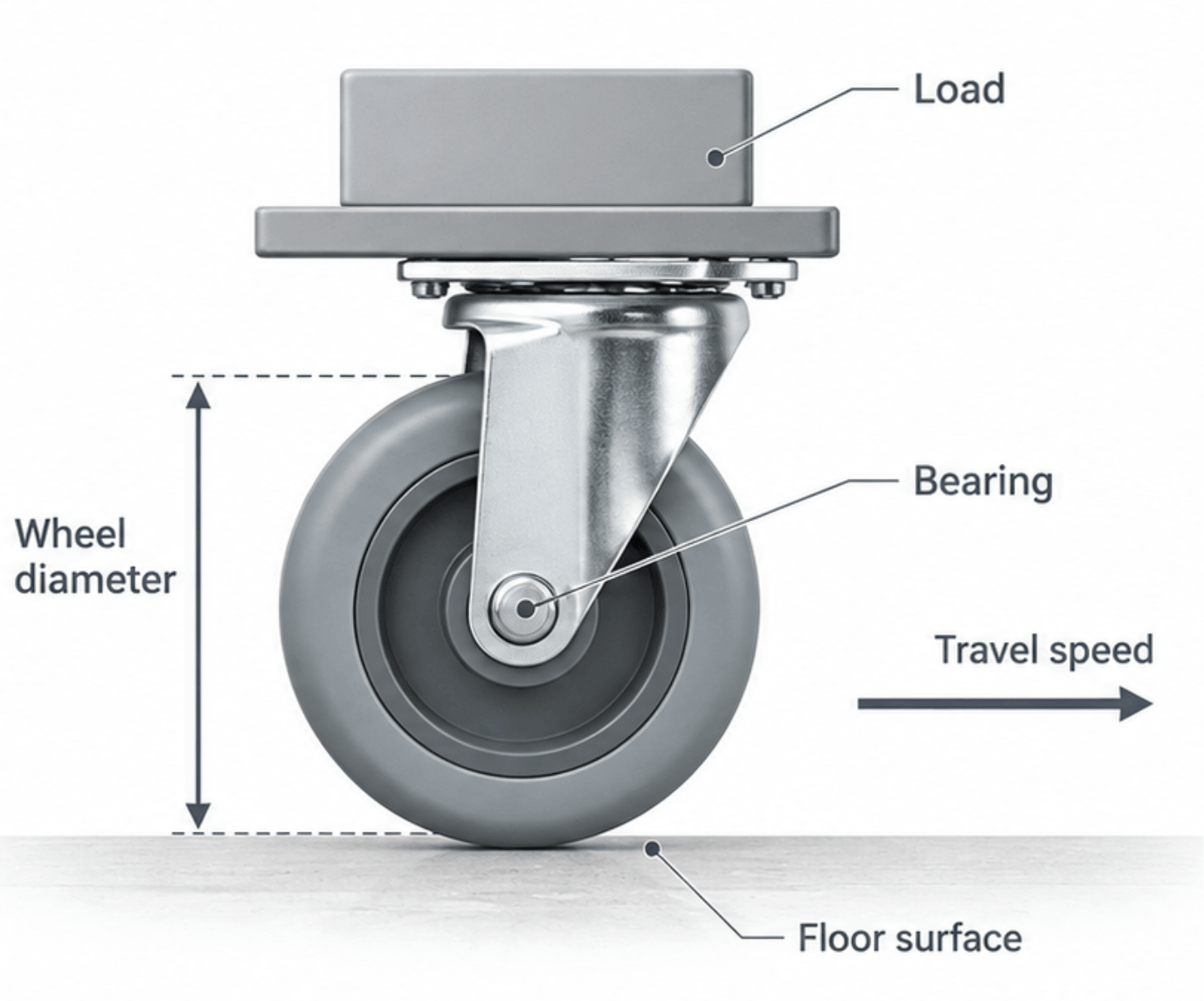
Once two or three material options remain, compare them on the equipment and route that will actually be used.
- Record the operating conditions. Include equipment weight, maximum payload, load position, floor finish, joints, debris, travel speed, daily travel distance, parking duration, and cleaning exposure.
- Confirm load suitability. Obtain the complete caster’s dynamic rating and its stated test conditions. Check the most heavily loaded positions rather than assuming every caster always carries an equal share. Keep wheel-only, complete-caster, static, and dynamic ratings separate.
- Check geometry before changing materials. Record wheel diameter and width, overall mounting height, mounting dimensions, swivel clearance, and bearing configuration. Changing these alongside the material makes the cause of any performance difference harder to identify.
- Measure movement separately. Compare starting, straight-line rolling, and turning force at the same load and speed. Include restarts after the longest normal parking interval.
- Inspect the floor and wheel. Look for transferred marks, staining, indentation, tread cuts, embedded debris, permanent deformation, and signs of tread separation.
- Repeat relevant exposure. Where cleaning, moisture, cold, or heat is part of normal service, include that condition in the comparison instead of relying only on a dry, room-temperature trial.
Wheel performance changes with load, surface, temperature, geometry, and bearings; keeping those conditions consistent makes the comparison useful.
For an Inford selection request, submit these operating details with the required mounting dimensions and brake or directional-lock function. Ask for a named wheel option, its current specification sheet, and the complete caster configuration so that the final decision rests on a reproducible specification rather than “PU,” “rubber,” or another material label alone.