
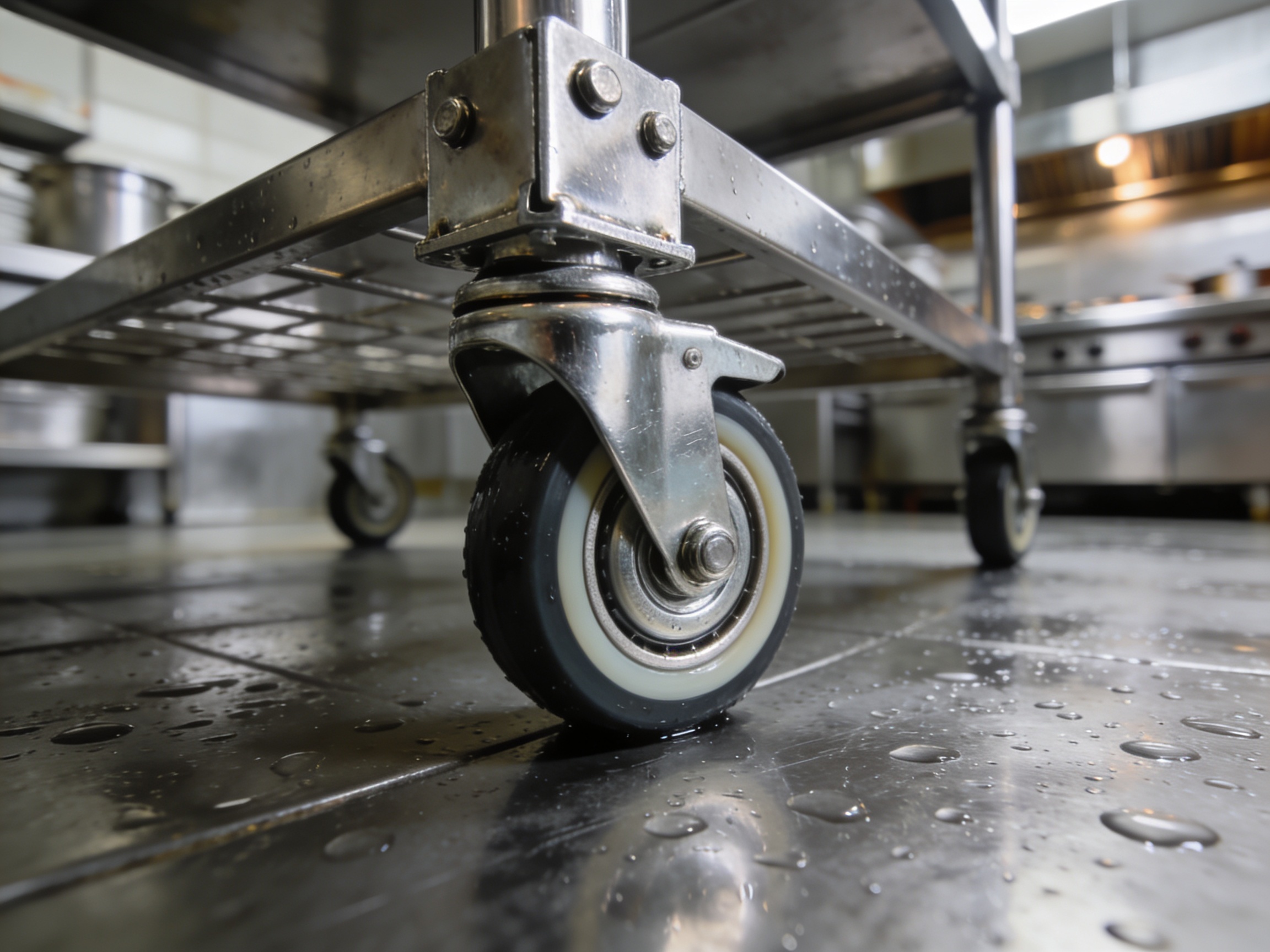
Caster chemical and cleaning compatibility must be checked against the exact cleaning product, its working concentration, the exposure conditions, and the complete caster configuration. A wheel material name alone cannot establish whether a caster will withstand a cleaning process.
For an Inford or BBT caster, request confirmation against the specific model and configuration before approving a cleaner or disinfectant. A material resistance chart can help screen candidates, but it does not verify the wheel tread, wheel core, bracket, bearings, seals, lubricant, and brake as an assembly.
Identify the Cleaning Conditions First
“Compatible with disinfectants” is not a complete specification. Chemical resistance depends on the substance, concentration, contact duration, temperature, and other environmental conditions. Mixtures can behave differently from their individual ingredients, as noted in Blickle’s published chemical resistance guidance. That guidance supports material screening, not approval of Inford products.
Provide the following information for each cleaning product used on or around the caster.
| Required information | What to specify |
|---|---|
| Exact product | Manufacturer, trade name, product code, and formulation or regional version |
| Supporting documents | Current safety data sheet (SDS), product label, and technical instructions |
| Working concentration | Ready-to-use or diluted; dilution ratio and active ingredient concentration where available |
| Concentration basis | State whether the value is by weight, by volume, or expressed as an active ingredient concentration in ppm |
| Temperature | Solution temperature at application, maximum exposure temperature, and any heated drying stage |
| Application method | Damp wiping, spraying, foam cleaning, immersion, automated washing, or pressure washing |
| Contact duration | Required wet contact time, actual time before rinsing or drying, and any extended soaking |
| Frequency | Cleaning cycles per day or week and the intended service period |
| Rinsing and drying | Whether rinsing is required, rinse-water temperature, and air or heated drying |
| Cleaning sequence | Detergents, disinfectants, descalers, and other products used in sequence |
| Incidental exposure | Spills, floor-cleaning residues, standing liquid, and contact with concentrated product |
| Operating conditions | Load per caster, whether the equipment remains loaded during cleaning, and when it returns to service |
A dilution ratio is not necessarily the active ingredient concentration. For example, a percentage describing a commercial cleaner in water is different from the percentage of its active chemical. Identify which value is being supplied rather than treating them as interchangeable.
For disinfectants, preserve the manufacturer’s required concentration, application method, and wet contact time. CDC guidance emphasizes following these instructions for effective use. If those conditions conflict with the caster’s documented limits, resolve the equipment or process selection rather than shortening the disinfection cycle to protect the caster.
Caster Compatibility Review Matrix
Use the matrix below to define what must be reviewed for each exposure. It identifies the necessary confirmation; it does not assign chemical resistance ratings to unverified Inford or BBT models.
| Cleaning product or process | Exposure details needed | Components to include | Confirmation required before approval |
|---|---|---|---|
| Detergent or combined detergent-disinfectant | Exact formulation, use dilution, temperature, contact time, and rinse procedure | Tread, core, bracket finish, seals, bearings, and lubricant | Compatibility with the formulated product and repeated cleaning cycle |
| Alcohol-based cleaner or disinfectant | Alcohol type, concentration basis, other ingredients, and wetting frequency | Tread, core, tread-to-core bond where present, seals, and plastic covers | Evidence for the actual materials and formulation—not an “alcohol-resistant” description alone |
| Chlorine-releasing disinfectant, including sodium hypochlorite | Product identity, working active concentration, temperature, dwell time, and residue removal | Metal bracket, axle, fasteners, bearings, springs, tread, and core | Assessment of both polymer exposure and corrosion risk for the specified metal grades and finishes |
| Hydrogen peroxide or peracetic acid formulation | Individual active concentrations, other ingredients, temperature, and exposure cycle | Polymers, elastomers, metals, seals, and lubricant | Review of the complete formulation; approval for one oxidizing cleaner does not establish approval for another |
| Quaternary ammonium disinfectant | Exact product, use dilution, any added alcohol or detergent, and residue-management procedure | Tread, core, covers, brake contact surfaces, and seals | Compatibility with the commercial formulation and its repeated-use conditions |
| Acidic descaler or alkaline degreaser | Chemical identity, concentration, pH where available, temperature, and rinse sequence | Bracket finish, fasteners, tread, core, seals, and bearings | Product-specific material review; pH alone is insufficient |
| Hot-water or automated washing | Full temperature profile, cycle duration, cleaning chemistry, drying stage, and loading condition | Complete caster assembly | Confirmation for the combined thermal, chemical, and mechanical exposure |
| Pressure washing or immersion | Chemistry, temperature, duration, spray pressure and direction, or immersion depth | Wheel bearings, swivel raceway, seals, lubricant, and enclosed cavities | Assessment of liquid ingress and lubrication retention as well as chemical resistance |
| Steam cleaning or autoclaving | Complete cycle, including temperature, pressure, exposure, and drying | Complete caster assembly | Explicit model-specific suitability for that process; a general heat-resistance rating is insufficient |
The commonly used disinfectant groups include alcohols, chlorine-releasing agents, quaternary ammonium compounds, and hydrogen peroxide products. Their inclusion here identifies review categories, not equivalent performance or interchangeable uses. CDC advises selecting products with suitable material compatibility and following the product instructions.
How to Interpret a Compatibility Result
Treat each result as a statement about one defined combination of cleaner, caster configuration, and exposure conditions.
- Confirmed for the stated conditions: Written confirmation or applicable testing covers the identified configuration and cleaning cycle. Retain all stated limits.
- Supported for material screening only: Relevant material data exists, but the complete caster or repeated process has not been verified. Use the result to shortlist a configuration, not approve it.
- Further evaluation required: The formulation, material identity, exposure conditions, or supporting evidence is incomplete. Obtain the missing information or arrange an agreed evaluation.
- Not suitable for the stated conditions: Applicable evidence identifies unacceptable degradation, corrosion, or loss of function. Select another configuration or an approved alternative cleaning process.
Unknown does not mean resistant. An empty cell, an unlisted chemical, or a missing test result is not a pass.
Check the Complete Caster, Not Just the Wheel Tread
Tread, Core, and Their Connection
Identify the exact tread compound and wheel core material. Descriptions such as “rubber,” “nylon,” “TPE,” or “polyurethane” are too broad to establish resistance to a particular cleaning formulation.
Polyurethane chemistry is especially important when using reference charts: Blickle’s table distinguishes ester-based and ether-based polyurethane and assigns different ratings for some exposures. Those distinctions demonstrate why a generic polyurethane label cannot support a universal compatibility claim. They do not establish the chemistry or resistance of an Inford wheel.
For a wheel with a separate tread and core, include their connection in the review. A favorable tread-material rating does not establish that the core or bond will remain serviceable after repeated cleaning.
Bracket, Axle, Fasteners, and Internal Metal Parts
Specify metal grades and surface finishes where available. “Stainless steel caster” does not, by itself, identify the material of every bearing, axle, spring, or fastener.
Do not interpret stainless steel as resistance to every disinfectant. For example, Blickle’s reference table marks AISI 304 stainless steel as conditionally resistant to the listed 10% sodium hypochlorite exposure and identifies a localized corrosion or stress-cracking concern. This is a warning against blanket claims, not a recommended cleaning concentration or an Inford product rating.
Similarly, a corrosion-test result should not replace evidence for the actual cleaner. A salt-spray exposure and a repeated disinfectant cycle are different conditions.
Bearings, Seals, and Lubricant
Check whether the cleaning process can reach the wheel bearings or swivel raceway. Material resistance alone does not establish that an assembly will exclude liquid or retain its lubricant.
Treat immersion, pressure washing, and hot automated washing as separate approval questions. In a published trolley-washing application, Blickle identifies grease washout, corrosion, and reduced wet braking performance as concerns requiring application-specific caster design. That example supports reviewing the complete assembly; it does not demonstrate equivalent performance for other products.
Brakes and Directional Locks
Identify which functions the equipment requires:
- A wheel brake prevents wheel rotation.
- A directional lock holds the caster’s swivel orientation.
- A combined locking mechanism may perform both functions, depending on its design.
Include each fitted mechanism in the evaluation. Check engagement, release, holding function, and any change after cleaning or drying. A wheel that still rolls normally does not establish that its brake or directional lock remains effective.
Match the Evidence to the Actual Use
An SDS, a material resistance chart, and a caster test report answer different questions. Submit them together where available rather than treating any one document as complete proof.
| Evidence | Useful for | What still needs checking |
|---|---|---|
| Cleaner SDS and product label | Identifying the product, reported ingredients, hazards, dilution, and use instructions | Whether the exact caster configuration tolerates the cleaning process |
| Material supplier data | Screening a specified polymer, elastomer, metal, or coating against a stated exposure | Whether the tested grade matches the supplied component and whether other components are covered |
| Model-specific manufacturer confirmation | Defining acceptable use for an identified caster configuration | Its concentration, temperature, exposure, maintenance, and other limits |
| Component or immersion test | Assessing the tested sample under documented conditions | Assembly function, loading, cleaning sequence, and relevance to repeated service |
| Complete-caster cycle test | Evaluating the specified assembly through a defined cleaning process | Whether the cycle and acceptance criteria represent the intended application |
| Controlled equipment trial | Checking cleaning and mobility together under representative use | Whether the duration is sufficient for the intended decision and whether longer-term monitoring is needed |
For a useful compatibility record, retain the caster model and configuration, cleaner product version, test or document reference, issue date, exposure conditions, results, and acceptance limits.
A report for one wheel compound does not automatically apply to another color, compound, supplier grade, or wheel construction. Likewise, approval for one cleaner should not be transferred to another product solely because both list the same active ingredient.
Evaluate Repeated Cleaning Before Fleet-Wide Use
When available evidence does not cover the intended process, agree on an evaluation with the caster supplier and the equipment owner before deployment.
- Define the configuration and cleaning cycle. Identify the caster, all cleaning products in sequence, working concentrations, temperature profile, wet time, rinsing, drying, and representative loading.
- Record a baseline. Photograph the assembly and document tread condition, wheel dimensions where relevant, free rotation, swivel movement, brake operation, and directional-lock operation.
- Establish acceptance criteria in advance. Set application-specific limits for physical deterioration and functional change. Do not use “still usable” as the only criterion.
- Repeat the actual process. Include the intended number of cycles and any foreseeable extended exposure. An accelerated test needs a justified relationship to service conditions; a hotter or stronger solution does not automatically represent a known number of normal cleaning cycles.
- Inspect and function-test the assembly. Examine it immediately after exposure and after the normal drying or recovery period.
- Document the decision and its limits. Record whether the configuration is accepted, restricted, rejected, or requires further evaluation.
Look for tread softening, swelling, hardening, tackiness, cracking, tread separation, corrosion, seal damage, lubricant leakage, binding, and changes in brake or lock operation. Record cosmetic changes separately from functional failures, while considering whether surface deterioration affects cleanability.
If mobility is measured, distinguish starting force, sustained rolling force, and swivel force. Compare before-and-after results under the same load, floor condition, caster orientation, and measurement method.
Material compatibility and disinfection effectiveness remain separate decisions. A caster evaluation does not establish that a cleaning process provides the required infection-control outcome. Follow the disinfectant instructions and the equipment’s applicable cleaning procedure.
Request Caster Chemical & Cleaning Compatibility Confirmation
Submit one request for each proposed caster configuration and cleaning process. Include the exact cleaner name and current SDS, plus the label or technical instructions that define its use.
| Request field | Information to provide |
|---|---|
| Contact details | Name, company, and email |
| Equipment and application | Equipment type, operating environment, and whether the request concerns new equipment or a replacement |
| Caster identification | Inford or BBT model, part number, drawing, or clear photographs of the existing caster |
| Configuration | Wheel diameter, tread and core materials if known, bracket material, bearing type, seals, and fitted locking functions |
| Cleaner identification | Manufacturer, exact product name, product code, and regional formulation |
| Documents | Current SDS, product label, technical instructions, and any existing compatibility report |
| Use concentration | Ready-to-use or dilution ratio, active concentration, and concentration basis |
| Exposure cycle | Application method, temperature, wet contact time, cleaning frequency, rinse, and drying procedure |
| Additional exposure | Other cleaners in sequence, spills, standing liquid, pressure washing, immersion, or steam |
| Operating requirement | Maximum load per caster, loading during cleaning, movement conditions, and required brake or directional-lock function |
| Existing problem | Observed damage or functional change, time in service, and photographs |
| Required decision | Confirmation for an existing model, selection of an alternative configuration, or definition of a suitable evaluation |
Send the request to Inford using the contact details on the Inford Caster website. Request a response identifying the exact configuration reviewed, the supporting evidence, the permitted exposure conditions, and any evaluation still required before use.