
Standard casters solve the mobility problem — they let equipment, furniture, and machinery roll from one location to another. But what happens when the equipment also needs to stand perfectly level on an uneven floor, or when the working height must change to suit different operators?
That is where adjustable height caster wheels come in. These casters combine the rolling function with a built-in height adjustment mechanism, allowing you to raise, lower, or level the equipment they support — without removing the casters or adding shims and blocks.
This guide explains how adjustable height casters work, the difference between self-leveling and manual-adjust types, where each type is best applied, and how to size and specify them correctly for industrial, commercial, and furniture applications.
What Are Adjustable Height Casters?
Adjustable height casters are caster wheels with a built-in threaded stem or mechanical mechanism that allows the user to change the height of the equipment above the floor. By rotating the threaded stem or operating the adjustment mechanism, the equipment rises or lowers in controlled increments — typically 25–75mm (1″–3″) of total travel.
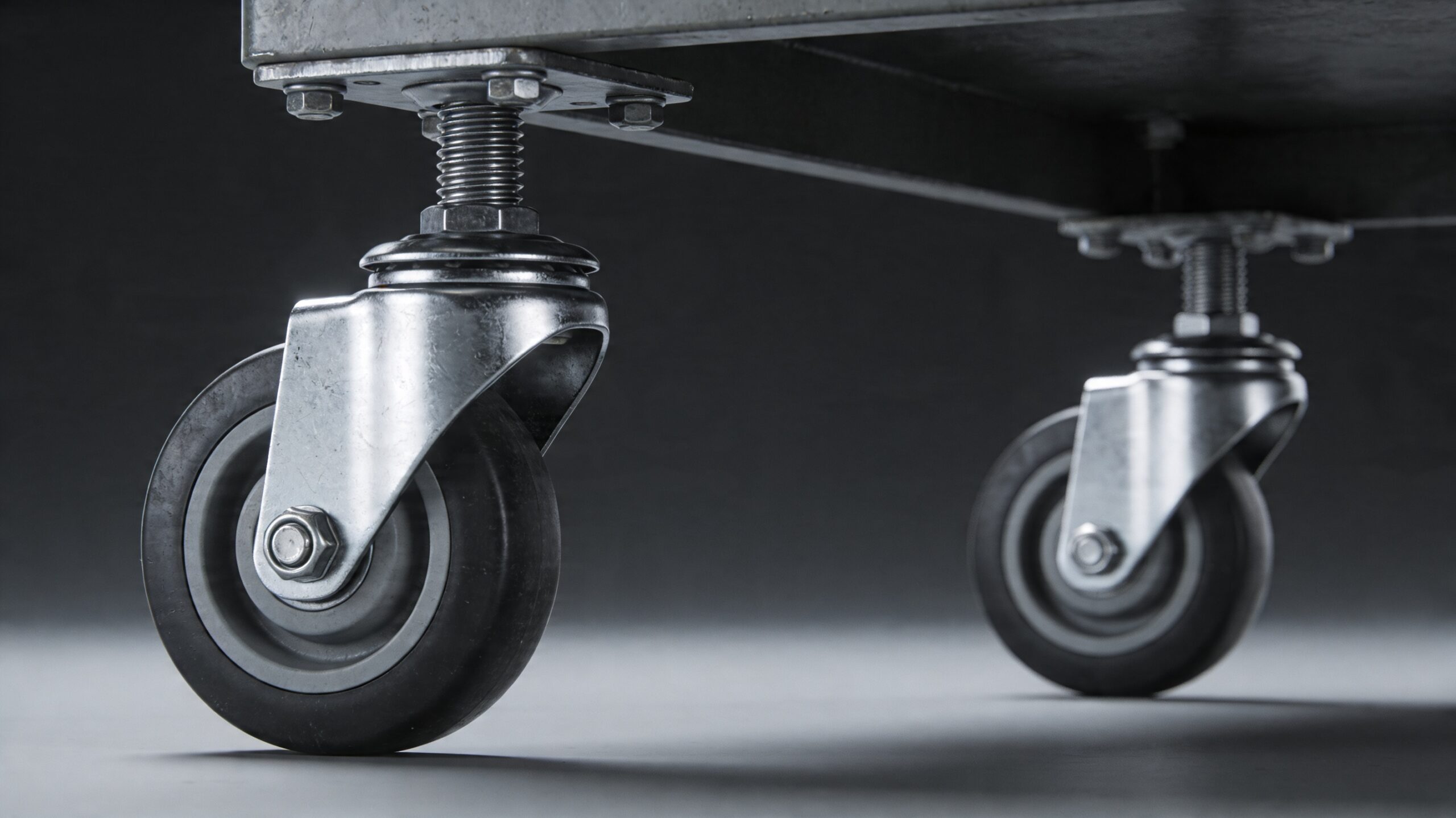
Core components:
- Wheel assembly — The standard caster wheel (swivel or rigid) that provides mobility
- Height adjustment mechanism — A threaded stem, ratchet system, or spring-loaded mechanism that changes the vertical position
- Locking mechanism — A nut, collar, or lever that locks the height in position once set
Why height adjustment matters:
Most facilities have floors that are not perfectly level. Factory floors develop low spots from heavy traffic. Warehouse concrete settles unevenly over decades. Restaurant kitchens have floor drains that create slopes. Without height adjustment, equipment on casters rocks, wobbles, and creates safety hazards. Adjustable casters eliminate these problems by compensating for surface irregularities at each individual wheel.
Self-Leveling vs Manual-Adjust Casters
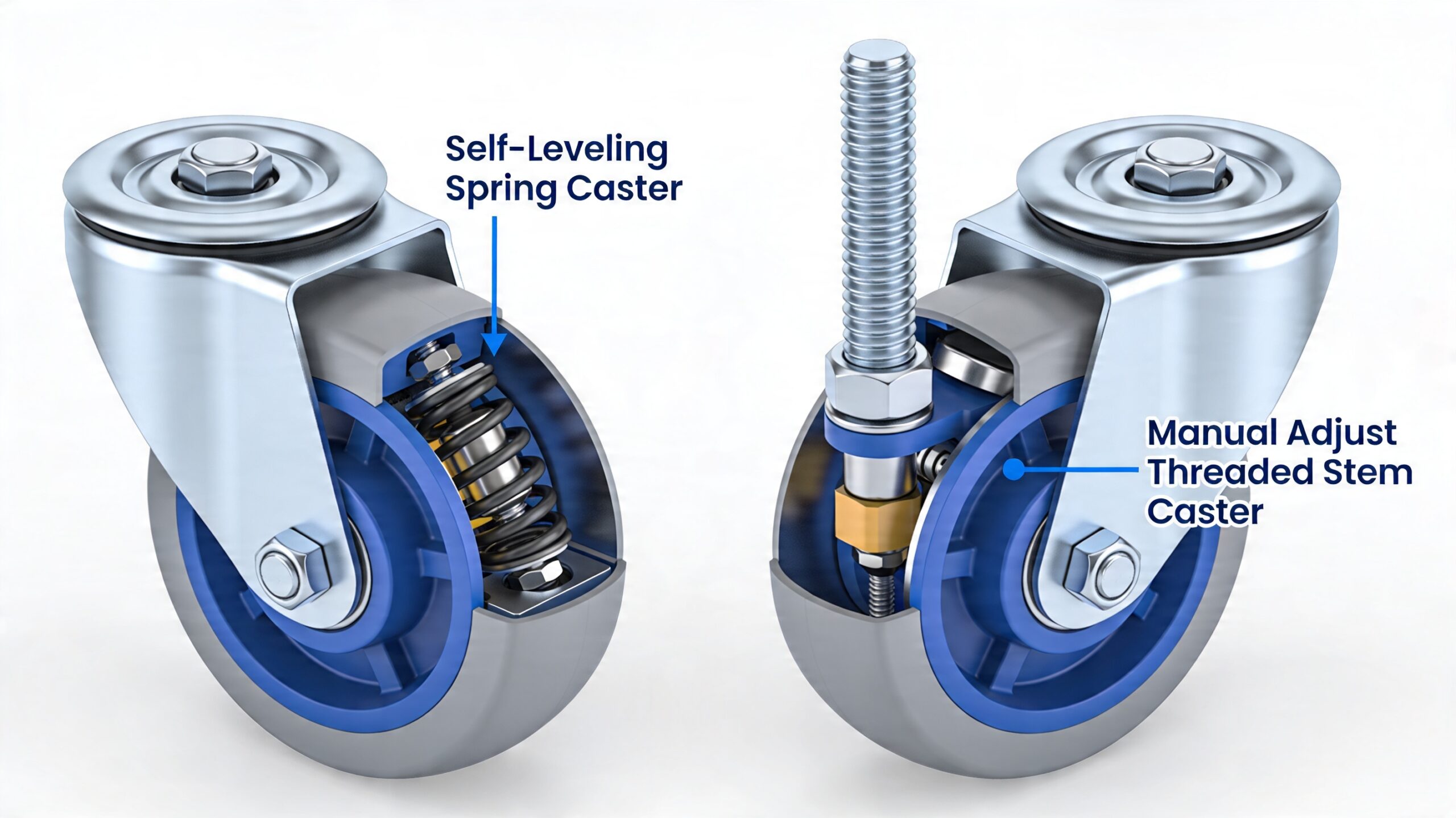
These two categories serve different purposes. Understanding the distinction prevents costly specification errors:
Manual-Adjust Casters (Threaded Stem Type)
The most common type. A threaded bolt extends from the caster frame, and rotating this bolt raises or lowers the caster relative to the equipment. A jam nut locks the bolt at the desired height.
How it works:
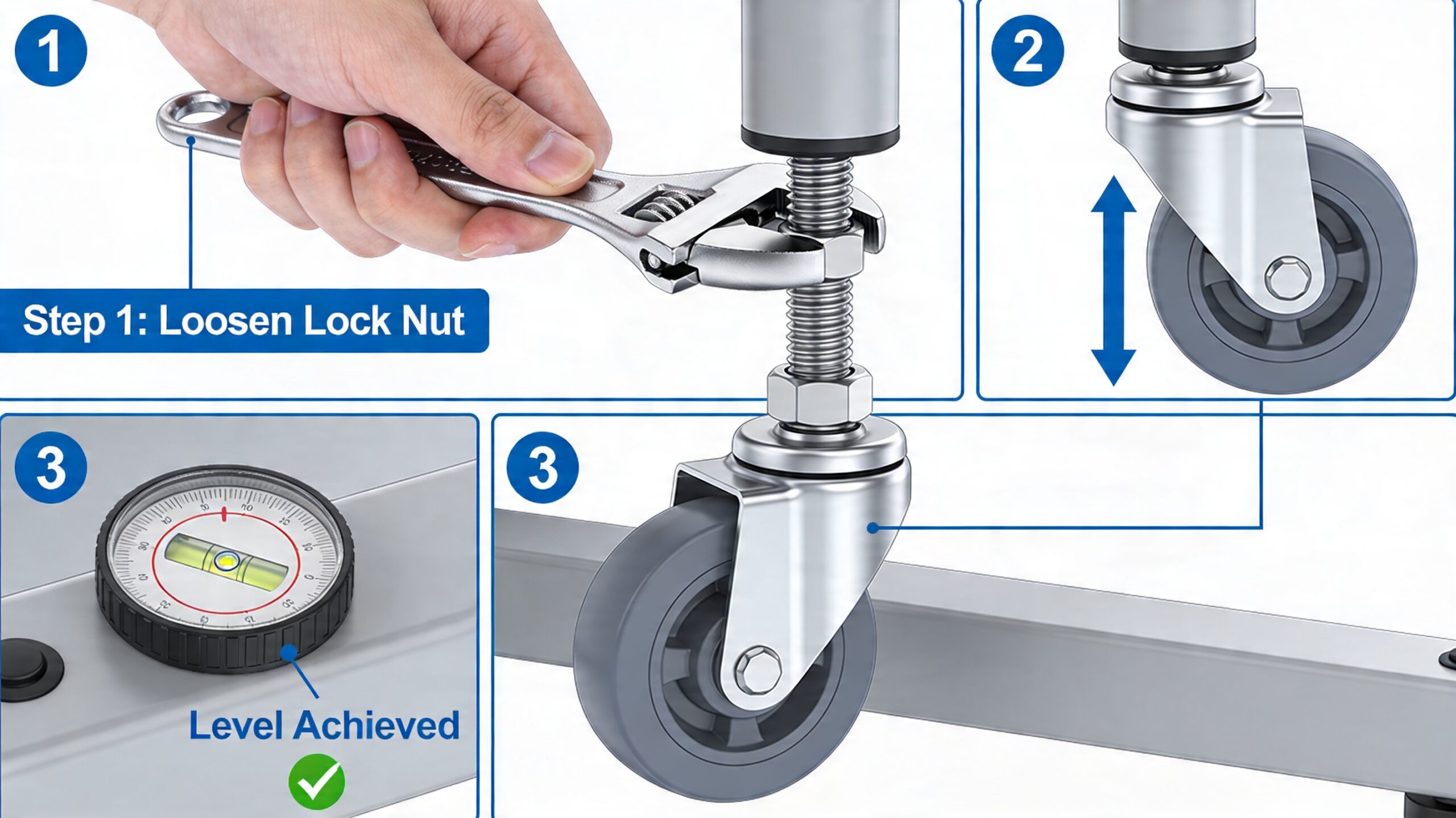
1. Lift the equipment corner slightly (jack, pry bar, or helper)
2. Turn the threaded stem clockwise to extend (raise) or counterclockwise to retract (lower)
3. Tighten the jam nut against the equipment frame to lock the height
4. Repeat for each caster until the equipment is level
Advantages:
- Simple, durable, low cost
- Infinite height positions within the adjustment range
- No moving parts beyond the threads — minimal maintenance
- Available in heavy-duty ratings (2,000+ kg per caster)
Limitations:
- Requires manual adjustment at each caster — time-consuming for frequent changes
- Equipment must be partially lifted to make adjustments
- Height does not auto-compensate for floor changes when the equipment is rolled to a new location
Best for: Permanent or semi-permanent installations where the equipment is leveled once and stays in place — production machinery, workbenches, display cases, server racks. ### Self-Leveling Casters (Spring-Loaded Type)
Self-leveling casters use an internal spring mechanism that automatically compensates for minor floor irregularities as the equipment rolls over them. The spring absorbs dips and bumps, keeping the equipment platform relatively level without manual intervention.
How it works:
- An internal compression spring sits between the wheel fork and the mounting plate
- When the wheel rolls over a low spot, the spring extends to maintain contact with the floor
- When the wheel encounters a high spot, the spring compresses to absorb the bump
- The spring rate is calibrated to the caster’s load rating — heavier loads require stiffer springs
Advantages:
- Automatic — no manual adjustment needed when repositioning
- Ideal for equipment that moves frequently across varied floor surfaces
- Absorbs vibration and minor impacts, protecting sensitive equipment
- Keeps equipment level while in motion
Limitations:
- Higher cost than manual-adjust casters (typically 40–60% premium)
- Cannot compensate for large height differences (limited to ±10–15mm of spring travel)
- Spring mechanisms wear over time and may require replacement
- Lower maximum load ratings compared to solid threaded-stem types
Best for: Mobile equipment that frequently changes location — rolling workstations, mobile tool carts, AV equipment, portable medical devices, food service trolleys. ### Retractable Leveling Casters
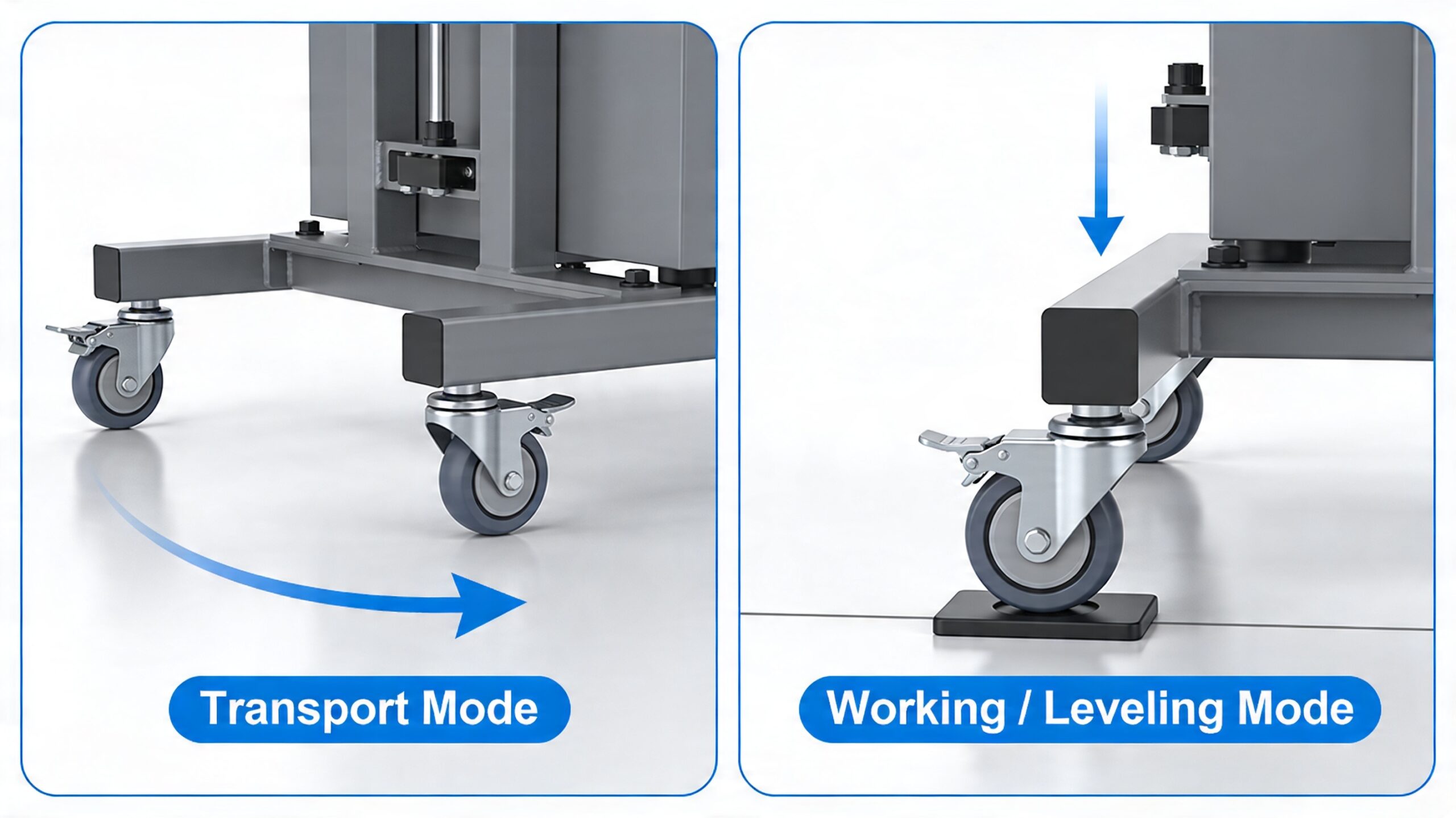
A hybrid design that combines a rolling caster with a retractable leveling foot. When the equipment needs to move, the caster wheel is in the down position. When the equipment is positioned, a lever or screw mechanism retracts the wheel and deploys a leveling foot, converting the caster into a rigid, adjustable-height support.
How it works:
- Transport mode: Caster wheel is lowered — equipment rolls freely
- Working mode: Operator activates the retraction mechanism — the wheel rises, and a threaded leveling foot descends to the floor
3. The leveling foot is adjusted to precisely level the equipment
4. Equipment is now stationary on solid supports, not on wheels
Advantages:
- Maximum stability when stationary — no rolling, no rocking
- Precise leveling through threaded foot adjustment
- Best vibration isolation (no wheel acts as a vibration path)
Limitations:
- Most expensive category (2–3× the cost of manual-adjust)
- Retraction mechanism adds complexity and maintenance requirements
- Transition between transport and working modes takes time
Best for: CNC machines, precision measuring equipment, heavy printing presses, laboratory instruments — any application where absolute stability during operation is critical but the equipment still needs to be moved occasionally.
Applications by Industry
Manufacturing & Industrial
- CNC machines and lathes → Retractable leveling casters (stability during cutting operations)
- Assembly line workstations → Manual-adjust threaded stem (level once per position change)
- Tool carts and mobile workbenches → Self-leveling spring type (frequent repositioning)
- Heavy machinery (>2,000 kg) → Heavy-duty threaded stem with steel wheels
Healthcare & Medical
- Mobile medical carts → Self-leveling with total-lock brakes (moves between patient rooms on varied floors)
- Hospital bed frames → Manual-adjust with central locking (level for patient safety, lock for transport)
- Laboratory instrument tables → Retractable leveling (absolute stability for centrifuges, analyzers)
Food Service & Hospitality
- Kitchen prep tables → Manual-adjust threaded stem (level on sloped kitchen floors around drains)
- Food service trolleys → Self-leveling spring type (rolls across dining room, kitchen, and service areas)
- Buffet stations → Manual-adjust with brake (positioned and leveled for service, locked during use)
Retail & Commercial
- Display fixtures → Manual-adjust with decorative covers (level on retail floors, aesthetically clean)
- Point-of-sale counters → Self-leveling (repositioned frequently during merchandising changes)
- Stock room shelving → Heavy-duty threaded stem (loaded heavy, adjusted infrequently)
Furniture & Office
- Standing desk frames → Self-leveling PU wheels (home offices often have uneven floors)
- Conference tables → Manual-adjust with locking brake (level the table, then lock all casters)
- Modular office partition walls → Self-leveling for easy reconfiguration
Load Capacity & Sizing Guide
How to calculate the required load rating:
Per-caster load = (Equipment weight + Maximum working load) ÷ Number of casters × Safety factor
| Application | Number of Casters | Recommended Safety Factor | Example |
|---|---|---|---|
| Furniture (< 200 kg total) | 4 | 1.5× | 150 kg ÷ 4 × 1.5 = 57 kg per caster |
| Light commercial (200–500 kg) | 4 | 2× | 400 kg ÷ 4 × 2 = 200 kg per caster |
| Industrial (500–2,000 kg) | 4–6 | 2× | 1,500 kg ÷ 4 × 2 = 750 kg per caster |
| Heavy industrial (2,000+ kg) | 4–8 | 2.5× | 3,000 kg ÷ 6 × 2.5 = 1,250 kg per caster |
Height adjustment range guidelines:
| Floor Condition | Recommended Adjustment Range |
|---|---|
| Indoor, level concrete | 25mm (1″) total |
| Indoor, older building with settling | 50mm (2″) total |
| Indoor, industrial with slope/drains | 50–75mm (2″–3″) total |
| Outdoor or rough surface | 75mm+ (3″+) — consider leveling feet instead |
Installation & Adjustment Tips
Tip 1 — Level in a cross pattern
When adjusting four casters, level diagonally opposite pairs first (front-left + rear-right, then front-right + rear-left). This prevents the frame from racking (twisting) during adjustment.
Tip 2 — Use a spirit level on the working surface
Do not judge level by eye. Place a spirit level or digital inclinometer directly on the equipment’s working surface. What looks level to the eye can be 5–10mm off, which matters for precision work.
Tip 3 — Always lock the jam nut
After adjusting a threaded-stem caster, tighten the jam nut firmly against the equipment frame. Vibration will gradually rotate an unlocked stem, causing the equipment to slowly go out of level — a common complaint in manufacturing environments.
Tip 4 — Check level after loading
Equipment will settle under its working load. Level the equipment first, then add the full working load (materials, tools, product), and re-check level. Adjust as needed. This two-step process is especially important for heavy equipment.
Tip 5 — Re-level after relocation
Even if you are using self-leveling casters, check the level with a spirit level after moving equipment to a new floor area. Self-leveling compensates for minor surface variation, not for deliberate floor slopes around drains or doorways.
Frequently Asked Questions
Q: What is the difference between adjustable height casters and leveling feet?
Adjustable height casters provide both mobility (rolling) and height adjustment. Leveling feet provide height adjustment only — the equipment cannot be rolled once on leveling feet. Choose casters if the equipment needs to move; choose leveling feet if maximum stability is the only priority.
Q: Can I adjust the height while the equipment is loaded?
For threaded-stem casters, you typically need to slightly relieve the load on the caster you are adjusting (using a pry bar or jack) to rotate the stem. Self-leveling spring casters adjust automatically under load. Retractable casters require load relief during the transition between rolling and leveling modes.
Q: How much height adjustment do I need?
For most indoor applications on finished concrete or tile floors, 50mm (2 inches) of total adjustment range is sufficient. Industrial facilities with older, more uneven floors may need 75mm or more. Measure the worst-case height difference across your floor before specifying.
Q: Do adjustable casters cost more than standard casters?
Yes. Manual-adjust threaded-stem casters cost approximately 20–30% more than equivalent standard casters. Self-leveling types cost 50–80% more. Retractable leveling casters cost 100–200% more. However, eliminating the need for separate shims, blocks, and leveling accessories often makes the total cost comparable.
Q: What maintenance do adjustable height casters require?
Threaded-stem types: Lubricate threads annually, check jam nut tightness monthly. Self-leveling: Inspect spring function quarterly (push down and release — it should return smoothly). Retractable: Lubricate the retraction mechanism every 6 months and inspect for wear on the transition components.
Key Takeaways
- Adjustable height casters solve two problems at once: mobility and leveling on uneven floors.
- Manual-adjust (threaded stem) casters are best for semi-permanent installations — level once, lock in place.
- Self-leveling (spring) casters are best for frequently moved equipment — they auto-compensate for minor floor variations.
- Retractable leveling casters offer maximum stability by converting from rolling to rigid support mode.
- Always apply a safety factor of 1.5–2.5× when calculating per-caster load ratings.
Adjustable Casters for Every Application
Inford manufactures adjustable height casters from 50 kg to 2,000 kg per caster — manual-adjust, self-leveling, and retractable types. ISO 9001 certified with OEM customization for stem length, wheel material, and load rating.
→ Adjustable Height Caster Wheels | → Retractable Leveling Casters | → Get a Quote