
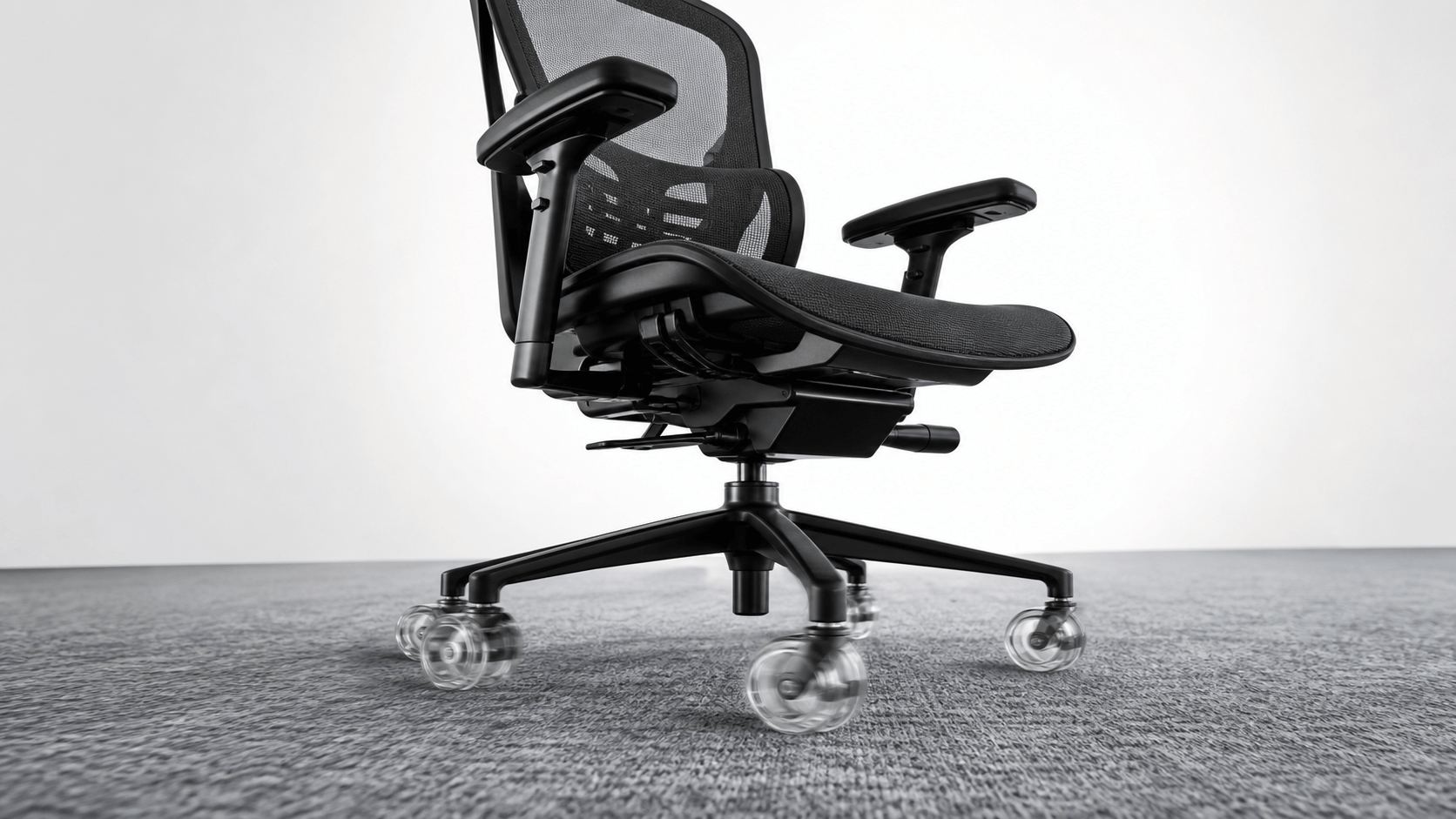
Standard caster wheels struggle on carpet. The soft, fibrous surface creates friction that makes chairs hard to roll, damages carpet fibers, and leaves visible track marks over time. If you have ever fought to push an office chair across thick carpet, you know the frustration.
The solution is not just “bigger wheels” — though wheel diameter matters. The best carpet casters use specific materials, tread designs, and wheel configurations optimized for carpet performance. The right caster rolls smoothly across carpet, does not damage fibers, and works equally well on carpet tiles, low-pile office carpet, and plush residential carpet.
This guide covers which caster features matter for carpet, the best materials and sizes for different carpet types, and our recommended picks for office chairs, furniture, and equipment on carpeted floors.
Why Standard Casters Fail on Carpet
Understanding why regular casters perform poorly on carpet helps you choose the right replacement:
Excessive sinking — Soft rubber and PU wheels with narrow treads sink into carpet fibers, creating a depression that the wheel must climb out of every time it rolls. This dramatically increases rolling resistance — making the chair or cart much harder to push.
Fiber entanglement — Carpet fibers wrap around exposed axles and get caught between twin-wheel designs, gradually building up and creating drag. Long carpet fibers (plush and shag) are most problematic.
Flat spot formation — Heavy static loads on soft wheels compress carpet fibers permanently underneath the caster, leaving visible dents. Office chairs that sit in one position for hours create four distinct dent marks in carpet.
Too-small diameter — Wheels under 50mm diameter on carpet act like wheels stuck in sand — they cannot roll over the “soft bump” of compressed carpet fibers in front of them. Every start from stationary requires excessive force.
Key Features for Carpet Casters
When shopping for carpet-specific casters, prioritize these features:
Wheel Diameter — Bigger Is Better
On carpet, larger diameter wheels roll more easily because they ride over the carpet surface rather than sinking into it. The difference is dramatic:
| Wheel Diameter | Carpet Rolling Effort | Best For |
|---|---|---|
| 40mm (1.5″) | Very High — struggles on all carpet | Not recommended for carpet |
| 50mm (2″) | High — acceptable on tight-loop commercial only | Thin office carpet tiles |
| 65mm (2.5″) | Moderate — good for most office carpet | Standard office carpet |
| 75mm (3″) | Low — excellent for all carpet types | Plush residential, home office |
| 100mm (4″) | Very Low — rolls effortlessly | Very thick carpet, equipment casters |
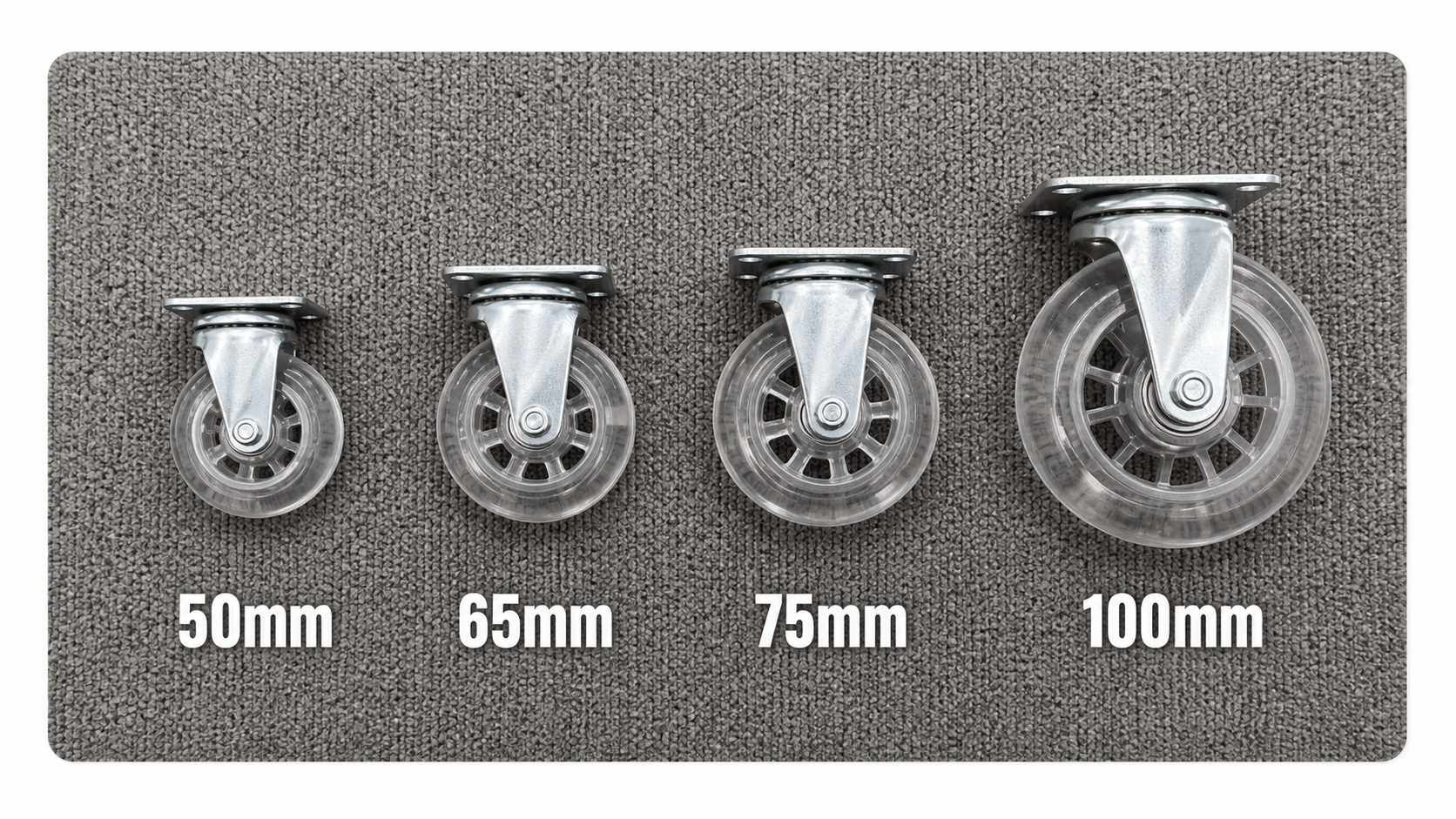
Recommendation: 65mm minimum for office chairs on standard commercial carpet. 75mm for home offices with residential-grade carpet. 100mm for furniture and equipment on plush carpet.
Wheel Material — Hard Over Soft
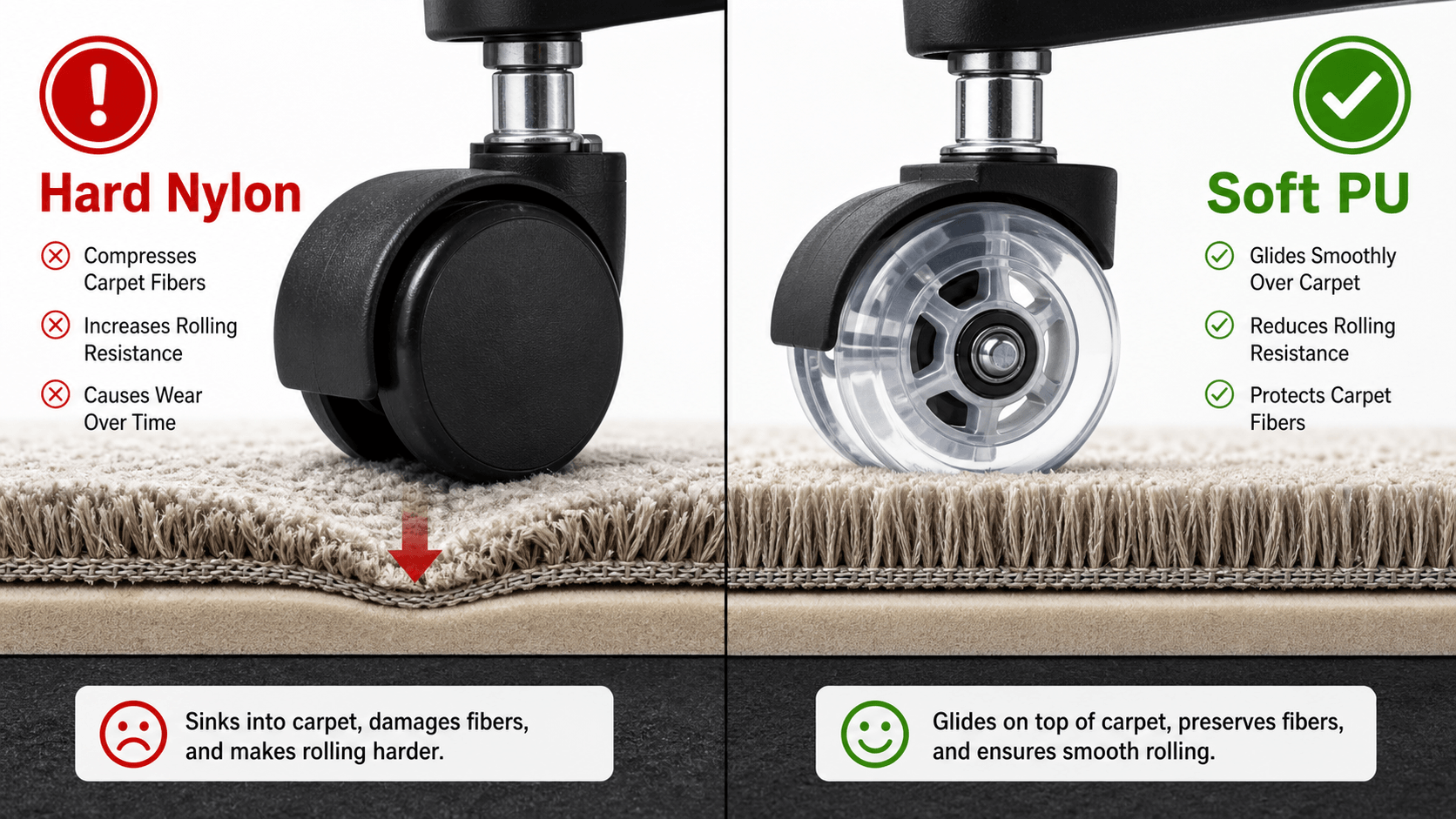
This is counterintuitive — you might think soft wheels would be gentle on carpet, but the opposite is true for performance:
- Hard nylon or polypropylene wheels roll over carpet fibers rather than sinking into them. They provide the easiest rolling on every carpet type.
- Soft PU or rubber wheels sink into carpet fibers, increasing friction and making rolling harder. These are designed for hard floors.
| Material | Carpet Performance | Hard Floor Performance |
|---|---|---|
| Hard nylon | ★★★★★ (best for carpet) | ★★ (may scratch) |
| Polypropylene | ★★★★ | ★★ (may scratch) |
| Hard PU (Shore A 90+) | ★★★★ | ★★★★ |
| Standard PU (Shore A 80–85) | ★★ | ★★★★★ (best for hard floors) |
| Rubber | ★ (worst for carpet) | ★★★★ |
The dual-floor dilemma: If you roll between carpet and hard floors (common in open-plan offices), hard nylon wheels for carpet will scratch hardwood or tile. Solutions:
- Rollerblade-style PU wheels — A hybrid with moderate hardness that performs acceptably on both surfaces
- Hard nylon with TPE (thermoplastic elastomer) tread — The nylon core handles carpet, the TPE outer layer protects hard floors
- Chair mat on carpet — Use a hard floor chair mat on the carpet section and keep soft-PU casters
Tread Width — Narrow Outperforms Wide
Narrow wheels cut through carpet fibers more easily than wide wheels:
- Narrow (20–25mm): Lower carpet contact area = less friction = easier rolling
- Wide (35–50mm): Higher carpet contact area = more friction = harder to push
For carpet-only use, choose the narrowest wheel width available for your load rating. This is the opposite of hard-floor recommendations, where wider wheels protect floor surfaces better.
Single vs. Twin Wheel Design
- Single wheel: Better for carpet — simpler design with less opportunity for fiber entanglement. Easier to clean.
- Twin (dual) wheel: Worse for carpet — fibers get caught in the gap between the two wheels. The split also creates two narrower wheels that can track unevenly. However, twin wheels distribute weight better on hard floors.
Recommendation for carpet: Single-wheel casters. If your existing chair uses twin-wheel casters (most office chairs do), aftermarket single-wheel rollerblade-style replacements are widely available.
Best Casters by Carpet Type
Commercial Loop-Pile Carpet (Office)
The most common office flooring — tightly woven loop fibers with a thin profile (6–10mm pile height).
- Best caster: 65mm nylon wheel, single-wheel design, grip ring stem
- Why: Loop-pile has moderate rolling resistance. 65mm wheels roll well without being too tall for standard desk height.
- Alternative: Rollerblade-style 75mm PU wheels if you also have hard-floor areas
Cut-Pile Commercial Carpet
Slightly softer than loop-pile, with cut fiber tips that create a plush feel (8–12mm pile height).
- Best caster: 75mm nylon or hard PU wheel
- Why: The taller, softer fibers require a larger wheel to maintain rolling efficiency. 65mm wheels begin to struggle on cut-pile.
Residential Carpet (Medium Pile)
Standard residential carpet with moderate cushion (10–15mm pile height). Found in home offices, bedrooms, and living rooms.
- Best caster: 75mm hard nylon wheel, 22mm tread width
- Why: Residential carpet is thicker than commercial, requiring larger wheels. Narrow tread cuts through fibers.
- Alternative: Use a heavy-duty chair mat to create a smooth rolling surface on very thick residential carpet
Plush & High-Pile Carpet
Thick, luxurious carpet with deep cushion (15–25mm pile height). Common in executive offices, master bedrooms, and living rooms.
- Best caster: 100mm nylon wheel or rollerblade-style 75mm wheels
- Why: At this pile height, even 75mm wheels can struggle. 100mm wheels ride above the carpet surface.
- Best alternative: A glass or polycarbonate chair mat. On very deep plush carpet, no caster performs as well as rolling on a smooth surface.
Carpet Tile (Modular)
Common in modern offices — 500mm × 500mm or 610mm × 610mm (24”×24”) tiles with thin loop-pile and minimal cushion (5–8mm pile height).
- Best caster: Standard 50–65mm PU or nylon wheels
- Why: Carpet tile is the thinnest commercial carpet type. Standard casters perform acceptably. The main concern is tile edges — choose wheels large enough to roll over tile seams without catching.
Top Recommendations by Use Case
Office Chairs on Carpet
Upgrade to rollerblade-style casters — these aftermarket casters replace standard twin-wheel office chair casters with larger (65–75mm), single-wheel designs using harder PU compound. They are the most popular carpet caster upgrade for a reason: dramatically easier rolling, no fiber entanglement, and most work on hard floors too.
- Stem type: 11mm × 22mm grip ring (fits most standard office chairs — verify stem diameter before ordering)
- Wheel diameter: 75mm recommended
- Sold in sets of 5 (for 5-star chair bases)
- Price range: $15–35 per set
Dining & Kitchen Chairs on Carpet
For chairs that roll between carpet and hard surface (tile kitchen to carpeted dining area), choose dual-floor casters with moderate hardness PU wheels.
- Stem type: Match existing stem — typically grip ring or threaded
- Wheel diameter: 50mm minimum, 65mm preferred
- Consider locking casters if the carpet area needs the chair to stay put during meals
Furniture on Carpet (Sofas, Tables)
Heavy furniture on carpet needs larger wheels to prevent permanent carpet indentation.
- Wheel diameter: 75–100mm for items over 50 kg
- Material: Nylon for best rolling; rubber if noise is a concern
- Consider caster cups (hard plastic discs under each caster) for extremely heavy furniture to distribute weight over a larger carpet area
Frequently Asked Questions
Q: What are the best caster wheels for thick carpet?
For thick (high-pile) carpet, use 75–100mm diameter wheels made from hard nylon or high-durometer PU (Shore A 95+). Narrow tread widths (20–25mm) reduce rolling resistance. Single-wheel designs prevent fiber entanglement. On very thick plush carpet (20mm+ pile), a chair mat may perform better than any caster.
Q: Do rollerblade casters work on carpet?
Yes — rollerblade-style casters are one of the best carpet solutions for office chairs. Their larger diameter (typically 75mm) and single-wheel design roll significantly better on carpet than standard 50mm twin-wheel casters. They also work on hard floors, making them ideal for mixed flooring offices.
Q: Will hard casters damage my carpet?
Hard nylon casters do not damage carpet fibers directly — they roll over the surface rather than grinding through it. The main risk is static load concentration. Heavy equipment left stationary for weeks on hard small wheels can create permanent carpet dents. Use caster cups under heavy static loads.
Q: How do I stop office chair casters from sinking into carpet?
Three options: (1) Replace with larger-diameter wheels (75mm+), (2) switch from soft PU to hard nylon wheels, or (3) place a polycarbonate chair mat under the chair. Option 1 is the best balance of cost and convenience for most situations.
Q: Can I use the same casters on carpet and hardwood?
Not optimally. Carpet-best casters (hard nylon) scratch hardwood. Hardwood-best casters (soft PU) sink into carpet. Compromise options: rollerblade-style PU wheels with moderate hardness (Shore A 92) or hard nylon with TPE outer tread. Neither performs perfectly on both surfaces but both are acceptable.
Key Takeaways
- Wheel diameter is the most important factor for carpet casters — 65mm minimum for commercial carpet, 75mm+ for residential.
- Hard nylon wheels outperform soft rubber and PU on carpet by riding over fibers instead of sinking into them.
- Single-wheel casters prevent fiber entanglement, which is the primary cause of carpet caster drag and maintenance.
- Rollerblade-style casters are the most popular and effective upgrade for office chairs on carpet.
- For extremely thick plush carpet (20mm+), a chair mat may outperform even the best carpet-optimized casters.
Carpet-Optimized Casters from Inford
Inford manufactures caster wheels specifically designed for carpet performance — hard nylon, rollerblade-style PU, and dual-floor hybrid options. Available in 50mm to 100mm diameters with all standard mounting types.
→ Caster Wheels for Carpet | → Hardwood Floor Casters | → Get Floor-Specific Recommendations