
A single caster wheel shedding sub-micron particles can quietly cause a semiconductor fab to lose an entire production batch, and an ungrounded cart wheel can discharge enough static to destroy a sensitive component in microseconds. Cleanroom and ESD-controlled environments impose two distinct but often overlapping requirements on caster wheels — particulate control and electrical resistance — and getting either wrong carries real financial consequences. This guide covers exactly what engineers and procurement teams need to specify.
Two Different Problems: Particulate Control vs Electrostatic Discharge
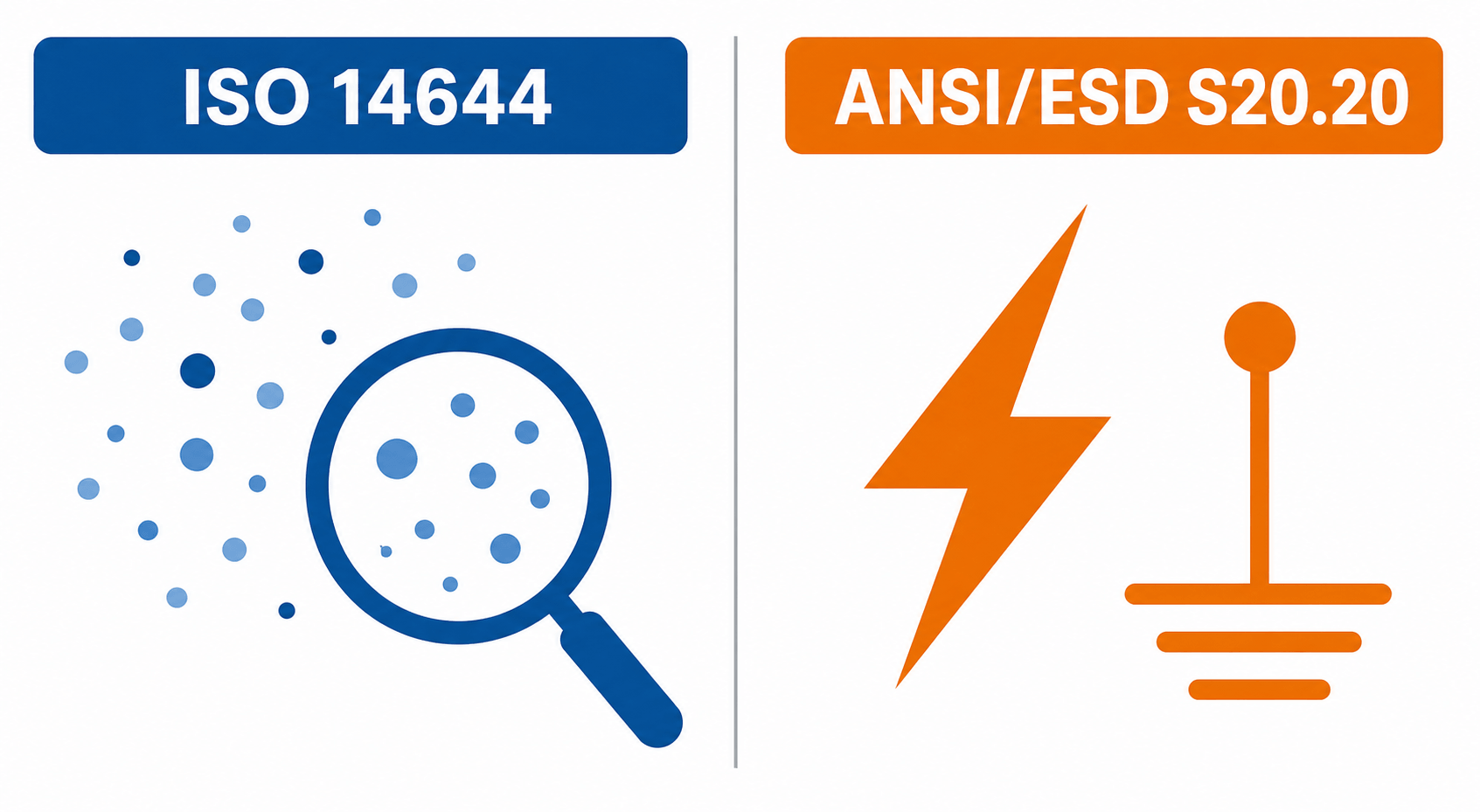
Cleanroom and ESD requirements are frequently bundled together in casual conversation, but they solve different problems and are governed by different standards. Particulate control is about preventing wheel material from shedding dust, fibers, or outgassing chemicals into the controlled airspace, governed primarily by ISO 14644. Electrostatic discharge control is about providing a safe electrical path from equipment to ground to prevent static buildup from damaging sensitive electronics, governed by ANSI/ESD S20.20. A wheel can be excellent at one and poor at the other — this is why specifying “cleanroom wheels” without separately confirming ESD requirements is a common and costly mistake.
Particulate Control: ISO 14644 and Material Selection
ISO 14644-14 specifically provides a methodology to assess whether equipment — including transport carts and their casters — is suitable for use in cleanrooms based on airborne particle concentration, covering particle sizes from 0.1 micrometers up to 5 micrometers and larger. Equipment that passes this assessment is qualified for a specific cleanroom class; equipment that hasn’t been assessed, or that uses standard industrial wheel materials, should be assumed unsuitable for anything above ISO Class 7-8.
Material Comparison for Particulate Generation
| Material | Particulate Shedding | Rolling Resistance | Cleanroom Class Suitability | Key Tradeoff |
|---|---|---|---|---|
| High-purity TPU (thermoplastic polyurethane) | Very low | Low-medium | ISO Class 3-5 | Industry standard for cleanroom, but must be cleanroom-grade, not standard PU |
| Nylon (polyamide) | Virtually none | Extra low | ISO Class 1-3 | Hard material can crush particles on the floor and damage flooring; best for fixed long-term positions |
| Cleanroom-grade TPR | Medium | Superior cushioning | ISO Class 5-7 | Must be verified as cleanroom-grade to avoid plasticizer outgassing that causes molecular contamination |
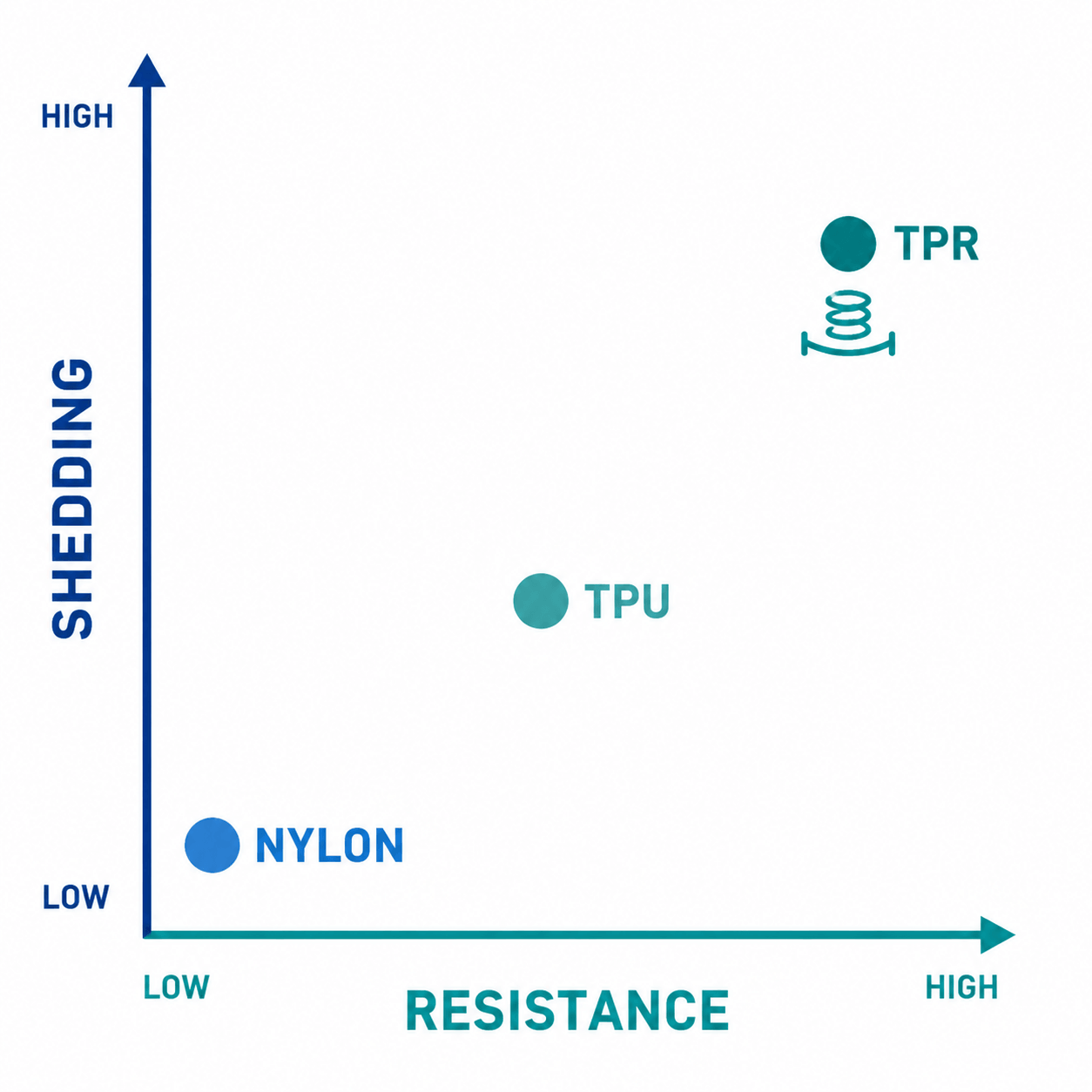
Nylon’s extreme hardness makes it the lowest-shedding option and suitable for the tightest cleanroom classes, but that same hardness means it can crush small particles already on the floor rather than rolling over them cleanly, and it can also cause floor damage under heavy repeated use — for that reason nylon is best reserved for equipment that stays in a fixed position most of the time rather than moving frequently. High-purity TPU is the most common overall cleanroom choice because it balances low shedding with acceptable rolling resistance, but the critical detail is that it must be specifically formulated cleanroom-grade TPU — standard commercial-grade polyurethane is not automatically clean enough despite looking identical. If you’re weighing PU against other tread families in a non-cleanroom context first, our polyurethane vs rubber caster wheels guide covers the baseline material tradeoffs this builds on.
The Outgassing Problem With TPR
Standard TPR (thermoplastic rubber) can outgas plasticizers over time, releasing volatile organic compounds that cause molecular contamination even if the wheel doesn’t visibly shed particles. This is invisible contamination — it won’t show up in a basic visual inspection — which is why cleanroom-grade TPR certification specifically needs to be requested and verified, not assumed from a generic “TPR” product listing.
Electrostatic Discharge: ANSI/ESD S20.20 Requirements
ANSI/ESD S20.20 sets the framework for protecting electrical and electronic components from electrostatic discharge damage, and it defines specific resistance thresholds that caster wheels and the equipment they support must meet.
Resistance Thresholds You Need to Know
The standard specifies a maximum resistance of 1×10^9 ohms for mobile equipment work surfaces to achieve a safe path to ground, while true conductive-rated wheels typically test below 1×10^6 ohms, exceeding the standard’s requirement with margin. Some federal specifications (FF-C-77 and FF-C-88) set an even tighter bar, requiring resistance below 250,000 ohms when tested at 500 volts.
| Classification | Resistance Range | Standard Reference |
|---|---|---|
| Conductive | Under 1×10^6 ohms | Exceeds ANSI/ESD S20.20 requirement |
| Antistatic | 1×10^6 to 1×10^9 ohms | Meets minimum ANSI/ESD S20.20 threshold |
| Federal spec conductive | Under 250,000 ohms at 500V | FF-C-77 / FF-C-88 |
| Standard (non-ESD) | Not controlled | Not suitable for ESD-protected areas |
The Full Conductive Path Matters More Than the Wheel Alone
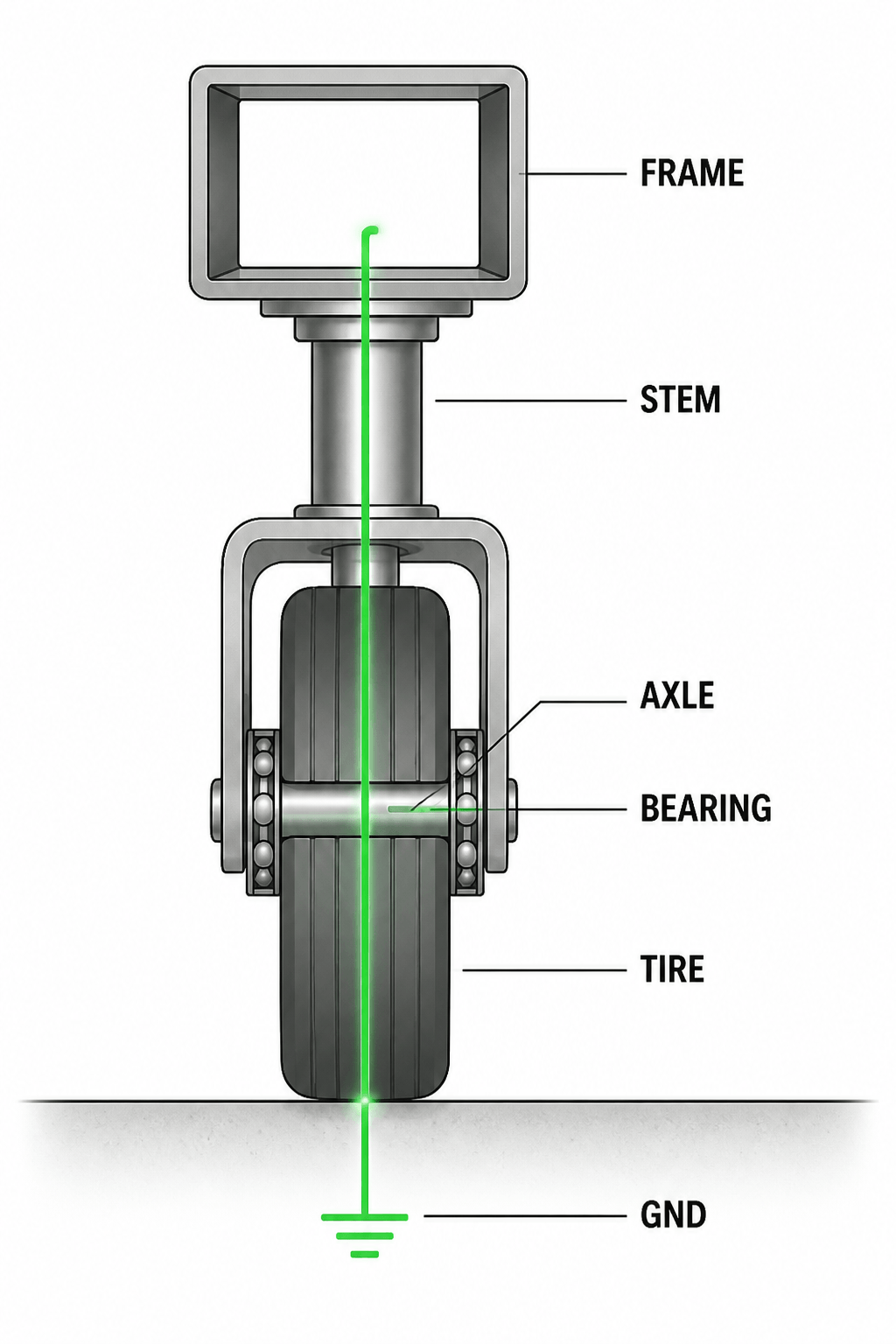
A conductive-rated tire is worthless if the rest of the caster assembly breaks the path — the resistance measurement has to hold across the entire chain from equipment frame through stem, axle, bearing, and tire to the floor. Industry guidance is explicit on this point: for reliable ESD protection, carts should be equipped with conductive wheels on all four positions, not just one or two, and the floor itself must also be conductive with a short distance between conductive contact points. Some engineers rely on grounding chains (drag chains) as an alternative or backup to conductive wheels, but a properly specified conductive caster on a conductive floor provides a more reliable ground connection than a drag chain, which can lift off the floor or lose contact during movement.
How Conductive Wheels Actually Achieve Their Rating
Conductivity in cleanroom-appropriate wheels is typically achieved by blending carbon black or engineered conductive polymers into the base polyurethane or nylon compound, creating a material that dissipates static charge into a conductive floor while still meeting the base material’s particulate-control performance. This is why a genuine ESD-rated cleanroom wheel commands a price premium over a standard wheel that merely looks similar — the conductive filler is an engineered addition, not a surface coating that can wear off.
Combining Cleanroom and ESD Requirements
Many pharmaceutical, semiconductor, and electronics assembly environments require both particulate control and ESD compliance simultaneously, which narrows the usable material list to conductive-grade cleanroom TPU or conductive nylon specifically formulated to pass both tests. When both requirements apply, request test documentation for each independently — a supplier’s cleanroom certification does not imply ESD compliance, and vice versa, since they are tested under entirely different protocols (ISO 14644 particulate assessment versus ANSI/ESD S20.20 resistance measurement).
Stainless Steel Hardware for Sterile and Pharmaceutical Cleanrooms
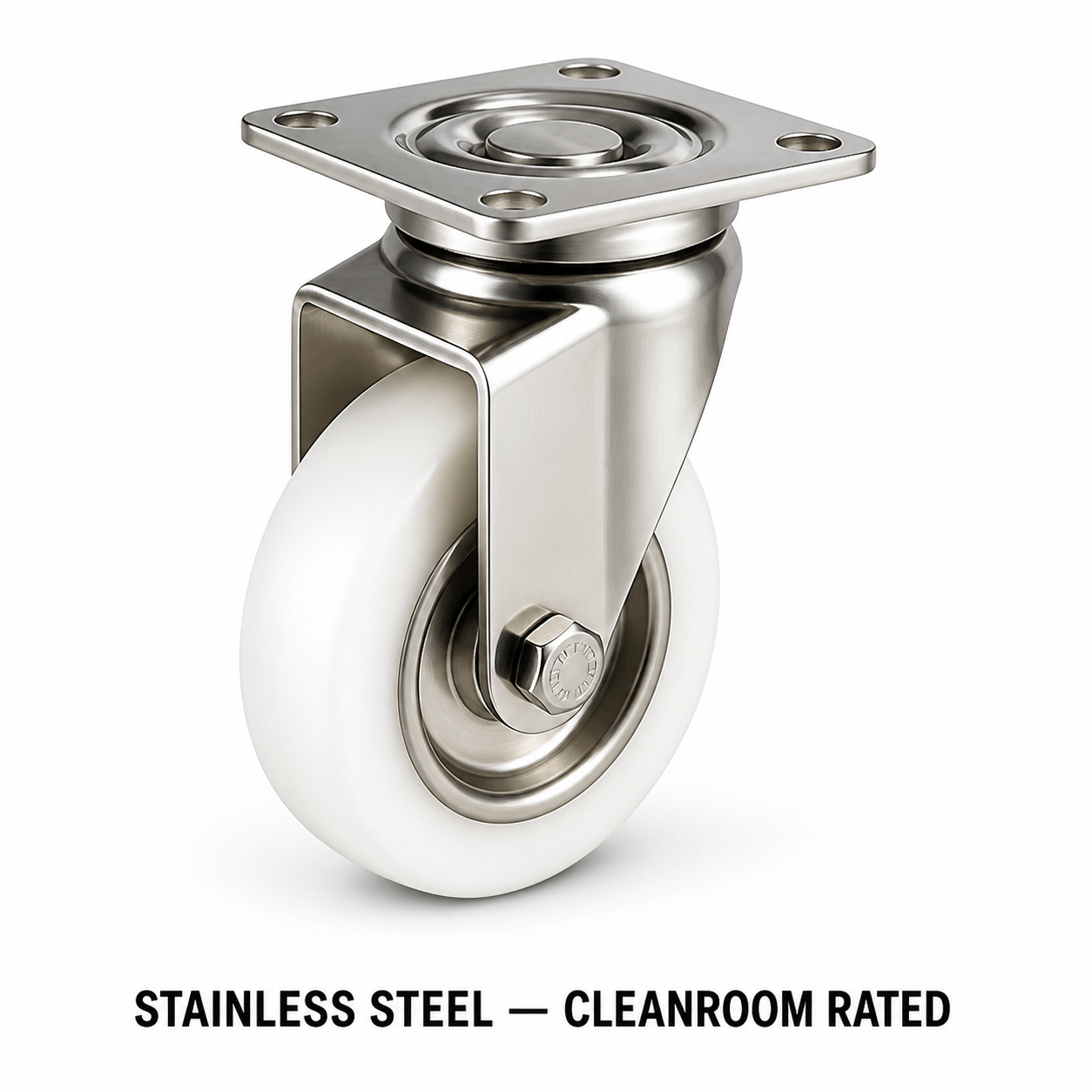
Pharmaceutical and biotech cleanrooms typically require stainless steel caster hardware rather than plated steel, because the equipment must withstand repeated cleaning, disinfection, and in some cases autoclave sterilization cycles. Beyond material choice, prioritize fully enclosed bearings to prevent particle escape from the bearing itself, smooth rolling action to avoid vibration-sensitive flooring damage, locking mechanisms for precise equipment positioning during procedures, and high-temperature tolerance for any units that go through autoclave cycles. This overlaps with considerations covered in our high-temperature caster wheels guide for equipment facing repeated thermal cycling.
Common Specification Mistakes
- Assuming “cleanroom” and “ESD-safe” are the same requirement and only testing for one.
- Using standard commercial PU or TPR because it looks identical to cleanroom-grade material, without requesting certification.
- Fitting conductive wheels to only one or two of four caster positions, breaking the reliability of the ground path.
- Overlooking the stem, axle, and bearing as potential break points in the conductive chain, focusing verification only on the tire.
- Choosing nylon for frequently-moved cleanroom carts without accounting for its floor-damage and particle-crushing tendency under heavy repeated use.
- Skipping outgassing verification on TPR components, allowing invisible VOC contamination that a visual inspection won’t catch.
Cleanroom & ESD Caster Specification Checklist
- Identified whether the application requires particulate control (ISO 14644), ESD compliance (ANSI/ESD S20.20), or both
- Requested cleanroom-grade material certification, not just a generic material name (TPU, TPR, nylon)
- Confirmed resistance rating in ohms against the specific classification needed (conductive under 10^6, antistatic under 10^9, or federal spec under 250,000Ω)
- Verified the full conductive path — frame, stem, axle, bearing, tire — not just the tire material
- Specified conductive wheels on all four caster positions, not a partial set
- Requested outgassing/VOC test documentation for any TPR components
- For pharma/biotech, confirmed stainless steel hardware and autoclave tolerance if applicable
- Verified ISO 14644-14 equipment suitability assessment matches your facility’s actual cleanroom class
Get a Custom Quote for Cleanroom or ESD Casters
If your equipment operates in a cleanroom, semiconductor fab, or ESD-protected area, share your required ISO class and resistance specification with our team for a matched wheel recommendation — contact us to start your quote.