
Medical environments are among the most demanding workplaces for caster wheels. A caster failure on a hospital bed can endanger a patient. A noisy wheel on an IV stand can disrupt recovery. A non-sterile bearing housing can contribute to healthcare-associated infections (HAIs) — the CDC estimates that approximately 1 in 31 hospital patients acquires at least one HAI on any given day, contributing to hundreds of thousands of infections and tens of thousands of deaths annually in U.S. hospitals.
Standard industrial casters are not designed for these challenges. Medical caster wheels must meet a different set of requirements — from regulatory compliance and infection control to noise reduction and precision movement.
This guide covers everything facility managers, hospital procurement teams, and medical device manufacturers need to know about selecting the right medical casters. We will explain the key standards, walk through every major type, compare materials, and provide a practical selection framework you can apply to your next purchase.
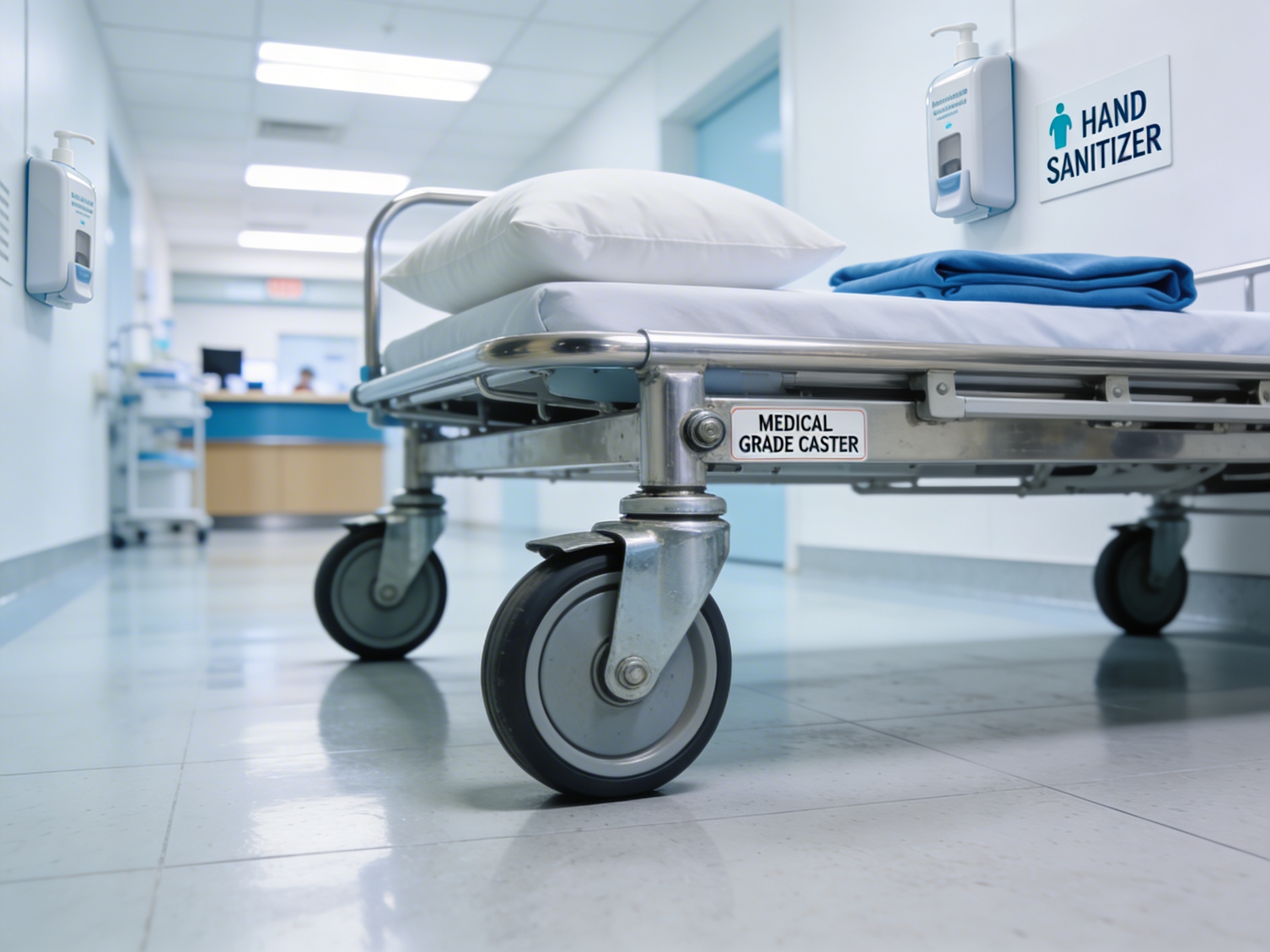
What Makes Medical Casters Different from Standard Casters
Standard casters prioritize load capacity and cost. Medical casters prioritize an entirely different set of performance criteria:
Infection Control
Healthcare-associated infections (HAIs) cost the U.S. healthcare system an estimated $28–$45 billion in direct costs annually (NIH/CDC estimates). Every surface in a healthcare facility — including caster wheels and housings — is a potential contamination vector. Medical casters use sealed bearing assemblies that prevent fluid and biological material from entering the mechanism. Materials like 316L stainless steel, ABS engineering plastic, and medical-grade polyurethane resist chemical disinfectants used in daily cleaning protocols without degrading.
Noise Performance
The World Health Organization recommends hospital ward noise levels stay below 30 dB LAeq at night (with a maximum of 40 dB LAmax for individual sound events). Standard hard-plastic casters rolling on tile floors can generate 60–70 dB — almost twice the recommended limit. Medical casters use thermoplastic rubber (TPR) and polyurethane treads engineered to absorb vibration and reduce rolling noise to under 40 dB.
Precision Movement
A nurse pushing a 300 kg hospital bed through a doorway needs responsive directional control with minimal force. Medical casters use precision ball bearings and engineered swivel mechanisms that reduce start-up resistance while maintaining smooth, predictable turning radius.
Regulatory Traceability
Hospitals require full documentation for every component. Medical casters must be traceable to raw material sources, with production records that satisfy ISO quality management systems and regional regulations such as CE marking and REACH/RoHS compliance.
Types of Medical Caster Wheels by Application
Medical casters are not one-size-fits-all. Each healthcare application has specific requirements:
Hospital Bed Casters
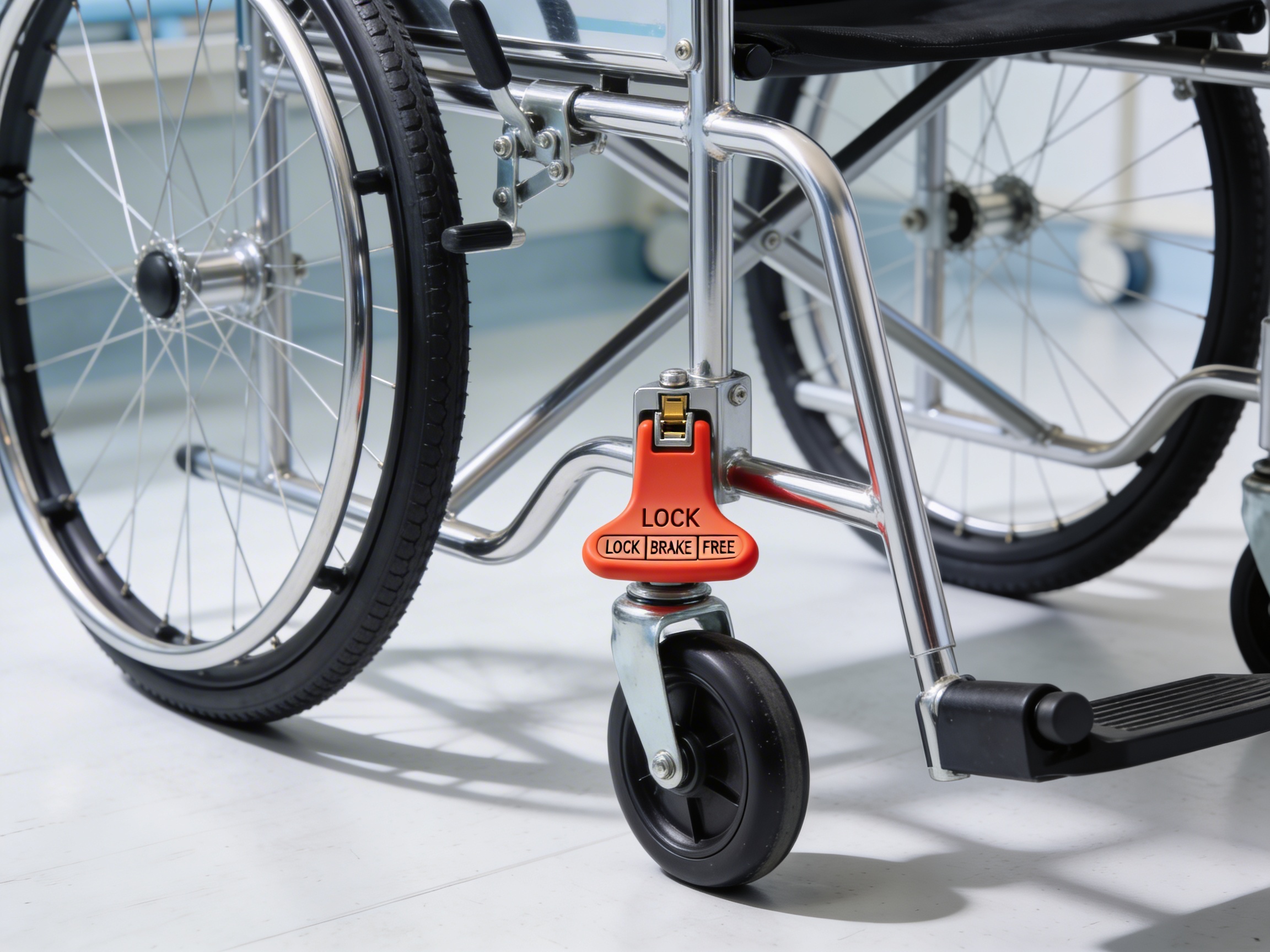
Hospital beds are the single largest category of medical caster deployment. Key requirements include:
- Central locking systems — One foot pedal locks all four casters simultaneously. This is critical for patient safety during transfers and procedures.
- Dual-lock braking — Independently locks both wheel rotation and swivel rotation to prevent any movement.
- TPR or PU treads — Reduce rolling noise below 40 dB on tile and vinyl floors.
- Load capacity: Typically 100–150 kg per caster (400–600 kg total for a four-caster bed set, covering bed frame, mattress, and patient weight).
- Wheel diameter: 100mm, 125mm, or 150mm depending on bed model.
Bariatric hospital beds require specialized casters rated to 200 kg or more per caster to accommodate higher patient weights safely.
Medical Equipment Casters
Diagnostic machines, ultrasound units, patient monitors, and laboratory carts all use equipment-class medical casters. These applications demand:
- Stainless steel brackets — 304 or 316L stainless steel resists corrosion from chemical disinfectants like quaternary ammonium compounds and hydrogen peroxide solutions.
- Sealed precision bearings — Prevent dust and fluid ingress, extending service life in environments where daily wet cleaning is standard.
- Non-marking wheels — Essential in imaging suites and laboratories where floor cleanliness signals are part of facility accreditation standards.
- Anti-static (ESD) options — Dissipate electrostatic charges to protect sensitive diagnostic electronics.
- Load capacity: 80–200 kg per caster.
MRI Room Casters
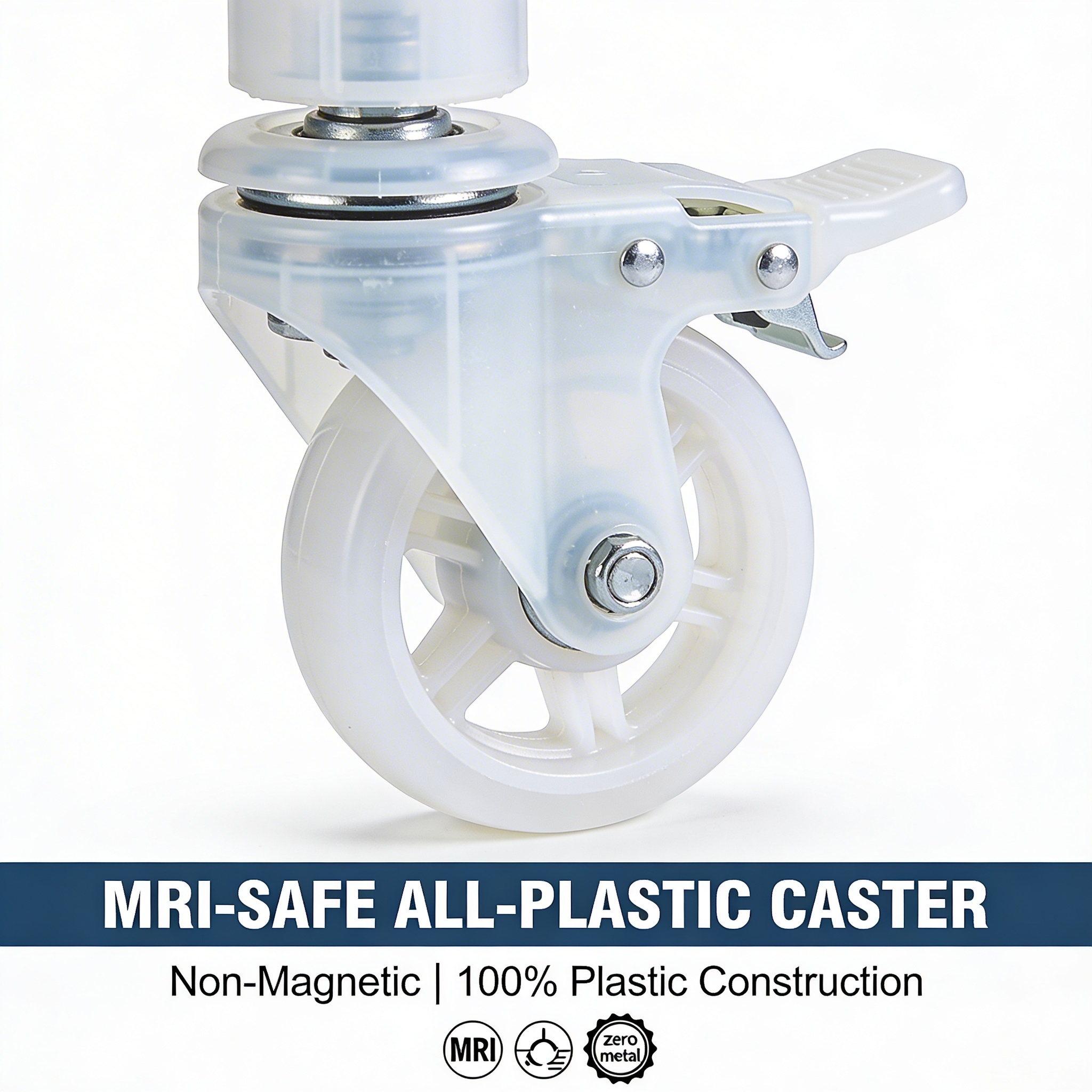
Magnetic Resonance Imaging (MRI) rooms present a unique safety challenge. MRI machines generate powerful magnetic fields — typically 1.5 Tesla or 3.0 Tesla — that can turn any ferrous metal object into a dangerous projectile.
Standard casters contain steel axles, ball bearings, and zinc-plated brackets. None of these are safe inside an MRI suite. MRI-compatible casters replace every metal component:
- All-plastic housings — Engineering-grade polymer brackets replace steel.
- Non-metallic axles — Composite or polymer axle pins.
- Polymer bearings — Replace standard steel ball bearings.
- Chemical-resistant construction — Withstand daily cleaning with hospital-grade disinfectants.
These casters are mandatory for any wheeled furniture, IV stands, or equipment carts used inside MRI scanning rooms.
Surgical Cart & Emergency Equipment Casters
Operating rooms and emergency departments require casters that respond instantly:
- Ultra-low start-up resistance — Enables one-handed cart maneuvering in tight surgical environments.
- Total-lock braking — Stops all wheel rotation and swivel movement immediately.
- Flush-mounted design — Eliminates trip hazards around surgical tables.
- Directional locks — Restrict movement to straight-line travel, useful for transporting crash carts down hospital corridors.
Medical Caster Materials Compared
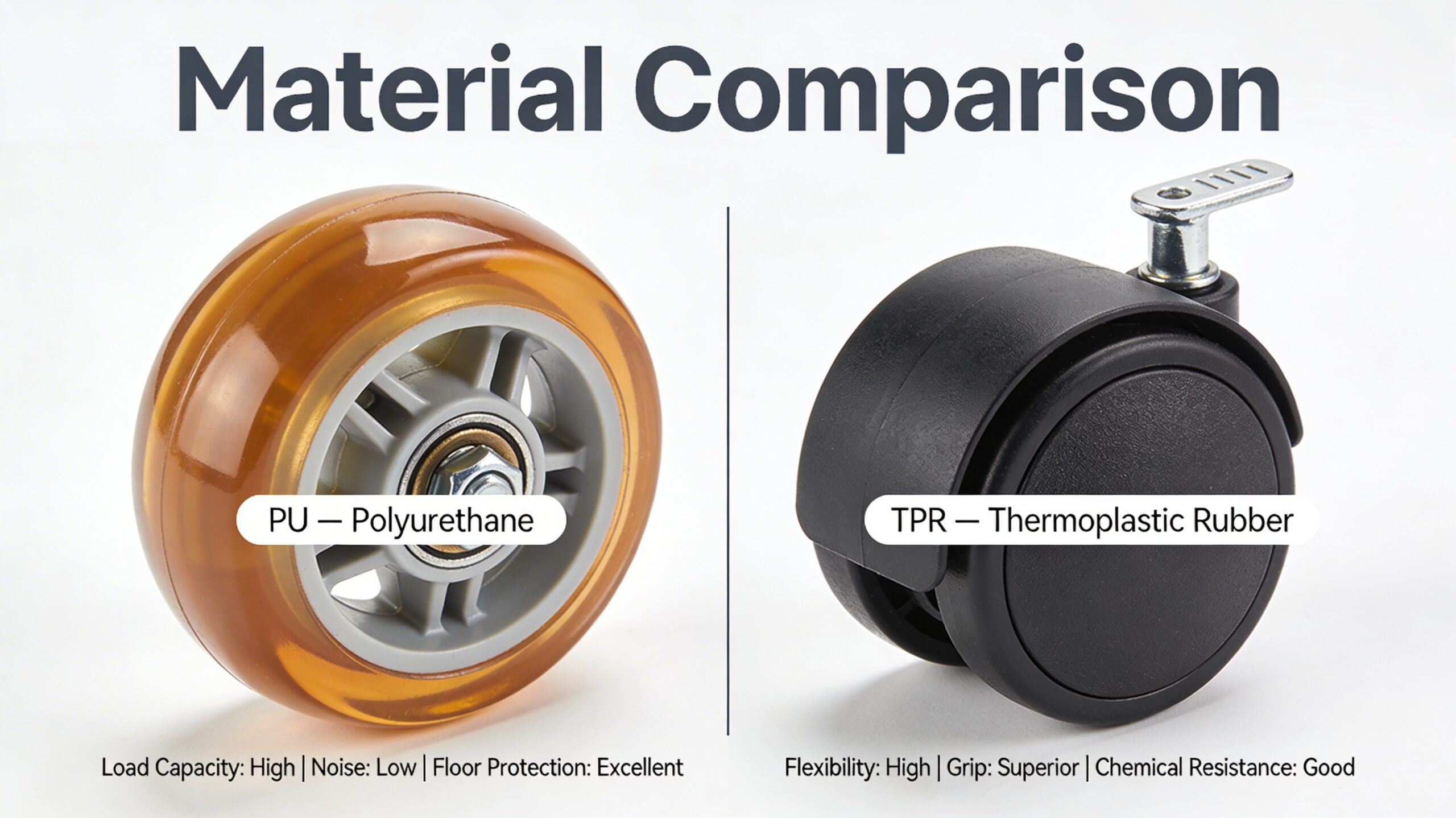
Material selection directly determines performance, lifespan, and suitability for specific healthcare environments. Here is how the most common materials compare:
| Property | Polyurethane (PU) | TPR (Thermoplastic Rubber) | Nylon | ABS Plastic | Stainless Steel (Bracket) |
|---|---|---|---|---|---|
| Noise Level | Low (< 45 dB) | Very Low (< 40 dB) | Medium (50+ dB) | Low | N/A (bracket material) |
| Floor Protection | Excellent | Excellent | Poor (scratches) | Good | N/A |
| Chemical Resistance | Very Good | Good | Excellent | Good | Excellent (316L) |
| Load Capacity | High | Medium | Very High | Medium | N/A |
| Non-Marking | Yes | Yes | No | Yes | N/A |
| MRI Safe | Yes (with non-metal bracket) | Yes (with non-metal bracket) | Yes (with non-metal bracket) | Yes | No (ferrous) |
| Best Use Case | Equipment carts, surgical | Hospital beds, IV stands | High-load equipment | Lightweight carts, MRI | Corrosive environments |
Key takeaway: Polyurethane (PU) offers the best overall balance of performance properties for most medical applications. TPR is preferred where absolute minimum noise is the top priority, such as patient wards and overnight care facilities.
How to Choose Medical Casters — A 5-Step Framework
Use this practical framework to select the right medical casters for your specific application:
Step 1 — Calculate Load Requirements
Determine the total weight (equipment + contents + patient, if applicable) and divide by 3 — not 4. Using a factor of 3 accounts for uneven weight distribution that is common when equipment is loaded or a patient shifts position. The result is your minimum per-caster load rating.
Example: A hospital bed weighing 120 kg with a 100 kg mattress and a 120 kg patient = 340 kg total. Divide by 3 = 114 kg minimum per caster. Select casters rated at 125 kg or higher.
Step 2 — Identify the Floor Type
- Hard floors (tile, vinyl, epoxy) → Choose softer treads (TPR or PU) for noise reduction and floor protection.
- Painted or coated floors → Require non-marking wheels to prevent scuff damage.
- Carpeted areas → Need harder wheels (nylon) for reduced rolling resistance.
Step 3 — Assess the Environment
- Sterile / clean rooms → Stainless steel brackets + sealed PU wheels.
- MRI suites → All-plastic, non-magnetic casters only.
- Chemical exposure → 316L stainless steel brackets + PU treads rated for the specific chemicals used.
- General ward → TPR wheels on zinc-plated or powder-coated brackets.
Step 4 — Determine Mobility Needs
- Frequently moved equipment → Precision swivel casters with low start-up resistance.
- Stationary with occasional repositioning → Standard swivel with reliable braking.
- Straight-line transport only → Rigid (fixed) casters on rear + swivel on front, or directional lock casters.
Step 5 — Verify Compliance
Confirm the manufacturer provides:
- ISO 9001 quality management certification
- Testing reports per EN 12531 (EU hospital caster standard) or ISO 22882 (international institutional/hospital caster standard)
- REACH and RoHS compliance documentation for material safety
- CE marking (for European market deployment)
Frequently Asked Questions About Medical Caster Wheels
Q: What type of casters are used in hospitals?
Hospitals primarily use twin-wheel swivel casters with TPR (thermoplastic rubber) or polyurethane treads. These materials provide quiet operation, floor protection, and easy cleaning. Hospital bed casters feature central locking mechanisms — a single foot pedal locks all four wheels simultaneously. MRI suites exclusively use all-plastic, non-magnetic casters.
Q: How do I know if my casters are MRI-safe?
MRI-safe casters must contain zero ferrous (iron-based) metals. Check with your manufacturer — standard casters use steel axles and ball bearings that are dangerous in MRI fields. MRI-compatible casters use polymer housings, composite axles, and plastic bearings. They should be explicitly certified for the Tesla rating of your MRI machine (1.5T or 3.0T).
Q: What load capacity do hospital bed casters need?
Standard hospital beds require casters rated at 100–150 kg each, supporting a combined bed capacity of 400–600 kg (including frame, mattress, and patient). Bariatric beds need casters rated at 200+ kg each. Always divide total weight by 3 (not 4) when calculating minimum per-caster ratings to account for uneven load distribution.
Q: Can medical casters be sterilized?
Medical casters are designed for chemical disinfection rather than autoclave sterilization. The wheels and brackets resist daily cleaning with hospital-grade disinfectants including quaternary ammonium, hydrogen peroxide, and bleach solutions. Sealed bearing assemblies prevent fluid entry. For applications requiring autoclave sterilization, specialized all-stainless casters are available.
Q: How often should hospital casters be replaced?
Hospital bed casters typically last 5–8 years under normal use, but should be inspected quarterly. Replace casters when you notice increased rolling noise, wobble, difficulty swiveling, visible tread wear, or compromised braking performance. High-traffic equipment like emergency department crash carts may require more frequent replacement.
Key Takeaways
- Medical caster wheels differ from standard casters in four critical areas: infection control, noise performance, precision movement, and regulatory traceability.
- Hospital bed casters need central locking, TPR treads for under-40 dB noise, and a minimum load rating calculated by dividing total weight by 3.
- MRI-safe casters must contain zero ferrous metal — all-plastic construction with polymer bearings is mandatory.
- Polyurethane (PU) wheels provide the best all-around performance for most medical applications; TPR is best where noise is the top concern.
- Always verify ISO 9001 certification, EN 12531 or ISO 22882 testing, and REACH/RoHS compliance before purchasing medical casters.
Need Medical Casters for Your Healthcare Facility?
Inford has been manufacturing precision casters for hospitals and medical equipment OEMs for over 30 years. We offer ISO 9001-certified production, OEM/ODM customization, and flexible MOQs for hospital procurement.
→ Get a Medical Caster Quote | → Explore Medical Caster Solutions | → Download Product Brochure