
Choosing the wrong caster manufacturer doesn’t just mean a delayed shipment — it can mean field failures, warranty claims, and product liability exposure once your equipment ships to end customers under your own brand. This guide gives procurement and engineering teams a technically grounded framework for auditing OEM caster suppliers, based on the international test standards the industry actually uses to rate load capacity and durability.
Why OEM Caster Sourcing Carries More Risk Than Catalog Buying
When you buy a batch of heavy duty industrial casters for internal warehouse use, a weak batch is a maintenance headache. When you’re an OEM embedding casters inside equipment that ships to hundreds of end customers, a caster failure becomes a warranty claim against your product, not the caster supplier’s. That shift means your evaluation criteria need to move beyond price and delivery time into the supplier’s actual testing rigor and documentation discipline.
The Standards Your Supplier Should Be Testing Against
The caster and wheel industry is governed by a specific family of ISO standards — ISO 22877 through 22884 — which define terminology, test methods, and load-testing requirements by duty class. Any manufacturer serious about OEM supply should reference these standards directly in their test reports, not just claim generic “heavy duty” ratings without a testing basis.
| Standard | Scope | Relevance to OEM Buyers |
|---|---|---|
| ISO 22877:2004 | Vocabulary and symbols | Ensures spec sheets use standardized terminology across suppliers |
| ISO 22878:2004 | General test methods and apparatus | Baseline reference for how load and durability tests are conducted |
| ISO 22879:2004 | Requirements for furniture casters | Applies if your equipment is furniture-adjacent (carts, workstations) |
| ISO 22881:2004 | Light-duty institutional equipment casters | Test speed 1.86 mph, obstacle height 3% of wheel diameter |
| ISO 22883:2004 | Medium/heavy-duty casters | Test speed 2.49 mph, 15,000 wheel rotations plus 500 obstacles |
| ISO 22884:2004 | Heavy-duty casters at higher speeds | Test speeds up to 3.73-9.94 mph depending on class |
Ask any prospective manufacturer which of these standards their dynamic load figures are certified against — a supplier quoting a load rating with no ISO or DIN EN 12527-12533 reference is likely using an internal, unverified figure.
What the Actual Test Protocol Looks Like
Under ISO 22881-22884, casters are run on a hard, horizontal test floor fitted with obstacles sized to 2.5%-5% of the wheel diameter (softer treads under 90 Shore A get the larger obstacle height, harder treads get the smaller one), at controlled ambient temperatures of 59-82°F. Medium and heavy-duty casters must complete 15,000 wheel rotations and clear 500 obstacles in cycles of three minutes running followed by a one-minute break, without deformation that impairs function. This is meaningfully more rigorous than a supplier simply rolling a sample back and forth by hand and calling it “tested” — if your manufacturer can’t describe obstacle height, cycle count, and floor spec for their test, they are not testing to the standard they claim.
The Load Capacity Formula You Should Verify Independently
Don’t take a supplier’s per-wheel load rating at face value — recalculate it yourself using the standard formula: required load per wheel equals the cart’s empty weight plus maximum applied load, divided by the number of wheels. Critically, for a 4-wheel cart, the industry-standard practice divides the total load by 3, not 4, because uneven floors and load distribution mean not all four wheels bear equal weight simultaneously. A supplier whose quoted per-wheel rating assumes perfectly even 4-way load distribution is overstating real-world capacity — this single detail has saved OEM buyers from under-speccing entire cart lines.
Core Supplier Evaluation Criteria
1. Documentation: Drawings, Test Reports, and Material Certs
A capable OEM manufacturer should provide full CAD drawings, ISO-referenced test reports, and raw material certifications before you commit to a first order — not a marketing PDF. Request the actual test report showing obstacle count, rotation cycles, and test speed used, not just a summary load figure.
2. In-House Testing Equipment
Ask specifically whether the factory operates a drum/rotation tester, static load tester, fatigue tester, and tensile (bond-strength) tester on-site, and request to see calibration records for that equipment during a factory audit.
| Test Type | Verifies | OEM Risk If Skipped |
|---|---|---|
| Static load test | Max weight while stationary, no permanent deformation | Structural failure under stationary equipment |
| Dynamic/drum test (ISO 22881-22884) | Wear and obstacle-clearing performance over rated cycles | Premature wheel cracking or seizing in the field |
| Fatigue test | Repeated stress cycling without bearing or axle failure | Critical for continuously moving equipment like AGVs and carts |
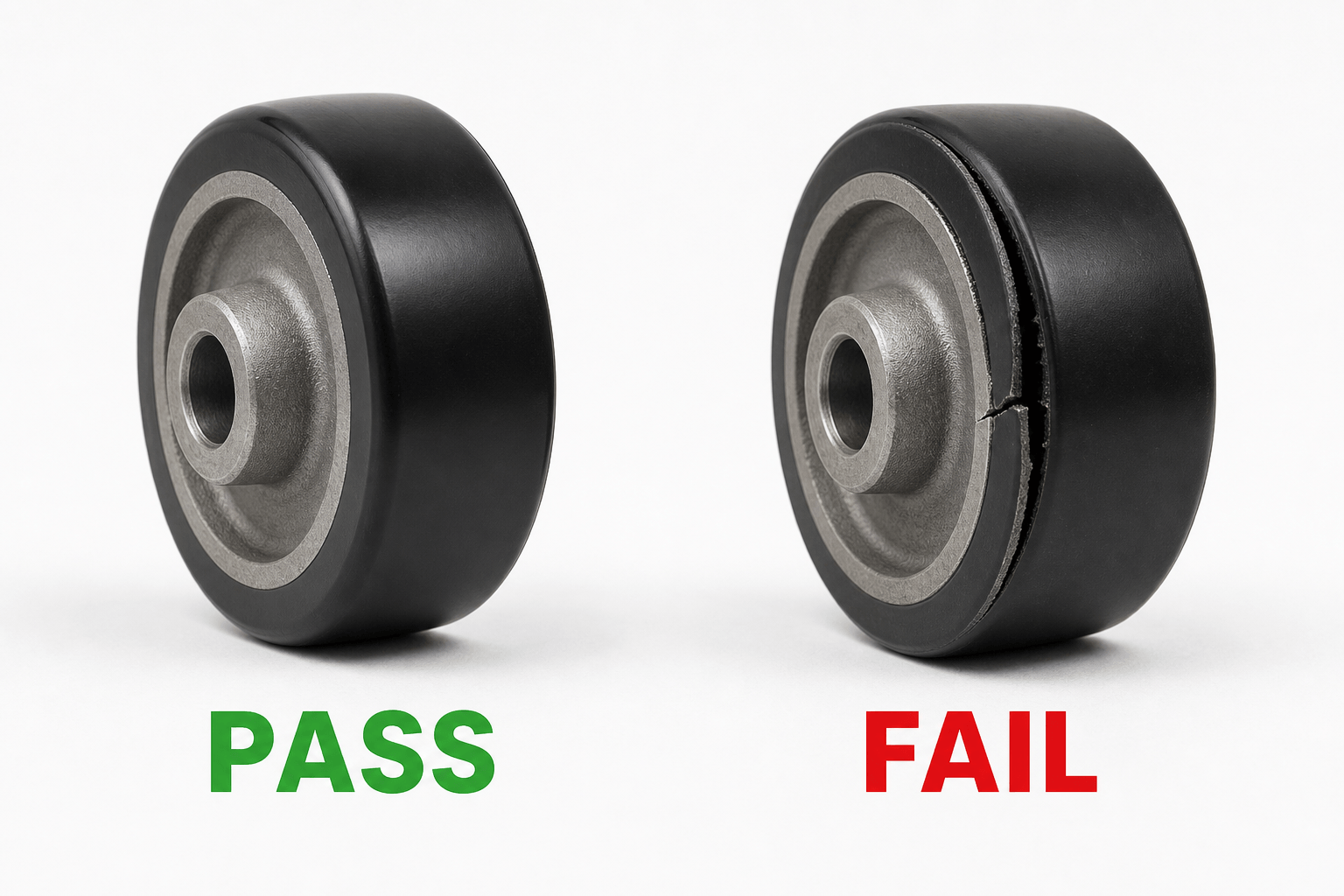
| Tensile/bond test | Adhesion strength between tread and metal core | Tread delamination and separation failures |
3. Verify Certifications Against Official Registries
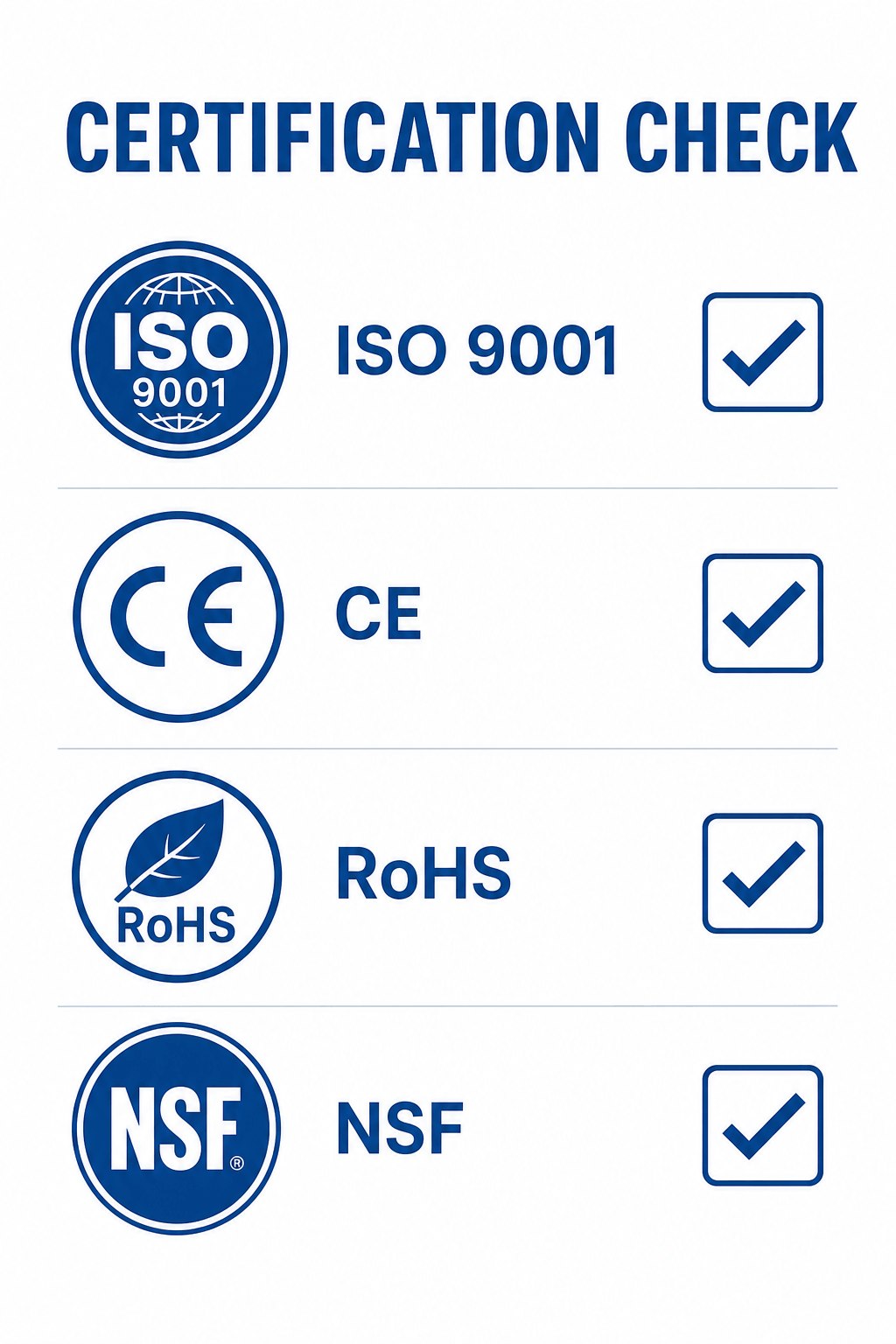
Request scanned ISO 9001, CE, RoHS, and (where relevant) NSF certificates with certificate numbers, then cross-check those numbers against the issuing body’s public database rather than trusting a PDF on its own. A certificate that can’t be verified independently should be treated as unverified, regardless of how official it looks.
4. Factory Verification and Legitimate Audit Access
Before placing a bulk order, verify the manufacturer’s legal registration against the relevant government business registry, search the company name alongside “complaint” or “dispute” in your sourcing due diligence, and request a live video walkthrough of the actual production floor and QC lab — not stock photography. Suppliers who resist showing their facility on camera, or who only communicate through a personal mobile number rather than a verifiable business line, are a recurring red flag in cross-border caster sourcing.
5. Product Range and One-Stop Capability
Manufacturers spanning heavy-duty, medical-grade, leveling, and stainless-steel product lines under one roof reduce vendor-management overhead for OEMs whose equipment spans multiple use cases. If your product line includes both a medical caster application and a standard industrial cart, consolidating both under one audited supplier avoids reconciling two separate QC standards.
6. Samples, MOQ, and Warranty Terms
Test physical samples against your own load calculation and environmental conditions before committing to volume, and treat an unusually high first-order minimum order quantity as a risk signal rather than a standard term. Push for a minimum one-year warranty in writing, and have every clause covering specification tolerances, packaging, lead time, and warranty claim procedure reviewed before signing.
OEM-Specific Design Considerations Beyond Standard Selection
If you’re specifying casters during your own product’s design phase — rather than sourcing from an existing catalog — three additional factors matter:
- Mounting geometry compliance — the caster’s stem or plate pattern must integrate with your product’s chassis without requiring field modification.
- Brand-consistent finish — hub color, plating, and visible hardware should match your product’s design language, since mismatched components undercut perceived build quality.
- Locked-in environmental specs — cold storage, chemical exposure, or continuous-duty cycling should be defined during design, not discovered after a field failure.
Supplier Audit Checklist
- Confirmed which ISO 22877-22884 (or DIN EN 12527-12533) standard the supplier’s load ratings are certified against
- Obtained the actual test report — obstacle count, rotation cycles, test speed — not just a summary figure
- Independently recalculated per-wheel load rating using the (empty weight + max load) / n formula, with the 4-wheel-cart divide-by-3 adjustment
- Verified in-house drum, static load, fatigue, and tensile testing equipment with calibration records
- Cross-checked ISO 9001/CE/RoHS/NSF certificate numbers against official issuing databases
- Completed a live video factory audit of production and QC areas
- Cross-checked business registration against the relevant government registry
- Ordered and load-tested physical samples before committing to bulk MOQ
- Secured minimum one-year warranty in writing and reviewed full contract terms
- Locked in mounting geometry, finish, and environmental specs during the design phase
Request a Technical Consultation
If you’re evaluating suppliers for an OEM caster program, we can provide ISO-referenced test reports, certification records, and independently verifiable load data upfront — contact us to start a supplier evaluation call.