
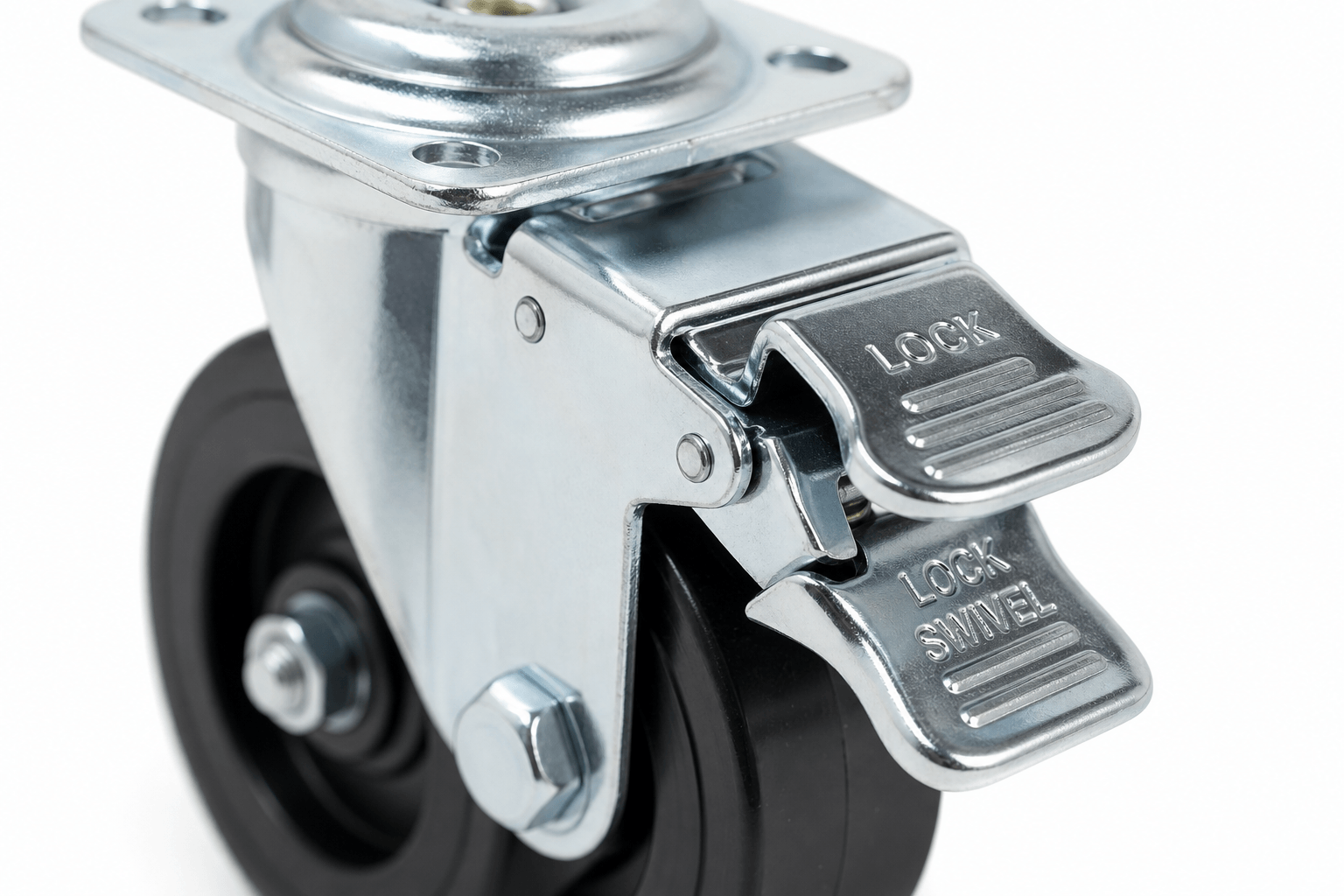
A caster wheel that rolls freely is useful — until you need it to stay put. A hospital bed that drifts during patient transfer, a workbench that slides during drilling, or a retail display that moves when customers lean on it creates safety hazards and operational problems.
Locking caster wheels solve this by adding a braking mechanism that holds the caster in a fixed position when engaged. But “locking” is not a single feature — there are multiple types of locking mechanisms, each designed for different applications and offering different levels of security.
This guide compares every major type of caster locking mechanism, explains how each works, identifies the best application for each type, and provides a selection framework to help you specify the right locking casters for your exact requirements.
Types of Locking Mechanisms
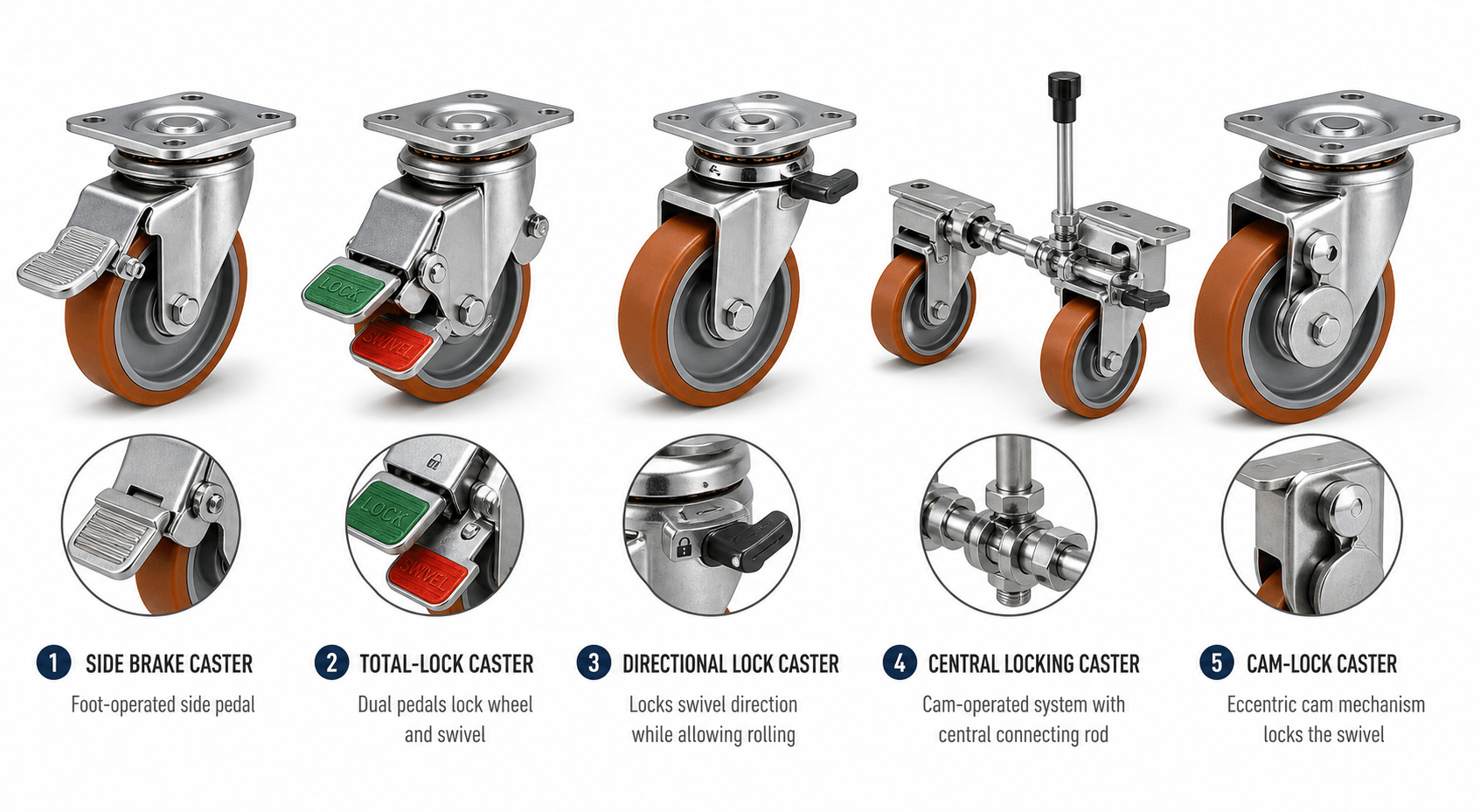
Side Brake (Wheel Lock Only)
The simplest and most common locking mechanism. A small lever on the side of the caster fork presses a friction pad against the wheel tread, preventing wheel rotation.
How it works:
1. Step on the brake lever (foot-operated) to engage
2. A friction pad presses against the wheel surface
3. The wheel cannot rotate — stopping forward/backward movement
4. Step on the release side of the lever to disengage
What it locks: Wheel rotation only. The swivel remains free — the caster can still pivot (rotate around its vertical axis) even with the brake engaged.
Pros:
- Lowest cost locking option
- Simple mechanism with few parts to fail
- Easy to operate — foot-activated in one motion
Cons:
- Swivel is NOT locked — equipment can still rotate or shift direction under side forces
- Brake pad wears over time, reducing braking effectiveness
- Holding force depends on friction — reduced on dusty or wet floors
Best for: Light-duty furniture, office chairs (supplementary braking), utility carts where swivel lock is not critical.
Total Lock (Wheel + Swivel Lock)
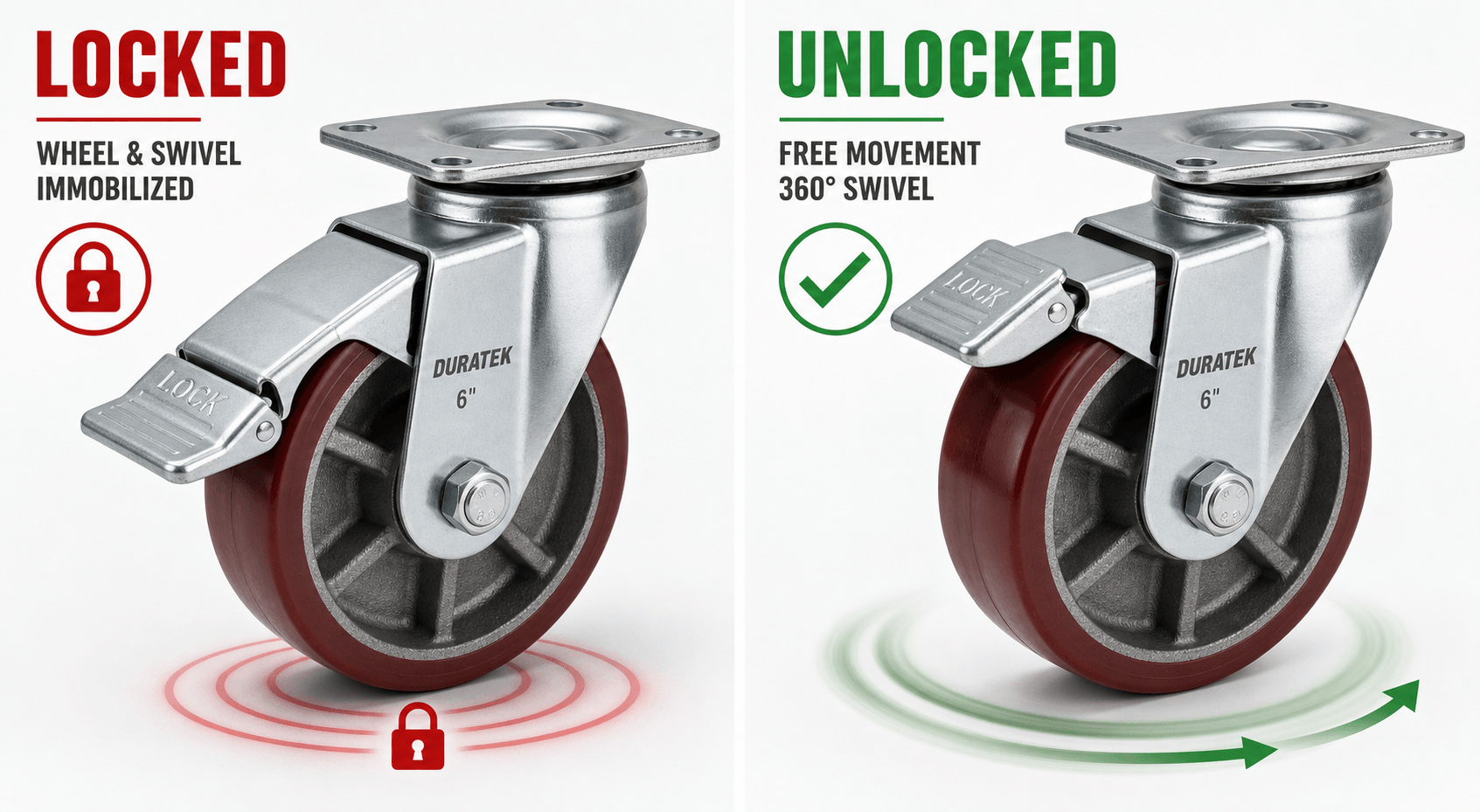
The industry standard for safety-critical applications. A single brake mechanism simultaneously locks both wheel rotation AND swivel rotation, completely immobilizing the caster.
How it works:
1. Press the total-lock lever (foot pedal, typically red/orange colored)
2. One mechanism engages the wheel brake (stops rolling)
3. Simultaneously, a pin or cam engages the swivel raceway (stops pivoting)
4. The caster is completely fixed — no rolling, no swiveling
5. Step on the release lever to disengage both locks
What it locks: Both wheel rotation and swivel rotation. The caster is fully immobilized.
Pros:
- Maximum stability — equipment cannot move in any direction
- Single-action operation — one pedal locks both functions
- Required by most safety standards for medical and scaffolding applications
Cons:
- Higher cost than side brake — total lock mechanisms include additional components for dual-action braking
- Mechanism is more complex — more components that can wear or jam
- Requires periodic cleaning to prevent debris from jamming the swivel lock
Best for: Medical equipment, scaffolding, industrial workstations, food service tables, laboratory instruments — any application where full immobility is required for safety.
Directional Lock (Swivel Lock Only)
Locks the swivel rotation only — the wheel can still roll forward and backward but cannot change direction. This converts a swivel caster into a rigid (fixed-direction) caster on demand.
How it works:
1. Push the direction-lock lever (usually a spring-loaded pin)
2. A pin engages one of several notches in the swivel raceway
3. The caster can only roll in the direction it is locked to
4. Pull the lever to release and restore full swivel
What it locks: Swivel rotation only. The wheel continues to roll freely.
Pros:
- Allows straight-line pushing of equipment that normally swerves (e.g., hospital beds in corridors)
- Prevents unwanted swiveling during transport over long distances
- Can be pre-set to lock at specific angles (0°, 90°, 180° — varies by model)
Cons:
- Does NOT prevent rolling — the equipment can still move forward and backward
- The caster must be manually aligned to the desired direction before locking
- Adding directional lock to all four casters creates a rigid cart that cannot turn
Best for: Hospital beds (corridor transport), long-distance platform trucks, equipment that travels long corridors or ramps, display fixtures that must maintain alignment.
Typical configuration: Two casters with directional lock (rear) + two free swivel casters (front) = straight-line stability with front-wheel steering.
Central Locking System
A mechanical or hydraulic system that engages brakes on all casters simultaneously through a single lever, pedal, or foot bar. The locking mechanism at each caster is connected by rods, cables, or a linkage system to a central actuator.
How it works:
- Press the central lock pedal (usually located on the equipment frame, not on individual casters)
- A mechanical linkage, cable, or hydraulic line simultaneously engages brakes on all four (or more) casters
3. All wheels are locked with one action
4. Release the pedal to unlock all casters
What it locks: Wheel rotation on all casters simultaneously. Some systems also lock swivel on all casters.
Pros:
- One-touch operation — lock/unlock all wheels instantly
- No need to walk around equipment to lock each caster individually
- Faster operation in time-sensitive environments (medical, production)
Cons:
- Most expensive locking option (system cost, not per-caster)
- Requires equipment designed for central lock integration — cannot be retrofitted easily
- Linkage/cable mechanism requires periodic adjustment and maintenance
Best for: Hospital beds, surgical tables, heavy industrial workstations, food service trolleys — equipment where operators need to lock/unlock all wheels quickly and frequently.
Cam Brake (Step Lock)
A variation of the side brake where the brake is engaged by stepping directly on the top of the wheel or a cam mechanism on top of the fork. Often used on lighter casters where a separate side lever would be impractical.
How it works:
1. Step down on the brake pedal positioned on top of the caster
2. A cam mechanism presses down on the wheel, wedging it against the fork
3. Friction between the cam, wheel, and fork prevents rotation
4. Step on the release tab to disengage
Pros:
- Compact — no side levers protruding from the caster
- Intuitive operation — step down to lock, step on tab to release
- Good for tight spaces where side-lever access is restricted
Cons:
- Wheel-only lock (no swivel locking)
- Lower holding force than total-lock mechanisms
- Wears the wheel surface over time at the brake contact point
Best for: Furniture casters, light-duty carts, equipment in home/office environments where space around the caster is limited.
Comparison Table — All Locking Types
| Feature | Side Brake | Total Lock | Directional Lock | Central Lock | Cam Brake |
|---|---|---|---|---|---|
| Locks wheel rotation | ✅ | ✅ | ❌ | ✅ | ✅ |
| Locks swivel | ❌ | ✅ | ✅ | Varies | ❌ |
| One-touch all-wheel | ❌ | ❌ | ❌ | ✅ | ❌ |
| Relative cost | $ | $$ | $$ | $$$$ | $ |
| Mechanism complexity | Low | Medium | Medium | High | Low |
| Safety rating | Basic | High | Medium | Highest | Basic |
| Common in | Furniture, carts | Medical, industrial | Hospital beds | Surgical tables | Light furniture |
How to Choose the Right Locking Caster
Decision framework — answer these three questions:
Question 1: Does the equipment need to be completely immobile when locked?
- Yes → Total lock or central lock
- Only rolling needs to stop → Side brake or cam brake
- Only direction needs to be fixed → Directional lock
Question 2: How many casters need to be locked?
- All casters, one at a time is acceptable → Total lock on each caster
- All casters, must be instant → Central locking system
- Only some casters → Apply locking casters selectively (e.g., rear pair only)
Question 3: What regulatory standards apply?
- Medical equipment (FDA, IEC 60601) → Total lock minimum, central lock preferred
- Scaffolding (OSHA 29 CFR 1926.452(w)(2), EN 1004-1:2020) → Positive wheel and/or wheel and swivel locks required on all casters
- Food service (NSF/ANSI Standard 2) → Total lock recommended for prep surfaces
- General commercial → Side brake acceptable for most applications
Maintenance & Troubleshooting
Common problems and fixes:
| Problem | Cause | Fix |
|---|---|---|
| Brake does not hold | Worn brake pad | Replace brake pad or entire caster |
| Brake is hard to engage | Debris in mechanism | Clean with compressed air, lubricate pivot points |
| Swivel lock does not engage | Pin misaligned with raceway notch | Rotate caster slightly until pin aligns, check for bent pin |
| Central lock cable loose | Cable stretched over time | Adjust cable tension at the central actuator |
| Brake engages on its own | Broken return spring | Replace the brake assembly |
Maintenance schedule:
- Monthly: Test all brakes — engage and verify hold on your actual floor surface
- Quarterly: Clean brake mechanisms, remove debris from swivel lock pins
- Annually: Inspect brake pads for wear, replace if thickness is below 50% of original
Frequently Asked Questions
Q: What is a total lock caster?
A total lock caster has a single brake mechanism that simultaneously locks both wheel rotation (prevents rolling) and swivel rotation (prevents pivoting). When engaged, the caster is completely immobilized — it cannot move in any direction. This is the standard for medical equipment, scaffolding, and safety-critical applications.
Q: Can I add locking to an existing non-locking caster?
Generally no. Locking mechanisms are integrated into the caster design at manufacturing. Retrofitting a brake onto a non-locking caster is not practical or safe. Replace the entire caster with a locking version that matches your mounting dimensions.
Q: How much holding force does a caster brake provide?
This varies by caster size, brake type, and floor surface. Holding force is tested per ANSI/ICWM standards, which evaluate brake efficiency at the caster’s rated load capacity — not as an absolute force number. A properly rated total-lock caster should prevent accidental movement under its rated load on clean, level floors. Wet, dusty, or inclined surfaces reduce brake effectiveness.
Q: Do all four casters need brakes?
For maximum safety, yes. However, some applications use brakes on only two casters (typically diagonal — front-left and rear-right). This provides adequate holding for moderate loads on level floors. OSHA and medical standards typically require brakes on all casters.
Q: What is the difference between a brake and a lock on a caster?
In caster terminology, “brake” and “lock” are often used interchangeably. Technically, a brake uses friction to resist movement (can be overcome with enough force), while a lock uses a positive engagement (pin, cam) that physically prevents movement. Total-lock casters combine both — a friction brake on the wheel and a positive lock on the swivel.
Key Takeaways
- Total-lock casters (locking both wheel and swivel) are the industry standard for safety-critical applications — medical, scaffolding, and food service.
- Side brakes lock only the wheel, not the swivel — the caster can still pivot, which may be insufficient for safety requirements.
- Central locking systems lock all casters with one pedal, saving time in high-frequency lock/unlock environments.
- Directional locks convert swivel casters to rigid for straight-line transport — commonly used on hospital beds.
- Always test brake holding force on your actual floor surface — dusty, wet, or sloped floors reduce brake effectiveness.
Locking Casters for Every Application
Inford manufactures locking casters with side brake, total lock, directional lock, and central lock options — from 50mm furniture casters to 200mm heavy-duty industrial. Custom brake configurations available for OEM applications.
→ Lockable Caster Wheels | → Locking Swivel Casters | → Heavy-Duty Casters with Locks | → Request Quote