
Polyurethane vs rubber caster wheel selection should start with the actual application, not with a universal winner. Both materials can protect floors and reduce noise compared with harder wheels, but they behave differently under load, on wet surfaces, around chemicals, and during repeated movement.
Polyurethane is often considered when load support, abrasion resistance, and lower rolling resistance matter. Rubber is often considered when cushioning, quiet movement, traction, and shock absorption matter. The right answer depends on floor surface, total load, movement distance, cleaning chemicals, temperature, outdoor exposure, and maintenance expectations.
This guide compares polyurethane and rubber caster wheels by selection criteria, then turns the comparison into a practical purchasing checklist. For a broader material overview, also see Inford’s caster wheel material guide.
Material Properties at a Glance
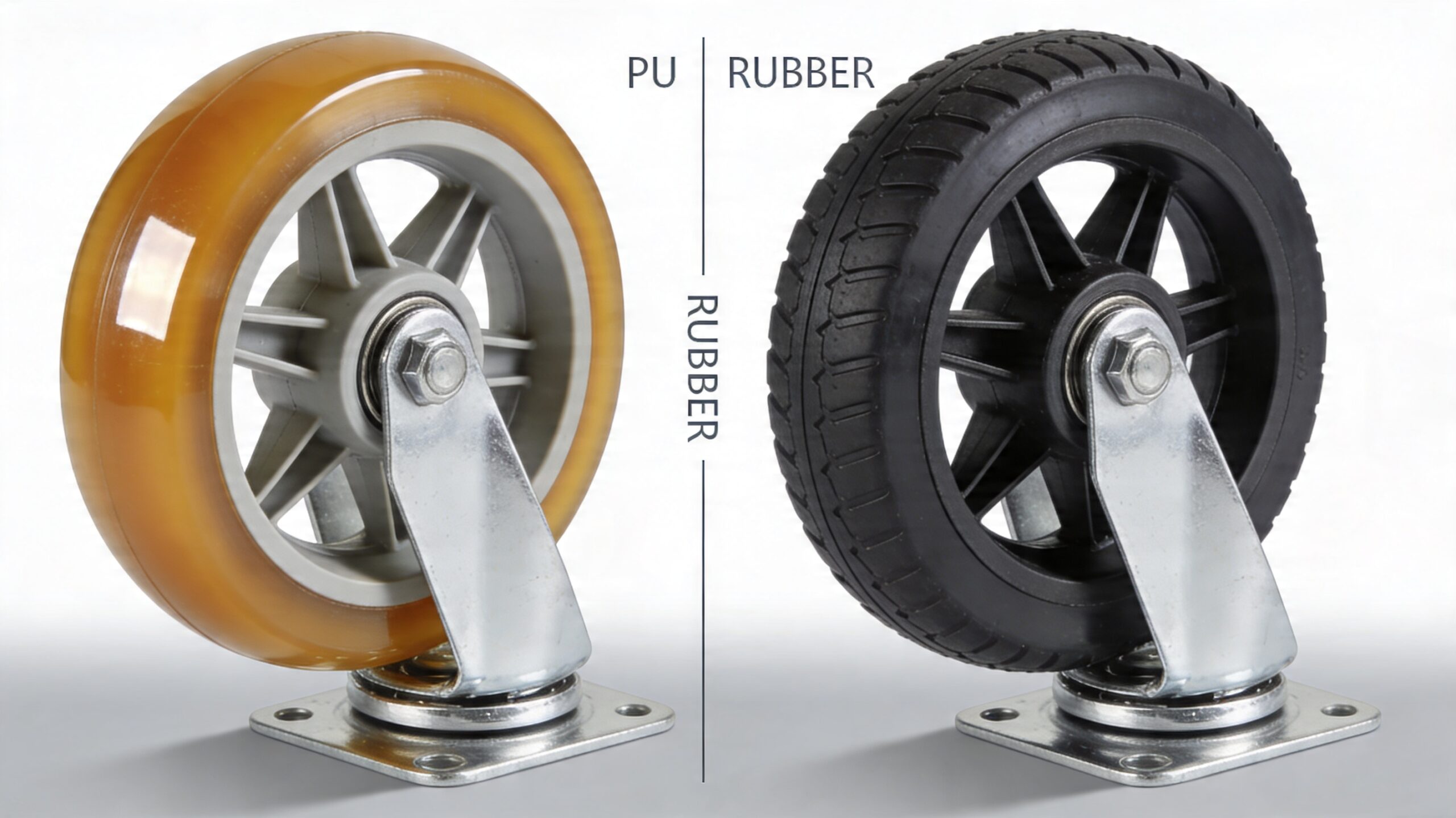
Use this table as a starting point before checking the exact caster model data.
| Selection point | Polyurethane caster wheel | Rubber caster wheel |
|---|---|---|
| Load support | Often selected for higher load and repeated movement | Better suited to lighter or cushioned movement needs |
| Floor protection | Good when specified as non-marking and matched to floor finish | Good cushioning and traction, but compound color matters |
| Noise and vibration | Usually quieter than hard wheels, with good rolling efficiency | Often quieter and more vibration-absorbing on uneven surfaces |
| Chemical and oil exposure | Often stronger around oils or industrial contamination, depending on formulation | Must be checked carefully around oils, grease, and chemicals |
| Outdoor or wet surfaces | Can work when the compound and bracket are specified for exposure | Often considered for traction and cushioning, but weathering still matters |
| Main purchasing risk | Choosing a tread too hard for the floor or too costly for the duty cycle | Choosing a compound that wears, marks, or deforms under the real load |
Quick decision rule: choose polyurethane when load, rolling distance, and industrial wear are the main concern. Choose rubber when noise, cushioning, traction, and floor feel are more important. Confirm the exact wheel compound before ordering.
Noise and Floor Protection
Both polyurethane and rubber can be floor-friendly when the right compound is used. The common mistake is assuming the material name alone proves non-marking performance.
Polyurethane floor behavior
- PU wheels can protect sealed concrete, tile, epoxy, and many hard floors when the tread hardness and compound match the surface.
- Harder PU can roll efficiently, but it may transmit more vibration on rough floors.
- For light-colored or finished floors, specify non-marking PU and test the wheel on the actual surface.
Rubber floor behavior
- Rubber wheels can provide excellent cushioning and quiet movement.
- Black or unsuitable rubber compounds may mark certain floors, especially under load or repeated turning.
- Gray, white, or non-marking rubber should be considered when appearance matters.
Selection note: If floor protection is the main concern, compare compound, hardness, load, and floor finish rather than choosing only by the words “PU” or “rubber.”
Load Capacity and Durability
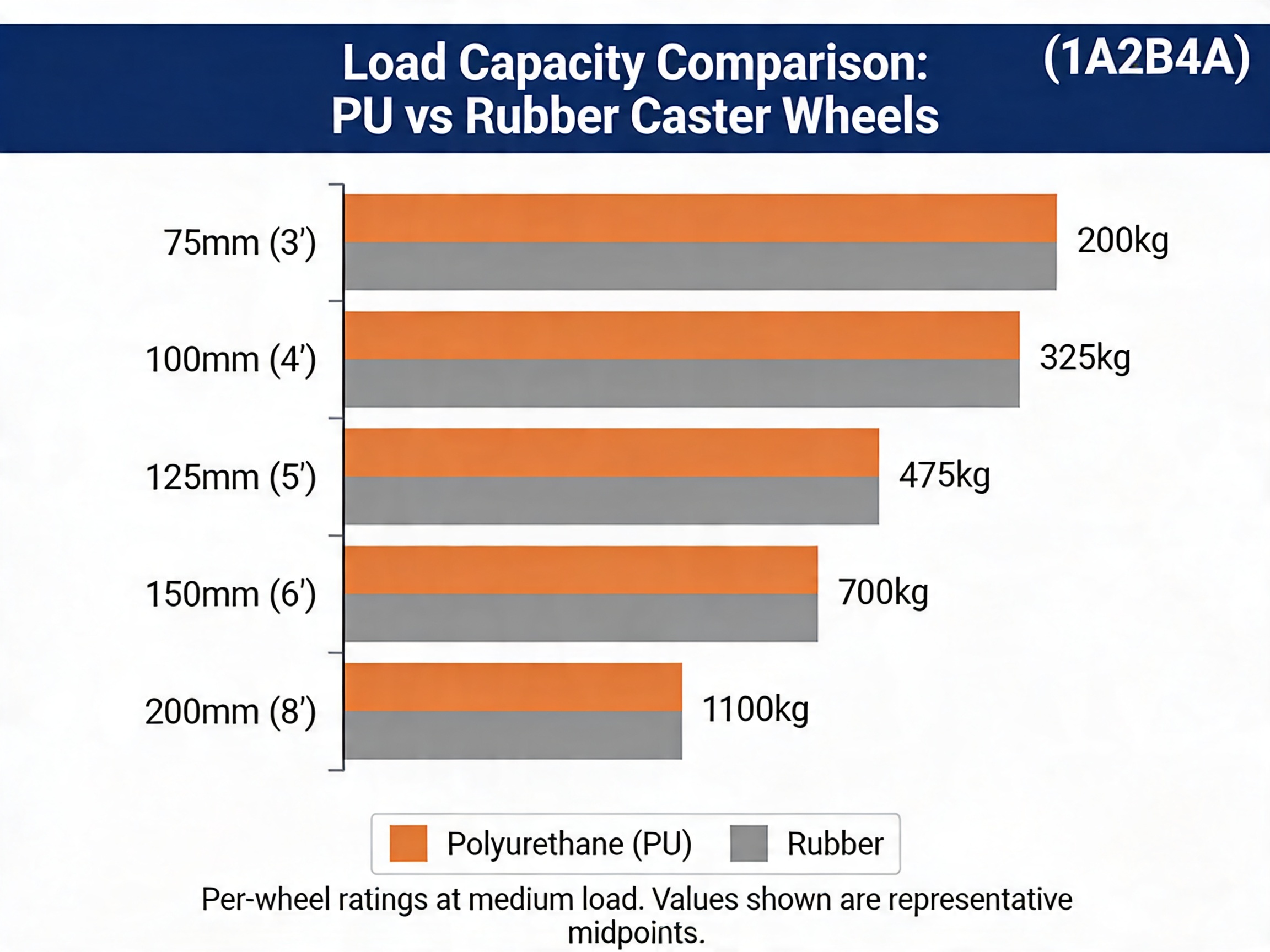
Polyurethane caster wheels are often specified for equipment that carries heavier loads, moves frequently, or travels long distances on smoother floors. Rubber caster wheels are often better when shock absorption, traction, and softer contact are more important than maximum rolling efficiency.
Choose polyurethane for load and wear when:
- the cart or machine moves frequently across smooth concrete or industrial flooring;
- the load is high enough that rubber deformation or flat spotting is a concern;
- oil, grease, or industrial contamination may contact the wheel;
- operators need lower rolling effort during repeated movement.
Choose rubber for cushioning when:
- noise and vibration matter more than maximum load efficiency;
- the route includes uneven floors, thresholds, or wet areas;
- the equipment is lighter or moved over shorter distances;
- traction and shock absorption are more valuable than abrasion resistance.
For heavier applications, confirm the complete caster rating, not only wheel material. The bracket, bearing, axle, mounting, and load distribution all matter. See Inford’s caster wheel load capacity guide for load-planning background.
Temperature and Chemical Resistance
Temperature and chemical resistance depend on formulation. A generic rubber wheel and a specialized rubber compound may perform very differently. The same is true for polyurethane.
Questions to ask before choosing:
- Will the wheel contact oil, grease, coolant, cleaning chemicals, fuel, food residue, or disinfectants?
- Will the caster be used in cold rooms, hot areas, outdoor storage, or frequent temperature changes?
- Does the wheel need to resist UV exposure, moisture, or washdown cleaning?
- Is the bracket material also suitable for the environment, or only the wheel tread?
Polyurethane is often compared favorably for industrial oil and wear conditions. Rubber can be useful for traction and cushioning, but the compound should be confirmed for the actual exposure. For outdoor routes, compare this article with Inford’s outdoor caster wheels guide.
Rolling Resistance and Ergonomics
Rolling resistance affects how much force an operator needs to start, steer, and stop equipment. Polyurethane often rolls more efficiently under load on smoother floors. Rubber may absorb more energy because it compresses more, but that same softness can improve traction and cushioning.
Use this practical split:
- Long travel distance or frequent movement: compare polyurethane first, especially on smooth floors.
- Short movement or sensitive environments: rubber may be acceptable or preferred for noise and cushioning.
- Manual handling: check wheel diameter, bearing type, swivel quality, and brake design in addition to material.
- Powered movement: check heat buildup, duty cycle, and floor wear with the supplier.
If the caster also needs reliable parking, review brake options in Inford’s swivel caster with brake guide.
Cost and Total Ownership
Purchase price should not be the only comparison. A cheaper wheel can become expensive if it wears quickly, marks the floor, increases push effort, or needs frequent replacement.
Compare these cost factors:
- Initial caster price: wheel material, bracket, bearing, and brake type all affect price.
- Replacement frequency: high-use carts may justify a more durable material.
- Downtime: replacing casters on production equipment can cost more than the wheel itself.
- Floor damage risk: marking or scratching can create maintenance costs.
- Operator effort: harder pushing can affect workflow and user acceptance.
Rubber may be a practical choice for low-use equipment, lighter loads, and noise-sensitive environments. Polyurethane may be a better long-term choice for demanding industrial movement.
Best Applications for Each Material
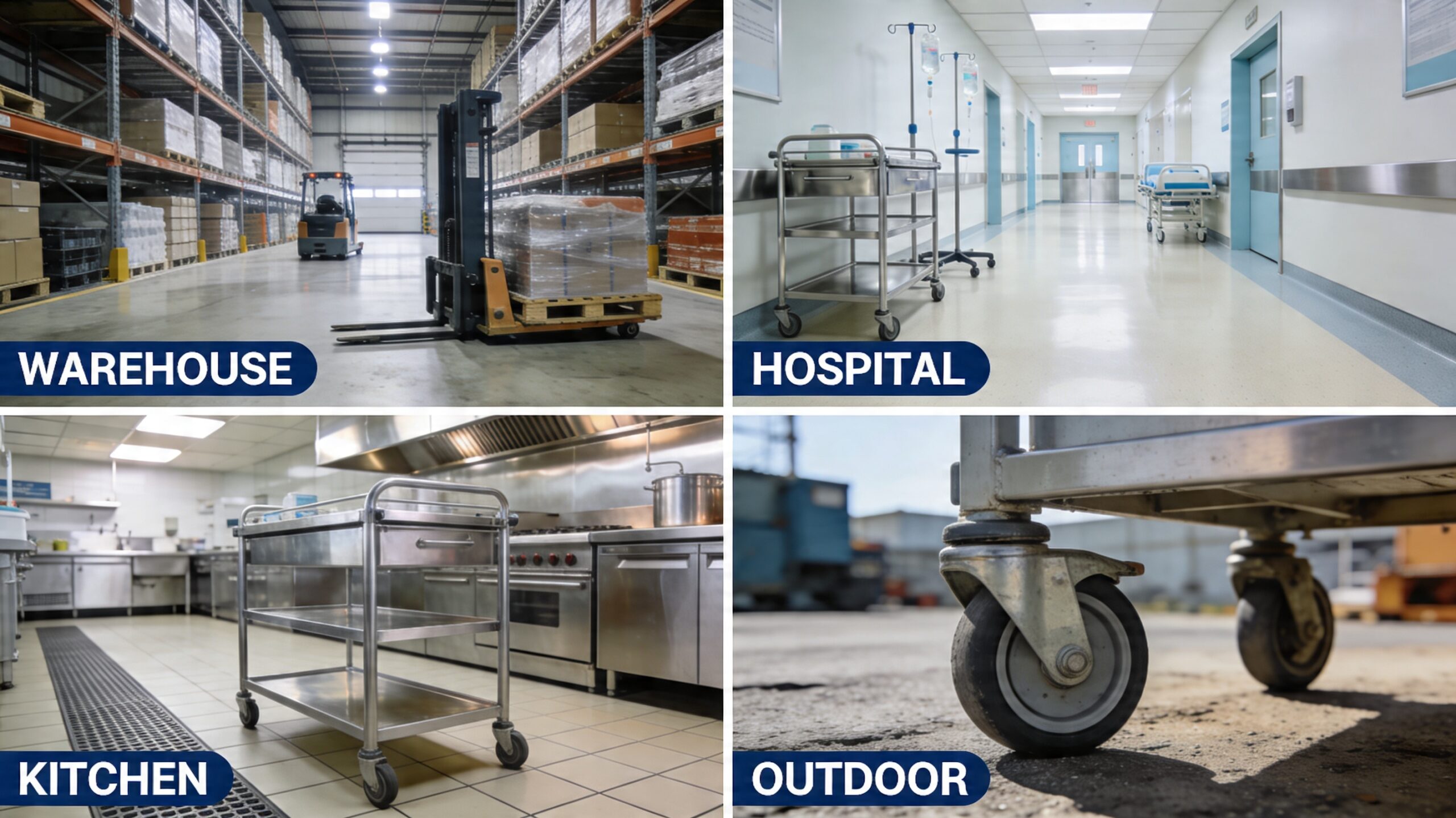
Choose Polyurethane When:
- load support and repeated movement are important;
- the equipment runs on smooth concrete, epoxy, tile, or industrial flooring;
- oil, grease, or industrial contamination may be present;
- lower rolling resistance matters for manual handling;
- the business wants longer service intervals and fewer wheel changes.
Choose Rubber When:
- quiet movement is more important than maximum rolling efficiency;
- the route includes uneven floors, small thresholds, damp areas, or vibration-sensitive loads;
- traction and cushioning matter more than heavy industrial wear;
- the equipment is lighter, moved less often, or used in customer-facing spaces;
- floor feel and shock absorption are key decision factors.
Consider Alternatives When:
- Nylon: for low rolling resistance on hard floors where noise and floor protection are less sensitive.
- Pneumatic tires: for rough outdoor routes, gravel, grass, or shock-sensitive loads. See Inford’s pneumatic tire casters guide.
- Special compounds: for chemical, temperature, ESD, food, or medical requirements.
Purchasing Checklist: PU vs Rubber Caster Wheels
Before approving a polyurethane or rubber caster wheel, record:
- total load, number of casters, and uneven load distribution;
- floor surface, ramps, thresholds, debris, moisture, and cleaning routine;
- movement distance, movement frequency, and whether the equipment is hand-pushed or powered;
- noise, vibration, traction, and floor-marking requirements;
- chemical, oil, grease, temperature, and outdoor exposure;
- mounting type, bearing type, brake requirement, and maintenance access.
Application Matrix for Faster Shortlisting
| Application | Material to compare first | Reason |
|---|---|---|
| Warehouse picking carts | Polyurethane | Repeated movement, load support, and rolling efficiency usually matter. |
| Hotel, office, or library equipment | Rubber | Quiet movement and floor feel are often more important than maximum load. |
| Medical carts and patient-adjacent equipment | PU or rubber, depending on route | Noise, cleaning, floor protection, and load all need to be balanced. |
| Food service or wet-floor carts | Rubber or special PU | Traction, washdown, and cleaning-chemical compatibility should be checked. |
| Industrial machines or production racks | Polyurethane | Higher load, abrasion, and oil exposure are common selection factors. |
| Outdoor or rough-ground equipment | Rubber, pneumatic, or outdoor-rated PU | Shock absorption, traction, bracket corrosion, and terrain matter more. |
Common Mistakes When Comparing PU and Rubber
- Comparing only wheel material: bracket strength, bearing type, mounting, brake design, and wheel diameter can change the result.
- Ignoring the floor finish: a wheel that works on sealed concrete may not behave the same on epoxy, tile, wood, carpet, or wet flooring.
- Assuming all rubber is the same: natural rubber, SBR, EPDM, and non-marking compounds can perform very differently.
- Assuming all polyurethane is the same: hardness, core material, formulation, and bonding quality affect load, wear, and floor behavior.
- Forgetting the maintenance plan: even the right material can fail early if debris, chemicals, overloading, or brake wear are ignored.
Frequently Asked Questions
Q: Are polyurethane casters better than rubber?
Not universally. Polyurethane is often better for higher loads, repeated movement, abrasion resistance, and industrial floors. Rubber is often better for quieter movement, cushioning, traction, and uneven surfaces.
Q: Do polyurethane casters mark floors?
They can be non-marking when the correct compound is specified, but the actual result depends on floor finish, load, heat, moisture, and wheel formulation. Test on the real floor before large-scale use.
Q: What rubber caster should I use for light-colored floors?
Use a gray, white, or non-marking rubber compound and confirm it under the expected load. Standard black rubber may mark some light floors.
Q: Which material is better around oil or grease?
Polyurethane is often considered first for industrial oil or grease exposure, but the exact chemical environment should be checked with the supplier. Some rubber compounds may not tolerate petroleum-based exposure well.
Q: Which material lasts longer?
Service life depends on load, floor, speed, distance, cleaning, chemicals, temperature, and maintenance. Polyurethane often lasts longer in abrasive industrial movement, while rubber can be the better fit when cushioning and traction are more important.
Key Takeaways
- Polyurethane vs rubber caster wheel selection depends on load, floor, movement distance, chemical exposure, noise, and traction needs.
- Polyurethane is often selected for load support, abrasion resistance, lower rolling effort, and industrial environments.
- Rubber is often selected for quiet movement, cushioning, traction, and uneven or sensitive surfaces.
- Non-marking performance depends on compound and floor finish, not material name alone.
- Ask for model-specific load rating, tread hardness, material compatibility, and maintenance guidance before ordering.
Need Help Choosing Between PU and Rubber Casters?
Inford can compare polyurethane and rubber caster wheels against your actual load, floor, movement route, chemical exposure, brake requirement, and maintenance expectations.
→ Request Material Recommendation | → View Caster Products | → Explore Caster Solutions