
A squeaking cart at 3 a.m. isn’t just an annoyance in a hospital ward — it’s a measurable factor in patient rest and satisfaction scores. In offices and labs, constant rolling noise from hard-wheeled chairs and equipment carts is a low-grade but persistent productivity drain. This guide breaks down exactly which materials, bearing types, and structural features determine caster noise, and how to specify wheels that solve the problem instead of just masking it.
Why Caster Noise Happens
Caster noise comes from three combined sources: the wheel material’s impact response, bearing friction and vibration transfer, and the acoustic behavior of the floor surface itself. Hard materials like steel, hard nylon, and hard plastic don’t cushion impact at all, so every small floor irregularity gets transmitted directly as vibration and sound, while metal-on-metal contact from dry or worn bearings adds grinding and squealing on top of that baseline noise. Hard floors like tile, polished concrete, or epoxy make the problem worse because they reflect sound rather than absorbing it, which is why the exact same wheel can sound dramatically louder in a hospital corridor than on carpet.
Decibel Comparison by Wheel Material
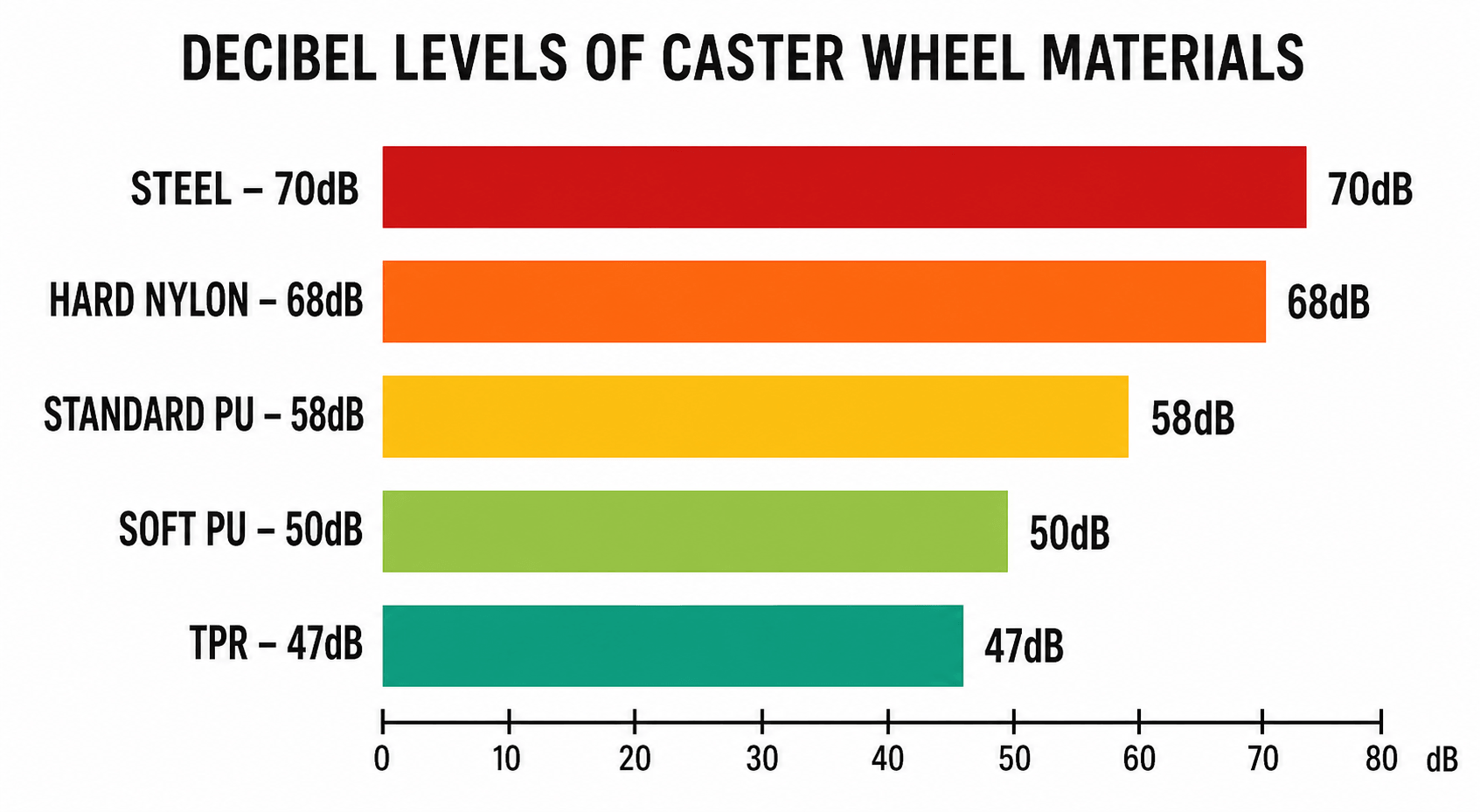
Independent measurements consistently show a 15-20+ dB spread between hard and soft wheel materials under equivalent load and floor conditions — and because decibels are logarithmic, that gap represents roughly a 4x to 8x difference in perceived loudness, not a marginal one.
| Wheel Material | Typical Noise Level | Primary Noise Source |
|---|---|---|
| Steel | 70+ dB | Metal-on-metal contact |
| Hard plastic / hard nylon | 68 dB | Impact vibration, no cushioning |
| Standard polyurethane (85A+) | 55-60 dB | Moderate impact absorption |
| Soft polyurethane (60A-75A) | 48-52 dB | Good vibration damping |
| Thermoplastic rubber (TPR) | 45-49 dB | Excellent shock absorption |
| Soft rubber (60A-80A) | 49 dB | Minimal friction, high flex |
A well-specified 8-inch, Shore 85A polyurethane wheel on precision sealed bearings with a kingpinless swivel can achieve 42-48 dB measured at 3 mph — quiet enough to be barely noticeable against typical hospital ambient noise, which itself often runs 40-45 dB in patient care areas. That’s the benchmark worth designing toward, not just “quieter than what we have now.”
Material Selection: What Actually Reduces Noise
Thermoplastic Rubber (TPR): The Healthcare and Retail Standard
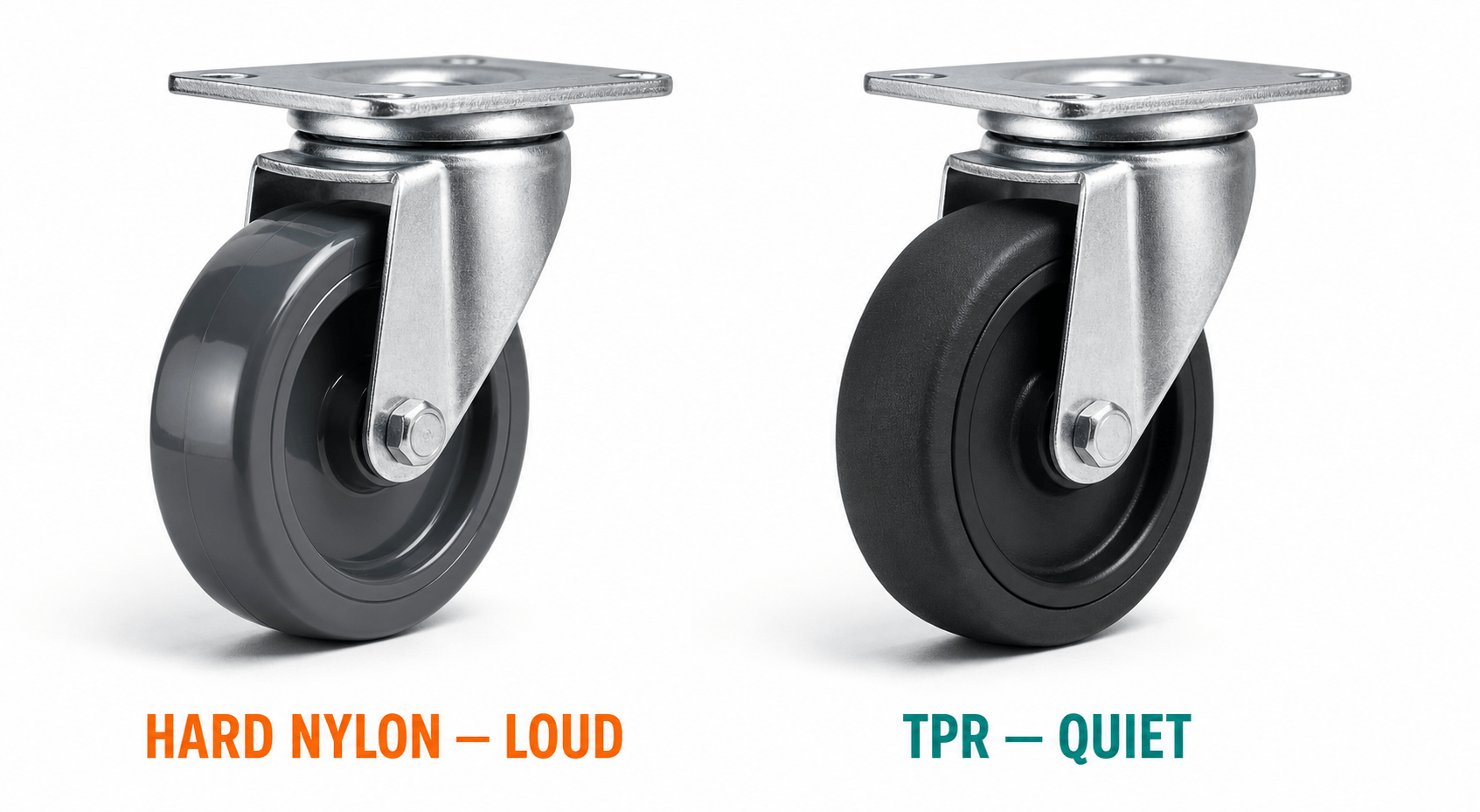
TPR keeps the quiet, floor-protective character of natural rubber while being non-marking and far more dimensionally consistent, which is why it has become the standard upgrade from black rubber in hospitals and retail environments. TPR wheels can run up to 70% quieter than hard wheels while resisting the flat-spotting and shape distortion that plagues natural rubber under sustained static load. The tradeoff is load capacity — TPR carries meaningfully less weight than polyurethane, so it fits lighter carts, IV poles, and quiet-zone equipment rather than heavy patient transport beds or bulk supply carts.
Soft Polyurethane: The Load-Capacity Compromise
For applications needing more load capacity than TPR while still prioritizing quiet, polyurethane in the 60A-75A hardness range is the sweet spot — it cushions and absorbs vibration noticeably better than the 85A-95A hardness used in standard industrial PU wheels, at some cost to wear life under heavy daily use. This is the material choice for hospital bed casters, heavier equipment carts, and any application where you need both noise control and a real working load rating; our swivel medical casters in healthcare guide covers the broader medical-caster selection criteria this fits into.
Why Nylon Is the Wrong Choice for Quiet Zones
Standard nylon offers excellent load capacity and low rolling resistance on smooth concrete, which is exactly why it dominates warehouse and industrial floors — but it is loud and transmits shock directly, making it the wrong material whenever floor protection or noise matters, as is the case in nearly every clinical or office environment. If your facility currently uses nylon casters purely out of habit rather than a specific load requirement, switching to TPR or soft PU is usually the single highest-impact noise fix available.
What’s Inside the Caster Matters Just as Much
Bearings
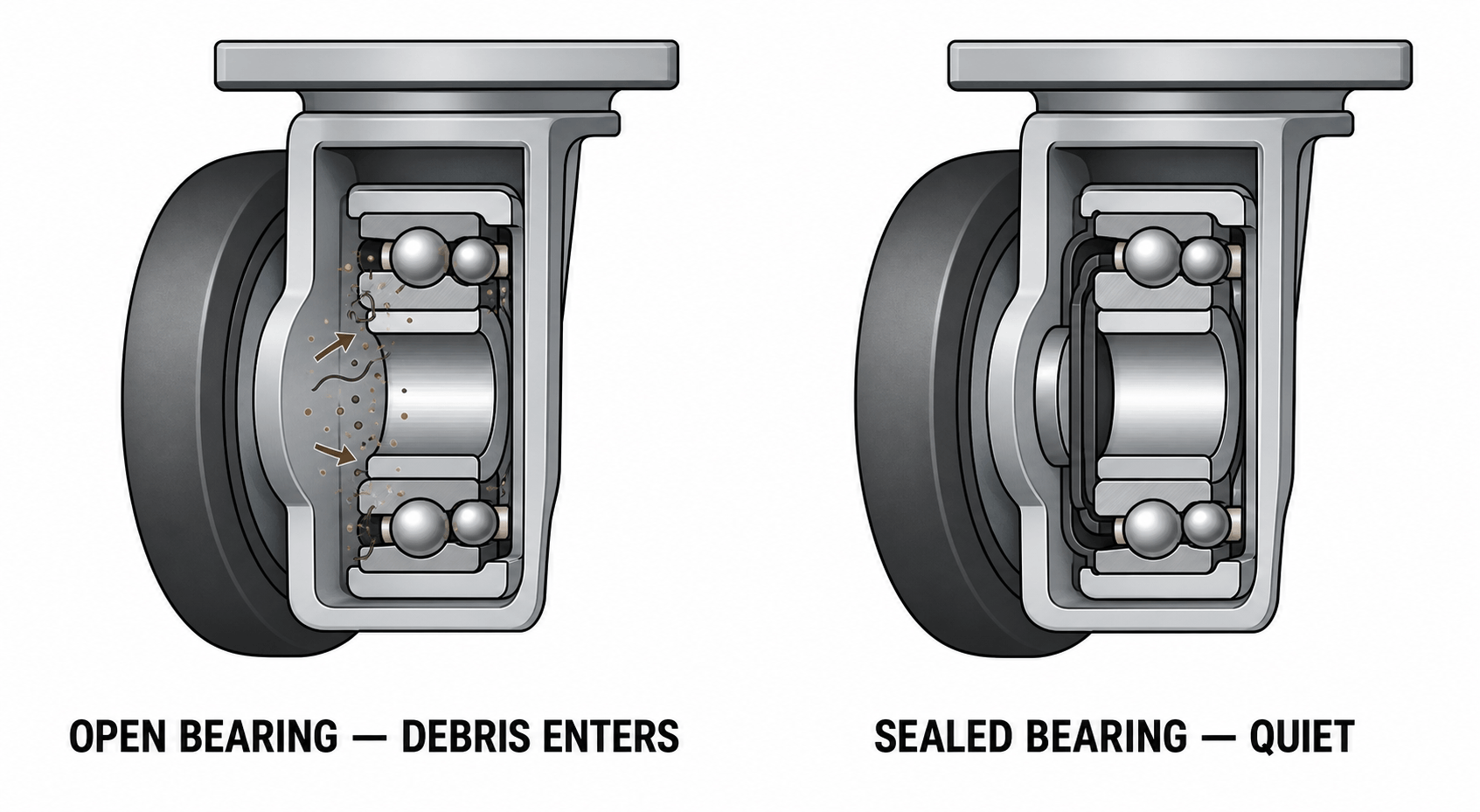
Precision sealed ball bearings roll more smoothly and stay quieter over time than open bearings, because sealing keeps out dust, hair, and debris that otherwise accumulate and cause grinding. Sealed, well-lubricated bearings alone — independent of wheel material — have been documented to cut noise by up to 75% compared to dry, contaminated bearings on the same wheel. This means a noise complaint about an existing fleet of carts is sometimes a maintenance problem, not a wheel-selection problem; regular cleaning and re-lubrication should be the first troubleshooting step before ordering replacement wheels.
Swivel Design and Kingpinless Construction
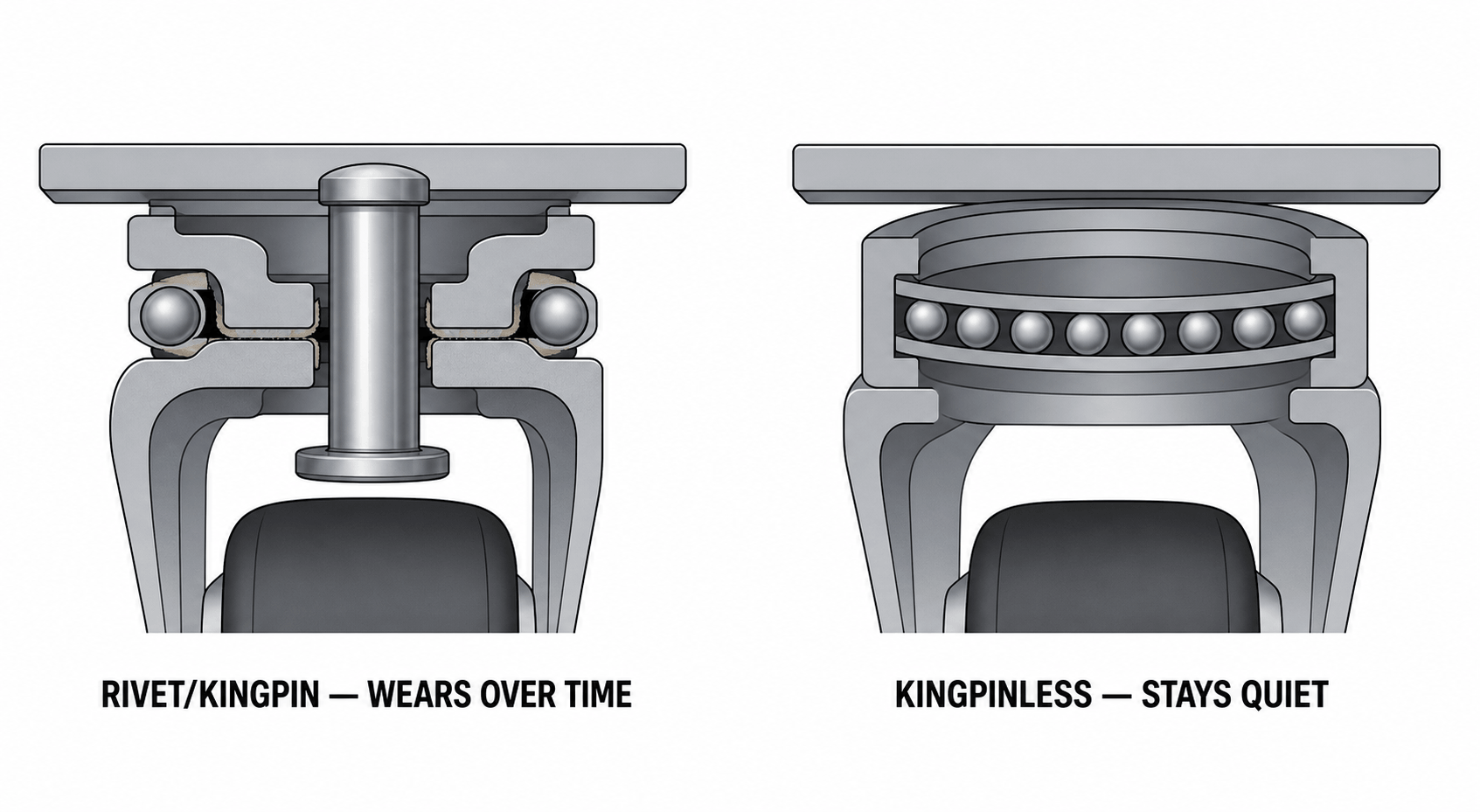
Kingpinless swivel sections use a ball-race raceway instead of a rivet/kingpin assembly, which reduces the play and rattle that develops at the swivel joint as a caster ages — this is one of the specification details separating a genuinely quiet caster from one that starts out quiet but develops noise within months.
Shock-Isolating Mounts
Some manufacturers offer spring-loaded caster stems or rubber mounting bushings that isolate vibration between the wheel and the equipment frame, with patented systems demonstrating up to 80% shock-load reduction and roughly 15 dB of additional noise reduction on top of material selection alone. These systems add cost but are worth considering for high-traffic hospital equipment or 24/7 office carts where noise complaints are a recurring issue despite already using soft-tread wheels.
Wheel Diameter Also Affects Noise
Larger wheels roll over floor joints, seams, and small debris more smoothly than smaller wheels of the same material, meaning a 5-inch or larger wheel is noticeably quieter than a 3-inch wheel under the same load. If floor noise persists after a material upgrade, checking whether the wheel diameter is simply too small for the floor conditions is a useful next step; our caster wheel height guide covers diameter selection in more detail.
Hospital-Specific Considerations
Clinical environments layer additional requirements on top of pure noise reduction: non-marking treads to protect vinyl composition tile and epoxy flooring, easy-clean surfaces compatible with hospital-grade disinfectants, and often a specific push-force ergonomic target to reduce staff strain during patient transport. A caster that’s quiet but degrades quickly under repeated disinfectant exposure isn’t actually solving the hospital’s problem — material chemical resistance and noise performance need to be evaluated together, not separately.
Office and Workspace Considerations
In office environments, the noise problem is usually chairs and equipment carts on hard flooring — laminate, polished concrete, or tile in open-plan spaces where sound travels freely between desks. Soft polyurethane or TPR office chair casters solve the immediate noise issue, but floor type matters just as much as wheel type; a soft wheel on carpet behaves very differently than the same wheel on hardwood, and mismatched pairing (hard wheel on hard floor, or soft wheel on carpet where it should be a hard wheel) is a common source of complaints that persist after a “quiet” wheel purchase. For carpet-specific selection guidance, see our dedicated caster wheels for carpet resource.
Noise Troubleshooting Checklist
- Confirmed whether existing noise is a maintenance issue (dry/contaminated bearings) before ordering new wheels
- Selected TPR for lighter, noise-priority applications or soft PU (60A-75A) where more load capacity is needed
- Avoided standard nylon or hard plastic in any clinical, hospitality, or open-plan office application
- Verified sealed bearing construction, not open/exposed bearings
- Considered kingpinless swivel design for long-term noise consistency as the caster ages
- Matched wheel diameter to floor conditions — avoid undersized wheels on uneven or jointed flooring
- For hospitals, confirmed the tread material also meets chemical resistance requirements for disinfectant exposure
- For offices, matched wheel hardness to actual floor type (hard wheel for carpet, soft wheel for hard flooring)
Get a Custom Quote for Quiet Casters
If noise complaints are recurring in your hospital, lab, or office equipment fleet, share your load requirements and floor type with our team for a matched wheel and bearing recommendation — contact us to start your quote.