
Moving a fully-loaded server cabinet or a lab bench full of sensitive instruments is nothing like moving a shopping cart — the margin for error is measured in millimeters of clearance and ohms of static resistance, not just kilograms of load. This guide covers everything procurement and facilities teams need to specify caster wheels correctly for data center racks and laboratory equipment, two environments where the wrong wheel choice can mean downtime, damaged electronics, or a failed compliance audit.
Why Data Centers and Labs Need a Different Wheel Category
Standard industrial caster wheels are engineered around raw load capacity and durability. Server rack and lab equipment casters have to solve for a narrower but stricter set of problems: tight bolt-pattern compatibility, low rolling height to fit under raised floors, electrostatic discharge (ESD) safety, and stability during transport of extremely top-heavy loads. Getting any one of these wrong can damage six-figure equipment, so this category rewards precision over price.
Server Rack Caster Wheels: Key Specifications
Load Capacity and Static vs Dynamic Ratings
Most standard server rack cabinets are designed to carry up to roughly 600 lbs of internal equipment weight, which means the caster set underneath needs a combined rating that matches or exceeds this figure. It’s important to distinguish between static load rating (weight while stationary, feet locked) and dynamic load rating (maximum weight while rolling) — the dynamic figure is always lower, and it’s the one that matters when you’re actually relocating a live cabinet.
| Cabinet Type | Typical Static Load Rating | Typical Dynamic Load Rating |
|---|---|---|
| Small wall-mount rack (9-12U) | 100-250 kg | 70-150 kg |
| Standard 19-inch rack (24-42U) | 700-830 kg | 400-450 kg |
| Extra heavy-duty rack | 1,700+ kg | 900+ kg |
For a deeper walkthrough of how load ratings are calculated across wheel types generally, see our guide on caster wheel load capacity.
Bolt Pattern and Mounting Compatibility
The most common server rack caster mounting standard uses a 45mm x 75mm bolt pattern with M6 hardware, which fits the majority of 4-post open racks and enclosed cabinets on the market. Always confirm bolt pattern compatibility before ordering — a mismatch here is the single most common reason server rack caster orders get returned.
Wheel Diameter and Floor Clearance
Server rack casters typically run 2 to 4 inches in diameter, which is deliberately smaller than general industrial casters because most data centers need racks to clear raised-floor tile heights and doorway thresholds without adding unnecessary standing height to the cabinet. If your facility uses raised flooring, factor in the combined caster height plus any leveling feet when confirming clearance.
Lab Equipment Caster Wheels: Key Specifications
ESD and Antistatic Requirements
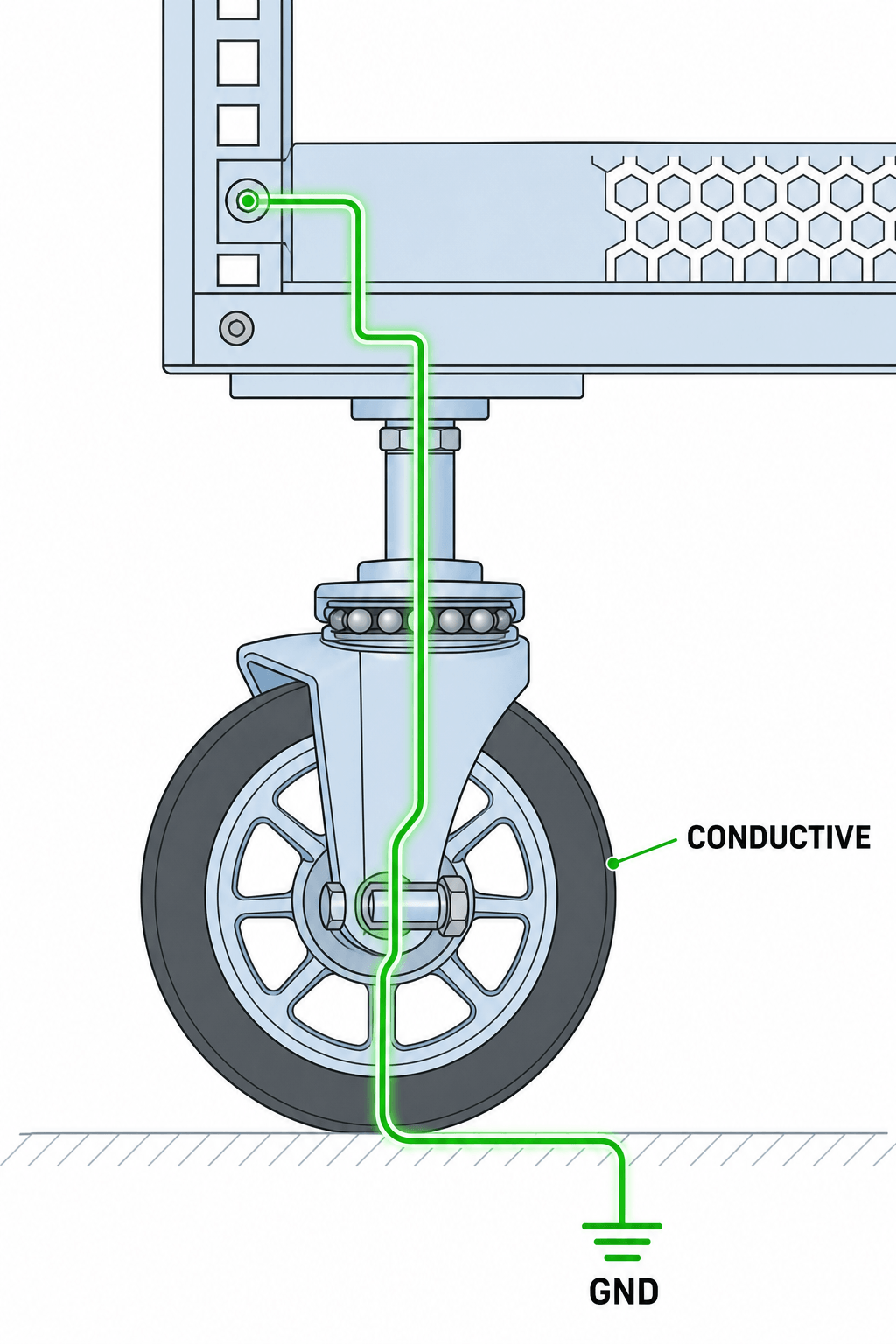
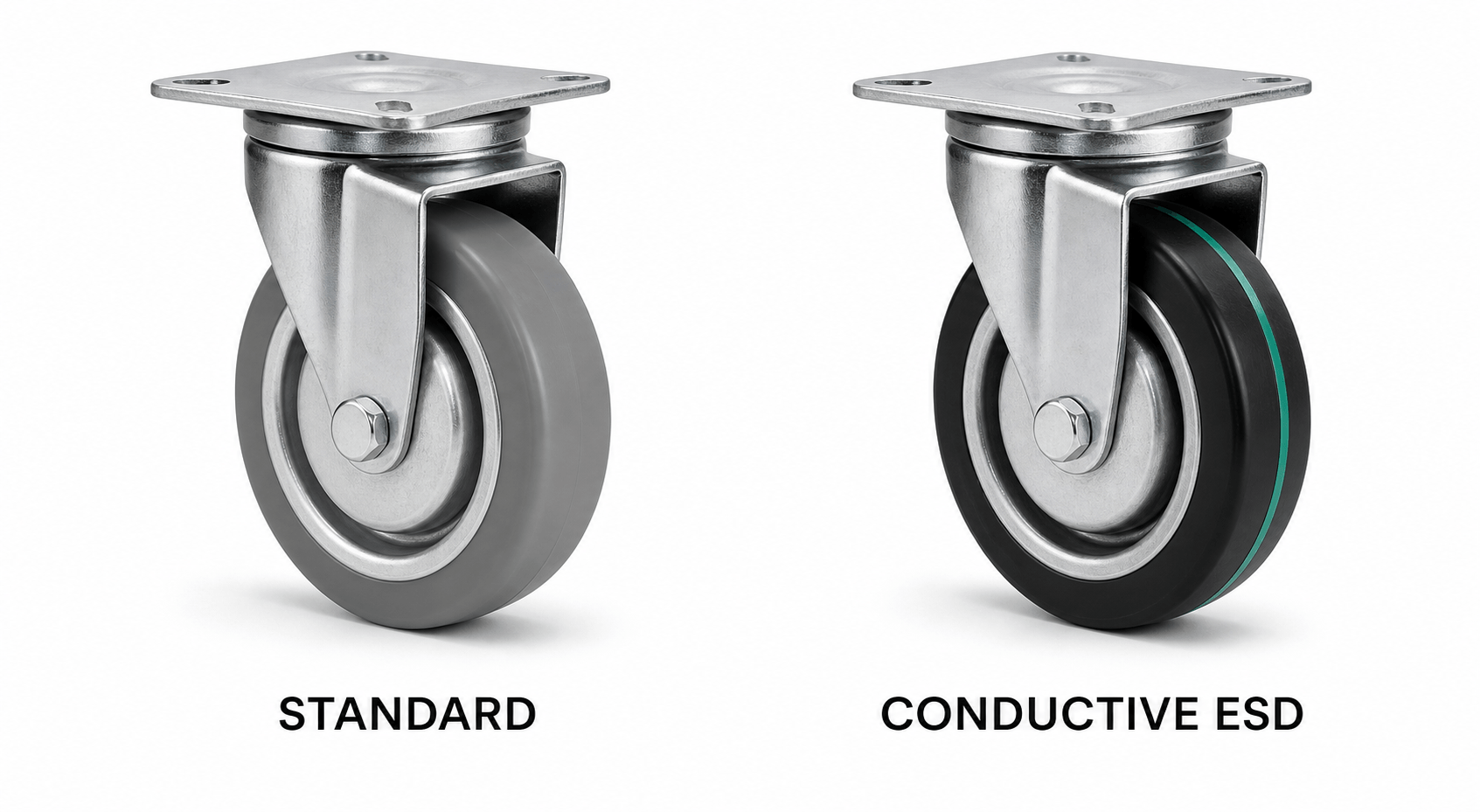
Laboratory equipment handling sensitive electronic components, semiconductors, or flammable materials often falls under ESD control protocols, which require casters with a defined ohmic resistance range rather than standard conductive or insulating wheels. Under ANSI/ESD S20.20, conductive casters must keep resistance below roughly 10^6 ohms, and the conductive path must run continuously from the equipment frame through the stem, axle, bearing, and tire — a single plastic component anywhere in that chain breaks the whole path. If you’re specifying plastic expanding stems for ESD environments, they need a copper wire bridge to maintain conductivity, since plastic alone will not carry the discharge path.
| ESD Classification | Max Resistance | Typical Application |
|---|---|---|
| Conductive | Under 10^4 ohms | Electronics assembly, cleanroom |
| Antistatic | Under 10^7 ohms | General lab, static-sensitive storage |
| Standard (non-ESD) | Not controlled | Non-sensitive lab equipment |
This directly connects to material choice — our comparison of polyurethane vs rubber caster wheels is worth reviewing before finalizing tread compound, since not every polyurethane formulation meets conductive-grade specs.
Non-Marking and Chemical Resistance
Labs frequently deal with reagent spills and require non-marking treads that won’t leave residue on epoxy or vinyl composition tile flooring. Combining non-marking compounds with chemical resistance narrows the usable material list considerably compared to a standard warehouse floor caster.
Precision Leveling for Sensitive Instruments
Analytical instruments — balances, microscopes, spectrometers — are often mounted on mobile carts that still need a level, vibration-damped resting position once wheeled into place. This is where retractable or leveling casters become relevant; see our guide on leveling caster wheels for optimal performance for how these mechanisms lock a cart into a rigid, level stance after transport.
Server Rack vs Lab Equipment Casters: Side-by-Side
| Factor | Server Rack Casters | Lab Equipment Casters |
|---|---|---|
| Primary concern | Load capacity, bolt pattern fit | ESD safety, chemical resistance |
| Typical diameter | 2-4 inch | 3-5 inch |
| Wheel material | Steel/plastic, PU | Conductive PU, non-marking rubber |
| Locking need | Often, for shipping stability | Often, for instrument stability |
| Compliance standard | Cabinet manufacturer spec | ANSI/ESD S20.20 |
Common Mistakes When Specifying These Casters
- Ordering by load capacity alone without checking bolt pattern — the wheel may hold the weight but physically not fit the cabinet frame.
- Assuming “antistatic-labeled” wheels are ESD-safe for cleanroom use — antistatic and conductive are different resistance tiers with different qualifying use cases.
- Skipping dynamic load rating and only checking static rating, which overstates how much weight is safe to move while rolling.
- Using standard rubber treads in labs with solvent exposure, leading to swelling, cracking, or residue transfer onto flooring.
- Forgetting stem length tolerance — a few millimeters of mismatch on threaded stem casters can prevent secure mounting; see our threaded stem casters vs standard casters comparison for stem-fit troubleshooting.
Specification Checklist Before You Order
- Confirm cabinet or cart static AND dynamic load ratings
- Match bolt pattern and hardware size exactly (commonly 45mm x 75mm, M6)
- Determine if ESD/conductive or antistatic wheels are required, and confirm the full conductive path (not just the tire)
- Check floor clearance against raised floor tile height or doorway thresholds
- Specify non-marking, chemical-resistant tread if operating in a lab with reagent exposure
- Decide if locking or leveling mechanisms are needed for shipping or instrument stability
- Request a sample unit before committing to a full fleet order across multiple racks or carts
Get a Custom Quote for Rack or Lab Casters
Whether you’re outfitting a single data center row or standardizing casters across a multi-site lab equipment fleet, our team can match load ratings, ESD requirements, and bolt patterns to your exact specification — contact us for a fast technical quote.