
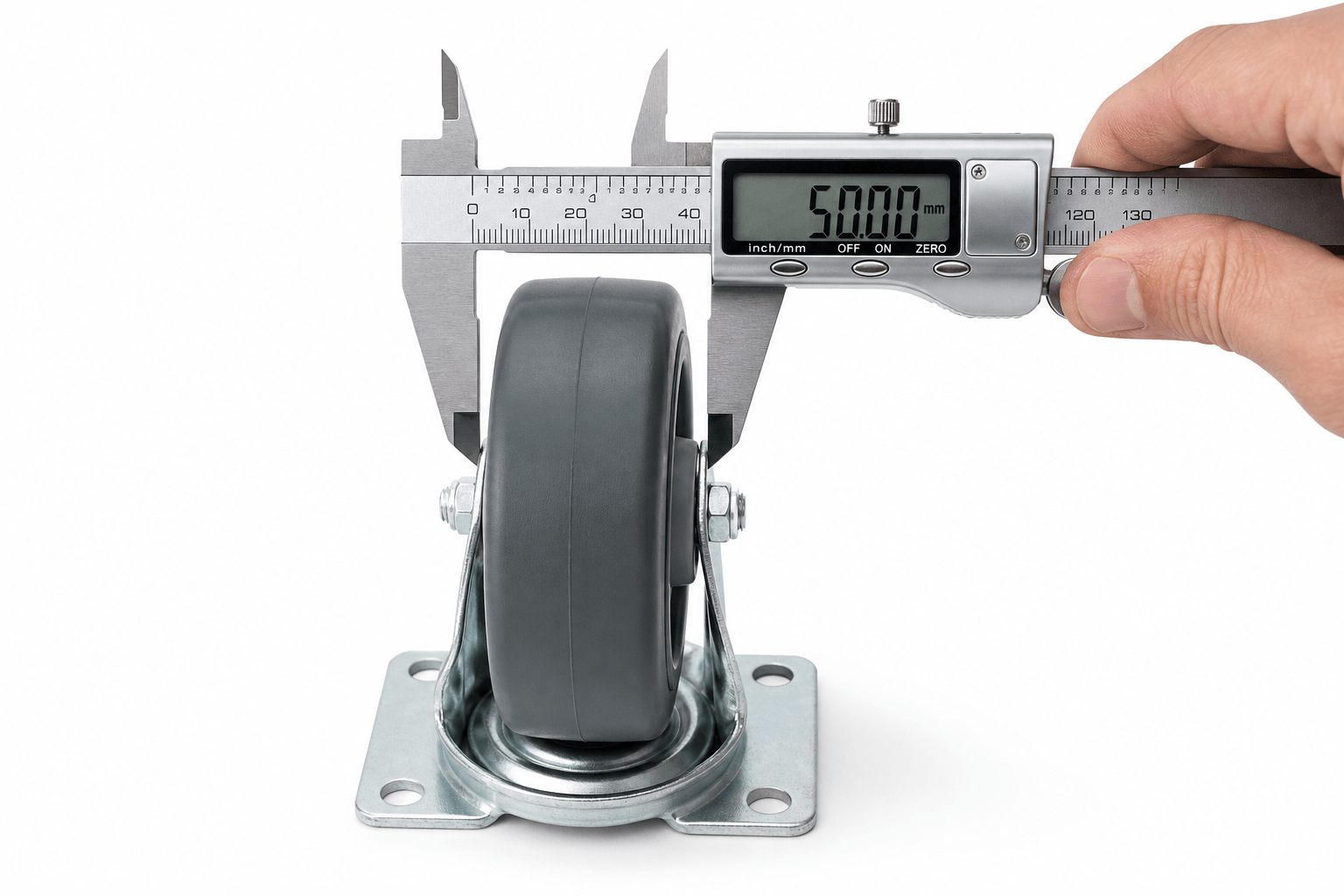
Ordering replacement casters seems simple — until you receive the wrong size, the wrong stem type, or a mounting plate that does not match your existing bolt holes. Mismatched casters mean wasted money and a second order wait.
The problem is that caster measurements are not intuitive. Wheel “size” refers to diameter, not the overall assembly height. Stem types vary between grip ring, threaded, and friction fit. And mounting plate bolt patterns look similar but can differ by 5mm — enough to make installation impossible.
This guide teaches you exactly how to measure every dimension of a caster wheel so you can order the correct replacement the first time. We cover wheel diameter, wheel width, overall height, mounting plate dimensions, stem measurements, and common sizing standards.
What Measurements You Need
Before removing or measuring anything, here is the complete list of dimensions you may need — depending on your caster’s mounting type:
| Measurement | What It Tells You | Always Needed? |
|---|---|---|
| Wheel diameter | The size of the wheel | Yes |
| Wheel width (tread width) | How wide the wheel contacts the floor | Yes |
| Overall height | Height from floor to top of mounting | Yes |
| Mounting type | Plate, stem, or bolt-hole | Yes |
| Plate dimensions (if plate mount) | Length × width of the top plate | Only for plate-mount |
| Bolt hole pattern (if plate mount) | Distance between bolt holes | Only for plate-mount |
| Bolt hole diameter (if plate mount) | Diameter of individual holes | Only for plate-mount |
| Stem diameter (if stem mount) | Thickness of the stem | Only for stem-mount |
| Stem length (if stem mount) | How long the stem is | Only for stem-mount |
| Grip ring dimensions (if grip ring) | Ring diameter and stem diameter | Only for grip ring |
Step 1 — Measure the Wheel Diameter
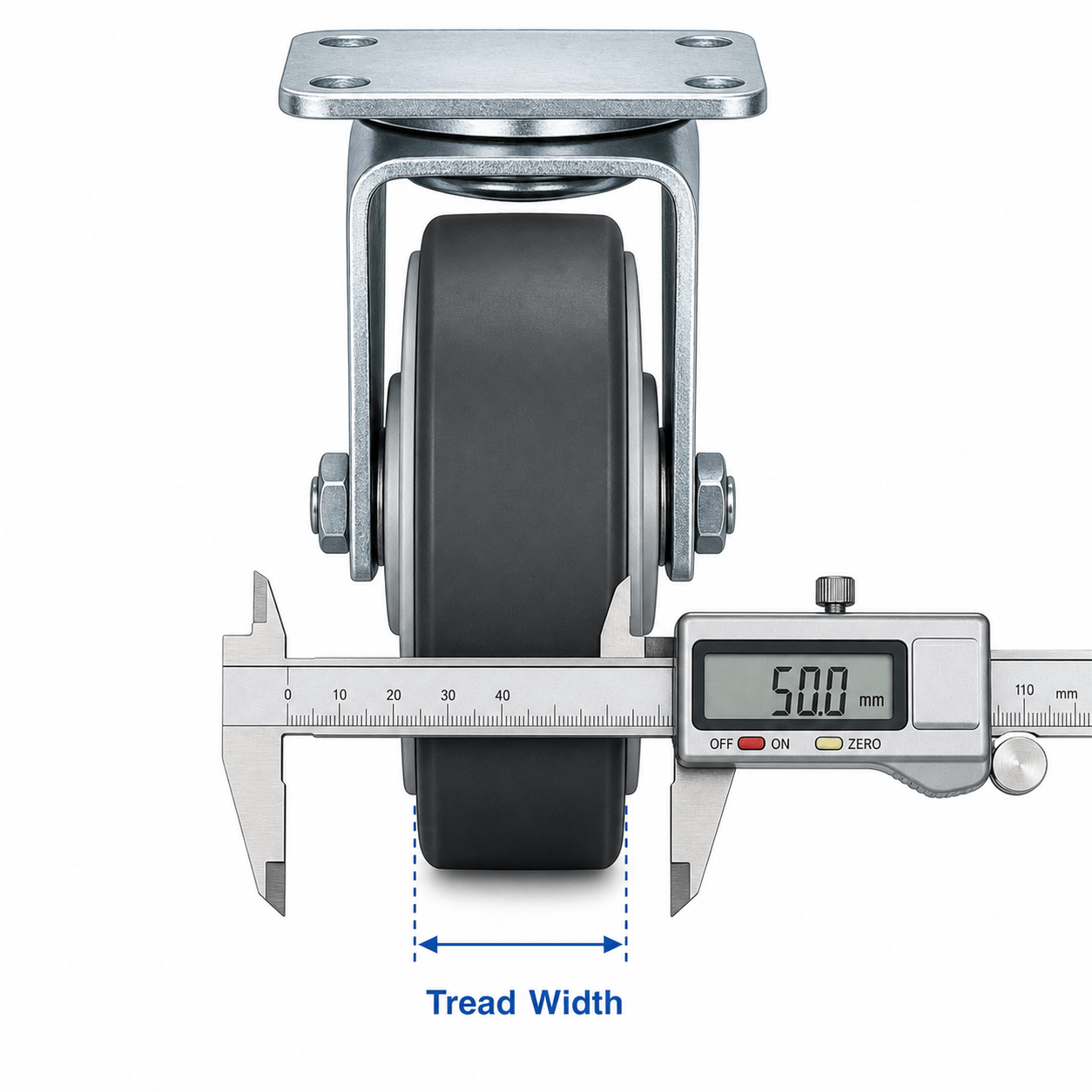
The wheel diameter is the most important measurement. It is the distance across the face of the wheel at its widest point.
How to measure:
1. Place the caster wheel on a flat surface
2. Measure from the floor contact point straight up through the center to the top of the wheel
3. This is your wheel diameter
Common pitfalls:
- Do NOT measure the overall caster height — the diameter refers to the wheel alone, not the entire assembly including the fork and mounting plate
- Measure the wheel, not the tire — If the wheel has a worn-down rubber tire, measure the full wheel including the tire at its original (unworn) thickness, or measure the bare wheel core and add the tire specification
- Worn wheels give smaller readings — If the wheel is significantly worn (flat spots, reduced tread), the measurement will be smaller than the original. Check manufacturer markings on the wheel hub for the rated size.
Standard wheel diameters:
| Metric (mm) | Imperial (inches) | Common Applications |
|---|---|---|
| 50mm | 2″ | Light furniture, office chairs |
| 75mm | 3″ | Medium furniture, light-duty carts |
| 100mm | 4″ | Industrial carts, medium equipment |
| 125mm | 5″ | Heavy-duty carts, scaffolding |
| 150mm | 6″ | Heavy equipment, outdoor casters |
| 200mm | 8″ | Extra heavy-duty, platform trucks |
Step 2 — Measure the Wheel Width (Tread Width)
The wheel width is the distance across the tread surface — the part that contacts the floor.
How to measure:
1. Look at the wheel from the front (end-on view)
2. Measure the width of the tread surface from one side to the other
3. This is your tread width
Why width matters:
- Wider wheels distribute load over a larger floor area — important for floor protection on soft surfaces (vinyl, hardwood)
- Narrower wheels roll more easily on carpet — they cut through fibers rather than sinking
- Width affects the caster’s load rating — wider wheels support more weight
Common widths: 22mm (7/8″), 25mm (1″), 32mm (1.25″), 38mm (1.5″), 50mm (2″)
Step 3 — Measure the Overall Height
Overall height is the total distance from the floor to the top of the mounting plate or stem — the full assembled height of the caster.
How to measure:
1. Stand the caster upright on a flat surface
- Measure from the floor surface to the top of the mounting plate (for plate-mount) or to the top of the stem shoulder (for stem-mount)
3. This is your overall height
Why it matters:
- Replacement casters must match the overall height of the originals — otherwise the equipment will be unlevel or the caster may not fit the existing mounting position
- A 5mm height difference across four casters can cause noticeable rocking
Overall height formula: Overall height ≈ wheel radius + fork-to-axle offset + plate/stem height. But just measure it directly — the formula is only useful for specifying custom casters.
Step 4 — Identify and Measure the Mounting Type
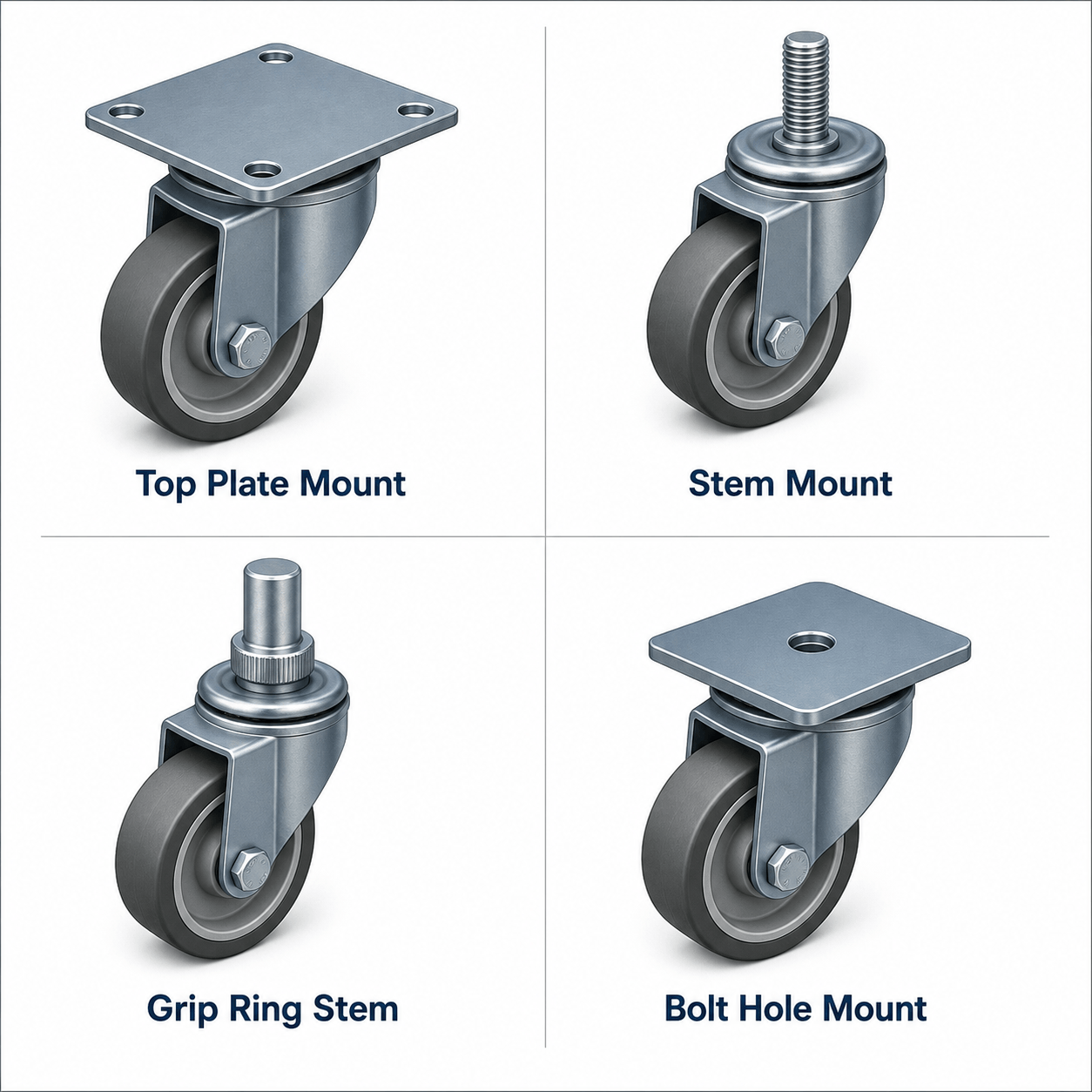
This is where most measurement errors occur. There are three primary mounting types:
Top Plate Mount
The most common industrial caster mounting. A flat metal plate with four bolt holes sits on top of the caster fork. The plate is bolted to the underside of the equipment.
Measurements needed:
- Plate size: Measure length × width of the plate (e.g., 75mm × 100mm or 3″ × 4″)
- Bolt hole spacing: Measure the distance between bolt hole centers — both the length spacing and width spacing (e.g., 50mm × 75mm)
- Bolt hole diameter: Measure the diameter of one bolt hole (e.g., 8mm or 5/16″)
Measuring bolt pattern accurately:
- Measure center-to-center, NOT edge-to-edge of the holes
- Measure both the short spacing (between holes on the short side) and the long spacing (between holes on the long side)
- Use calipers if available — a tape measure can introduce 1–2mm error which may cause fitment problems
Common plate sizes and bolt patterns:
| Plate Size | Bolt Pattern (C-to-C) | Typical Application |
|---|---|---|
| 60×75mm | 40×55mm | Light-duty furniture |
| 75×100mm | 55×75mm | Medium-duty carts |
| 100×125mm | 75×100mm | Heavy-duty industrial |
| 115×150mm | 85×125mm | Extra heavy-duty |
Threaded Stem Mount
A single threaded bolt extends from the top of the caster fork. The stem screws into a threaded insert (T-nut) in the equipment.
Measurements needed:
- Stem diameter: Measure the outside diameter of the threaded portion — this is the nominal thread size
- Stem length: Measure from the base of the stem (where it meets the fork) to the tip
- Thread pitch (metric) or Threads per inch (imperial): Count the number of threads within a measured length
Common threaded stem sizes:
| Thread | Diameter | Common Use |
|---|---|---|
| M8 × 15mm | 8mm | Light furniture |
| M10 × 15mm | 10mm | Medium furniture, carts |
| M12 × 25mm | 12mm | Industrial equipment |
| 3/8″-16 × 1″ | 9.5mm | US standard furniture |
| 1/2″-13 × 1.5″ | 12.7mm | US heavy-duty |
H3: Grip Ring Stem Mount
A smooth metal stem with a ribbed expansion ring near the tip. The stem friction-fits into a socket in the equipment leg. This is the most common mounting type for office chairs and light furniture.
Measurements needed:
- Stem diameter: Measure the smooth portion of the stem (above the grip ring) — this is the socket size
- Grip ring diameter: Measure the widest point of the ribbed ring
- Stem length: Measure from top of stem to bottom of grip ring
Common grip ring sizes:
| Stem Diameter | Ring Diameter | Socket Size | Common Use |
|---|---|---|---|
| 7/16″ (11mm) | 7/8″ (22mm) | 7/8″ socket | Office chairs (most common) |
| 3/8″ (9.5mm) | 3/4″ (19mm) | 3/4″ socket | Light furniture |
| 1/2″ (12.7mm) | 1″ (25.4mm) | 1″ socket | Heavy furniture |
Bolt Hole (Kingpin) Mount
A single bolt through the top of the caster fork attaches to a corresponding hole in the equipment. Common on shopping carts and certain industrial applications.
Measurements needed:
- Bolt hole diameter: Usually 1/2″ (12.7mm) or 5/8″ (15.9mm)
- Bolt length: From under the raceway cup to the end of the bolt
Quick Reference — Common Caster Sizes by Application
| Application | Wheel Diameter | Wheel Width | Mount Type | Overall Height |
|---|---|---|---|---|
| Office chair | 50–65mm | 22–25mm | Grip ring 11mm | 65–80mm |
| Dining chair | 40–50mm | 20–25mm | Grip ring or threaded | 50–65mm |
| Utility cart | 100–125mm | 32–38mm | Top plate 75×100mm | 130–165mm |
| Hospital bed | 125–150mm | 32–38mm | Top plate or threaded | 165–195mm |
| Warehouse cart | 150–200mm | 38–50mm | Top plate 100×125mm | 195–260mm |
| Scaffolding | 125–150mm | 32–38mm | Round stem 38mm | 175–210mm |
Frequently Asked Questions
Q: How do you measure a caster wheel size?
Measure the wheel diameter (distance across the wheel at its widest point, not the overall caster height), the wheel width (tread surface width), and the overall caster height (floor to top of mounting plate or stem). Then identify your mounting type (plate, threaded stem, or grip ring) and measure the relevant mounting dimensions.
Q: What size caster wheel do I need?
This depends on your application. For replacement casters, match all dimensions of the existing caster. For new installations, choose wheel diameter based on load and clearance requirements: 50–75mm for furniture, 100–125mm for carts and light industrial, 150–200mm for heavy industrial. Then calculate load rating requirements.
Q: How do I know what stem type my caster uses?
Remove one caster and examine the stem. A threaded bolt = threaded stem. A smooth pin with a ribbed ring near the tip = grip ring. A flat plate with four holes = plate mount. A smooth pin without a ring that was pushed into a hole = friction fit.
Q: Are caster sizes universal?
No. While there are standard sizes, dimensions vary between manufacturers. A “4-inch caster” from one brand may have a different plate size, bolt pattern, or overall height than a “4-inch caster” from another. Always measure your existing casters rather than relying on generic size descriptions.
Q: Where can I find the size printed on a caster?
Check the wheel hub, the inner side of the fork, or the top surface of the mounting plate. Many manufacturers stamp or mold the wheel diameter, load rating, and material code directly into the caster. Format is typically: diameter × width (e.g., “125×32” means 125mm diameter, 32mm wide).
Key Takeaways
- Always measure wheel diameter (across the wheel face), tread width, and overall caster height before ordering replacements.
- For plate-mount casters, measure bolt hole center-to-center spacing — not edge-to-edge — in both directions.
- The most common grip ring stem size for office and furniture casters is 7/16″ (11mm) diameter with a 7/8″ (22mm) socket.
- Worn wheels measure smaller than their rated size — check manufacturer markings on the hub for the original specification.
- Caster sizes are NOT universal between brands — always measure your existing casters rather than ordering by description alone.
Find Your Replacement Casters
Inford manufactures casters in every standard size and mounting type. Use our sizing guide or send us your measurements for an exact match recommendation.
→ How to Measure a Caster Wheel | → Threaded Stem Casters | → All Caster Products | → Contact for Sizing Help