
Automated Guided Vehicles (AGVs) and Autonomous Mobile Robots (AMRs) are only as reliable as the wheels underneath them. A caster that seems “good enough” in a spec sheet can quietly cause navigation drift, energy waste, or premature failure once it hits a real warehouse floor. This guide breaks down exactly how to specify AGV/AMR caster wheels so procurement and engineering teams can avoid costly redesigns.
Why AGV Wheels Are Different From Standard Casters
Standard industrial caster wheels are built primarily for static or manually-pushed loads, where occasional swivel lag or a bit of rolling resistance is tolerable. AGV and AMR wheels operate inside a closed-loop control system — odometry, LiDAR mapping, and motor controllers all assume a predictable, consistent wheel behavior. Any inconsistency in rolling resistance, swivel eccentricity, or wheel-core stability translates directly into positioning error, which is why AGV integrators specify wheels to tighter tolerances than furniture or cart applications.
Core Selection Criteria
Choosing the right AGV caster comes down to four sequential decisions: load calculation, material selection, wheel core, and tread profile.
1. Load Capacity Calculation
The load per wheel should be calculated using equipment weight plus maximum payload, divided by the number of support wheels, multiplied by a safety factor that reflects the operating environment. For deeper load-rating math and formulas, see our guide on caster wheel load capacity.
| Scenario | Obstacle Height vs Wheel Diameter | Recommended Safety Factor |
|---|---|---|
| Indoor, manual guidance | Less than 5% | 1.2 |
| Outdoor, manual guidance | Greater than 5% | 1.5 |
| Indoor, motorized | Less than 5% | 1.5 |
| Outdoor, motorized | Greater than 5% | 2.0 |
2. Material Selection
Polyurethane (PU) dominates AGV applications because it rates highest across the five criteria that matter most: wear resistance, noise, floor protection, shock absorption, and rolling resistance. The table below summarizes how common materials compare.
| Material | Shock Resistance | Wear Resistance | Floor Protection | Noise | Operating Temp (°C) | Best Fit for AGV? |
|---|---|---|---|---|---|---|
| Polyurethane (PU) | Good | Good | Good | Low | -20 to 80 | Yes — industry standard |
| Standard Nylon (PA) | Poor | Poor | Poor | High | -35 to 80 | Not recommended |
| Synthetic Rubber (TPR) | Excellent | Excellent | Fair | Very Low | -35 to 80 | Light-duty only |
| Hard Rubber (HR) | Fair | Fair | Fair | Medium | -20 to 80 | Occasional use |
If your project spans multiple wheel materials across a fleet, our detailed breakdown of polyurethane vs rubber caster wheels can help justify material choice to stakeholders outside engineering.
3. Wheel Core: Metal Is Non-Negotiable
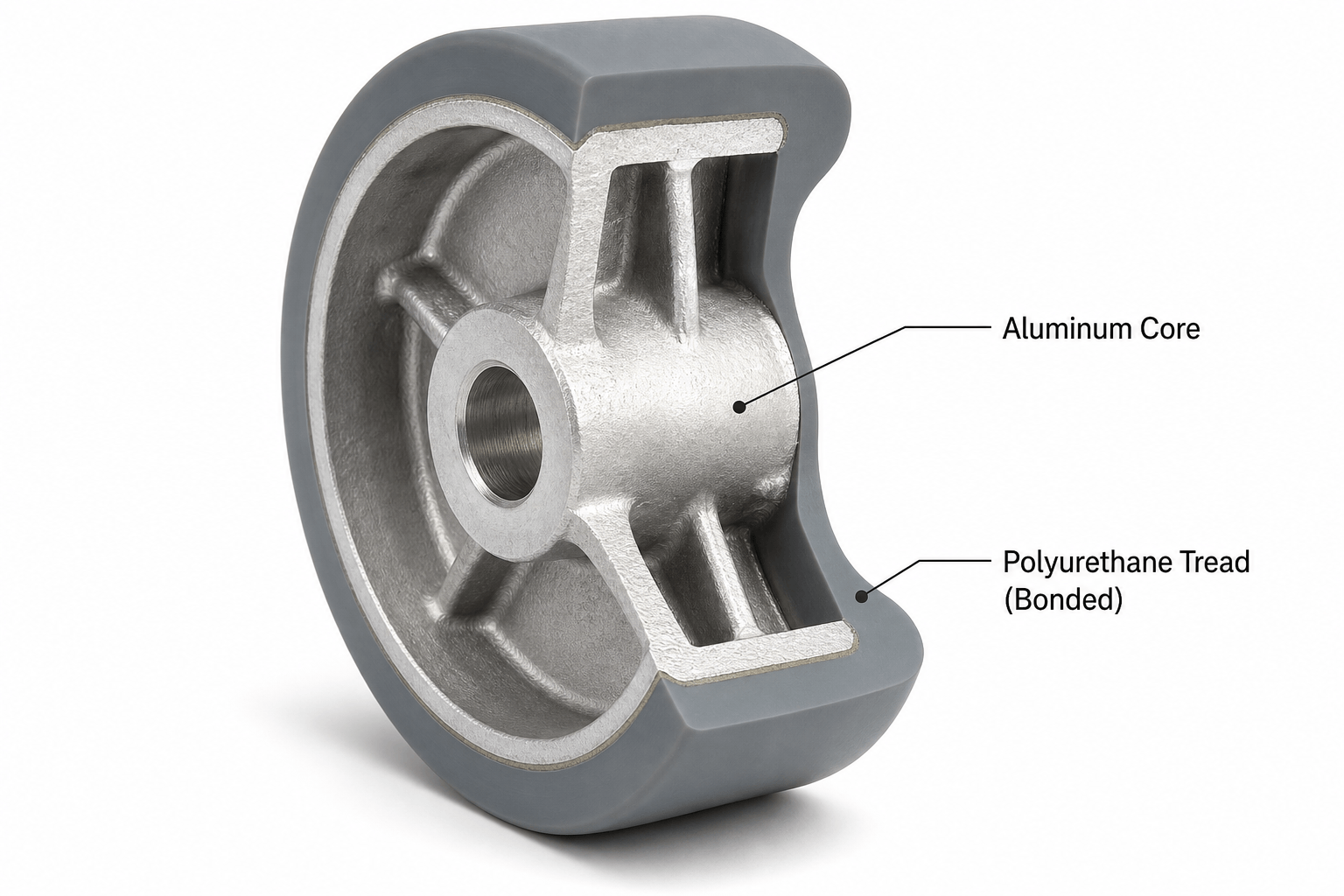
Plastic wheel cores expand under heat during high-frequency AGV cycles, which causes the tread to separate from the core and jam the drive train. Metal cores — typically aluminum or cast iron — are the only reliable option for continuous-duty robotic applications. Bearing choice matters just as much as the core material; see our comparison of plain bearing vs ball bearing casters to understand rolling-resistance tradeoffs at AGV operating speeds.
4. Tread Profile and Diameter
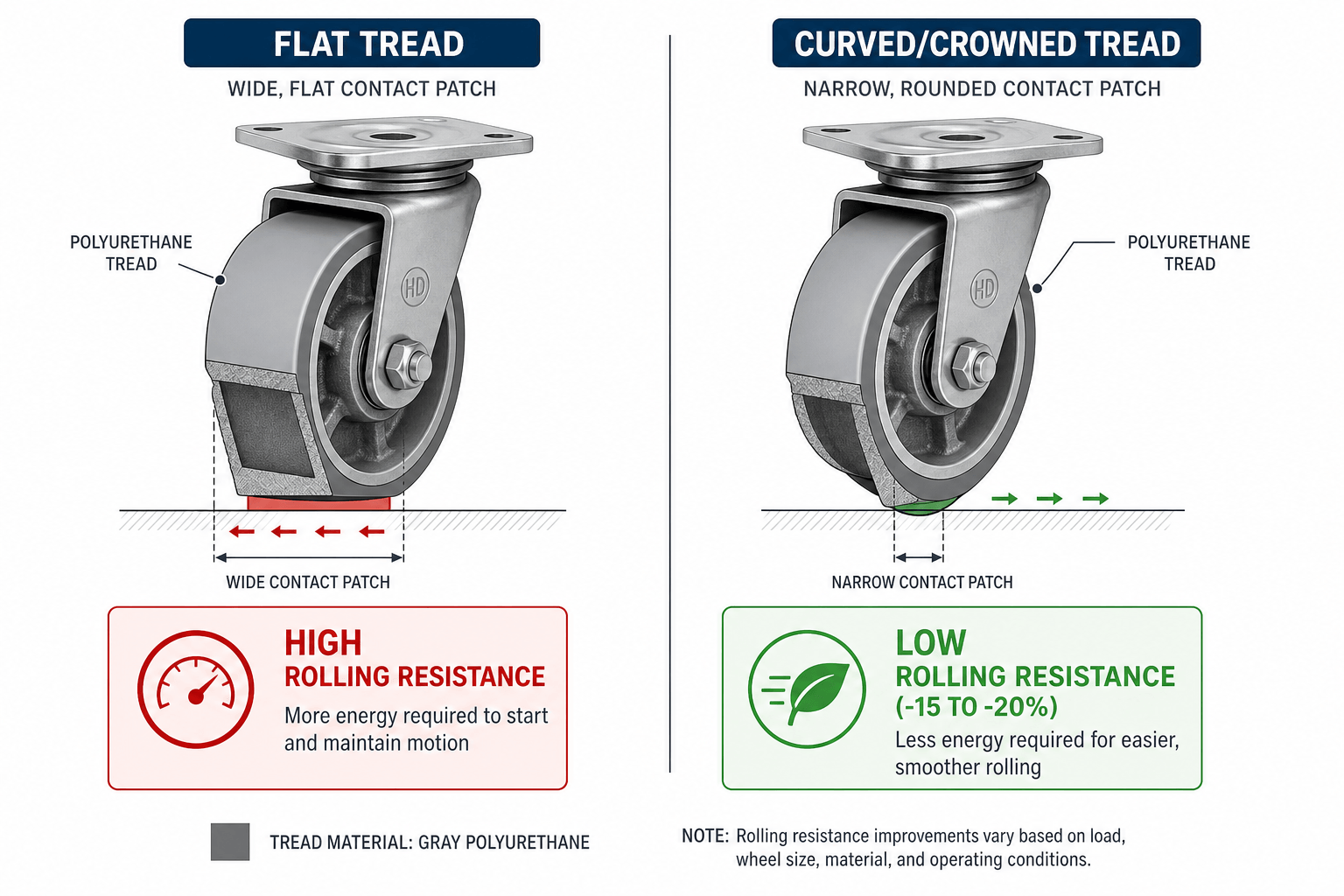
Curved (crowned) treads reduce the floor contact area, cutting rolling friction by roughly 15-20% compared to flat treads — a meaningful energy saving across a fleet running multiple shifts per day.
| Diameter | Material | Max Load per Wheel | Typical Use Case |
|---|---|---|---|
| 3 inch | PU 92A | 300 kg | Light-duty AMR |
| 4 inch | PU 92A | 500 kg | Medium-duty AGV |
| 4 inch | PU 95A | 800 kg | Heavy-duty AGV / material cart |
| 5-8 inch | PU 70-95D | up to 2,400 kg | Heavy industrial AGV, dual-wheel configs |
Swivel Eccentricity and Positioning Accuracy
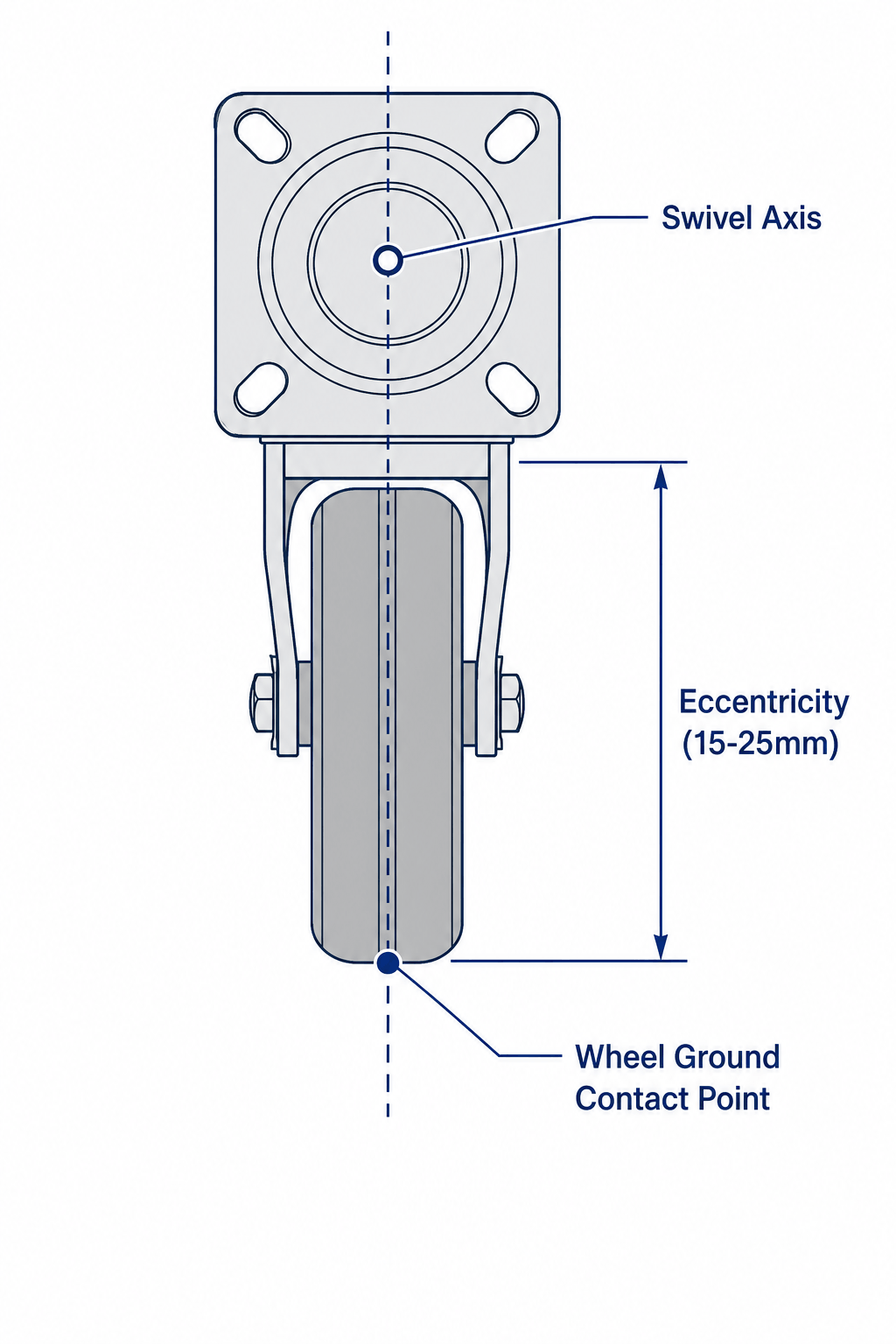
Eccentricity — the offset between the swivel axis and the wheel’s ground contact point — governs how easily an AGV caster rotates. AGVs generally perform best with 15-20mm of eccentricity, while heavier material carts benefit from 20-25mm for added stability. Too little eccentricity causes wheel “hunting” (oscillation) at low speeds; too much increases turning resistance and drains battery faster. This is one of the most overlooked specs in AGV wheel selection, and it’s rarely disclosed by generic caster suppliers — it needs to be confirmed directly with your manufacturer during the quoting stage.
Special Environments: Cleanroom, Cold Storage, and ESD
Many AGV fleets don’t run on a typical warehouse floor. If your robots operate in a pharmaceutical or electronics cleanroom, non-marking, low-particulate PU wheels are required — a topic we cover in more depth alongside broader cleanroom equipment mobility needs. For AGVs running in refrigerated or freezer environments, standard PU compounds can harden and crack; check our notes on high-temperature caster wheels for the flip-side consideration of thermal limits, since many of the same compound principles apply in reverse for cold environments. Static-sensitive electronics assembly lines typically require ESD/anti-static wheel treads, which should be specified explicitly in your RFQ rather than assumed.
Common AGV Wheel Failure Modes (and How to Avoid Them)
- Tread delamination: usually caused by plastic cores overheating under continuous duty — solved by switching to metal-core wheels.
- Navigation drift: often traced back to inconsistent rolling resistance between wheels on the same unit — solved by sourcing matched sets from a single production batch rather than mixing suppliers.
- Premature wear on one side: typically a sign of incorrect eccentricity or uneven floor loading — revisit your load calculation and swivel spec.
- Excessive noise in hospital or lab settings: swap to a softer-durometer PU or rubber-PU hybrid tread; our guide to swivel medical casters in healthcare covers noise-sensitive wheel selection in more depth.
AGV Wheel Selection Checklist
- Calculate load per wheel including safety factor for your indoor/outdoor and manual/motorized scenario
- Confirm polyurethane hardness rating (92A minimum for AGV duty)
- Specify metal wheel core — reject plastic-core quotes for continuous-duty robots
- Choose curved tread profile where load capacity allows
- Confirm swivel eccentricity (15-20mm AGV, 20-25mm heavy cart)
- Flag any special environment requirements (cleanroom, cold storage, ESD) in your RFQ
- Request matched-batch wheels across a single AGV unit to avoid drift
Get a Custom AGV Wheel Quote
If you’re specifying wheels for a new AGV or AMR platform, share your load, environment, and duty-cycle requirements with our engineering team for a matched wheel set recommendation — contact us to start your quote.