
A supermarket shopping cart has four caster wheels — and most shoppers never think about them until one starts wobbling, squeaking, or pulling to the side. For retail operators, however, shopping cart casters are among the most critical and frequently replaced components in their store equipment fleet.
A single grocery store operates 100–300 carts. Each cart makes dozens of trips per day across parking lots, over curb transitions, and through checkout lanes. That level of use — combined with weather exposure, debris, and occasional abuse — means caster replacement is a routine and significant maintenance cost.
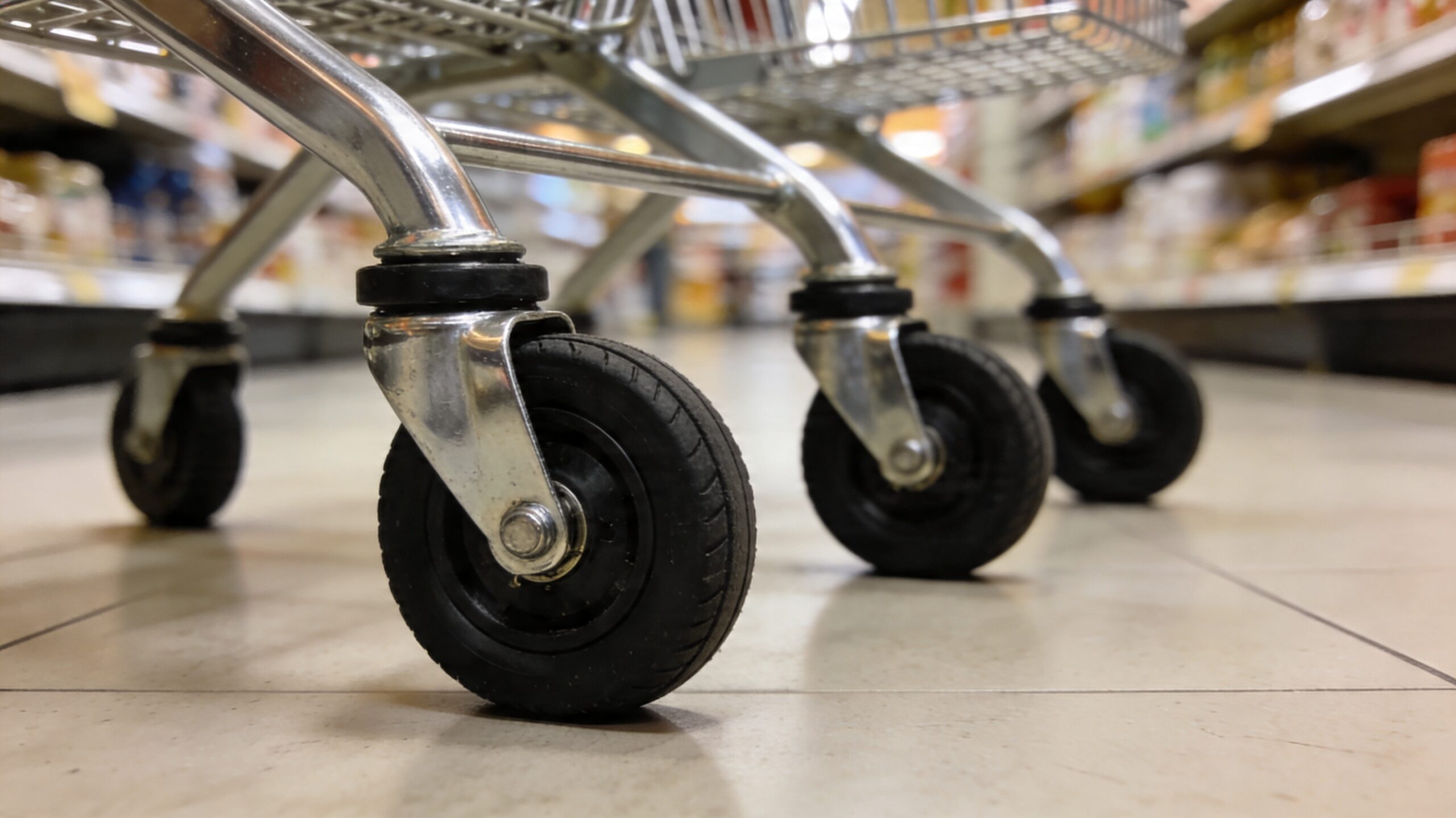
This guide covers shopping cart caster specifications, the different types available, anti-theft locking wheel systems, maintenance best practices, and how retailers can optimize their OEM caster sourcing for better performance and lower total cost.
Types of Shopping Cart Casters
Shopping carts use a distinctive caster configuration that differs from standard industrial or furniture casters:
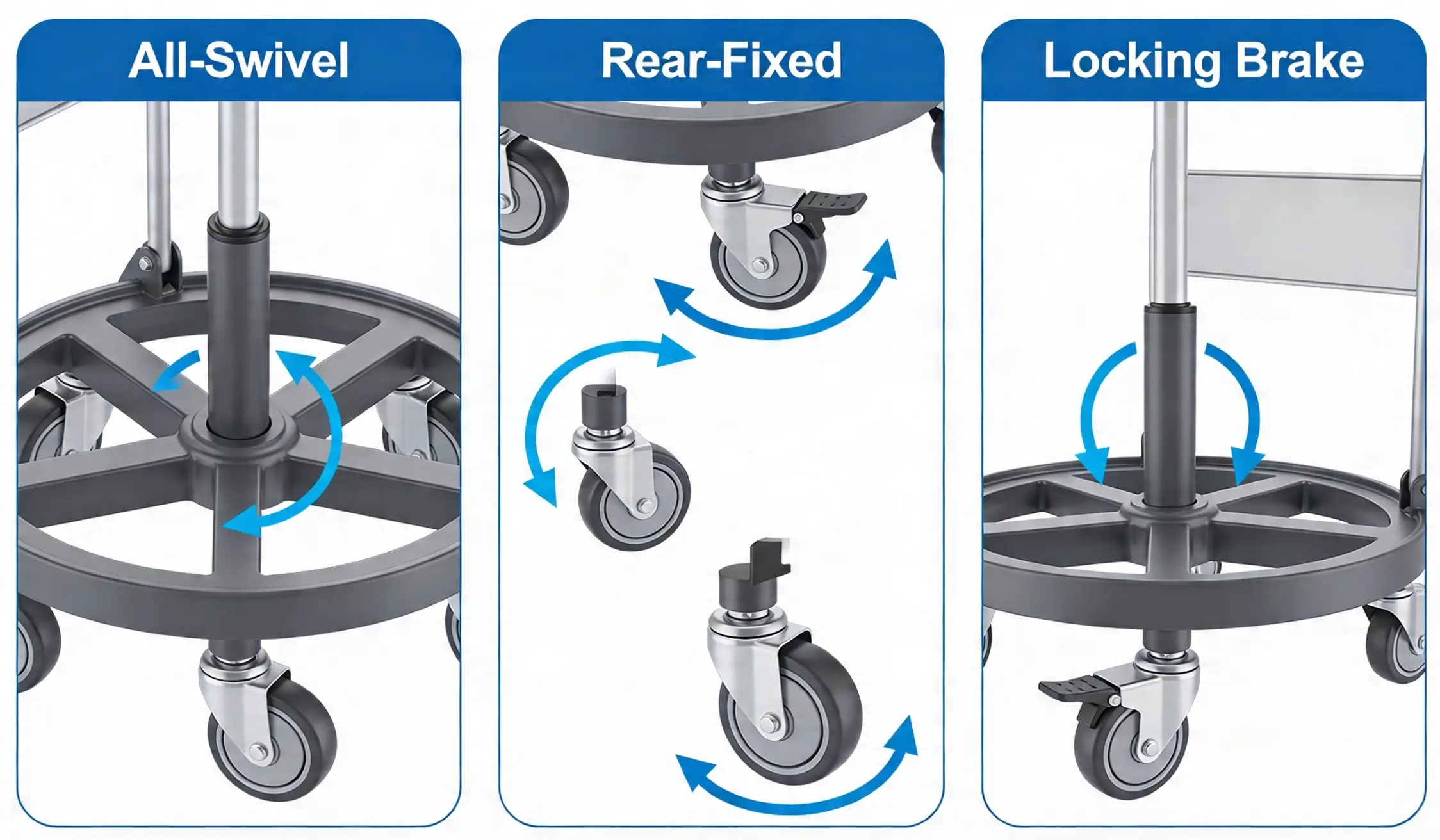
All-Swivel Configuration (Most Common)
The standard American shopping cart uses four swivel casters — all four wheels rotate 360°. This provides maximum maneuverability because the shopper can push the cart in any direction from any position.
- Advantage: Easy to navigate tight aisles, turn corners, and park in checkout lanes
- Disadvantage: The cart has no directional preference — it can drift sideways, especially when empty, and is harder to push in a straight line on slopes
Rear-Fixed / Front-Swivel Configuration
Common in European and Asian markets. The two rear wheels are fixed (do not swivel) while the two front wheels are full-swivel. This gives the cart strong directional stability while still allowing the shopper to steer by pivoting the front wheels.
- Advantage: Tracks straighter, less cart drift, easier to push on inclines and across parking lots
- Disadvantage: Less maneuverable in tight spaces — requires wider turns in narrow aisles
Smart/Locking Wheel Systems
A newer generation of shopping cart casters includes electronic or magnetic locking mechanisms that prevent the cart from leaving the store premises. These systems detect a buried perimeter wire or magnetic boundary and engage an internal brake when the cart crosses it.
- Technology: Magnetic brake activated by a buried wire signal
- Advantage: Dramatically reduces cart theft and parking lot retrieval costs (cart loss costs U.S. retailers an estimated $800 million per year)
- Disadvantage: Higher per-caster cost ($15–30 per smart wheel vs $3–6 for standard), periodic battery replacement, potential for false triggering
Standard Specifications & Sizing
Shopping cart casters follow industry-standard dimensions that have remained consistent across major manufacturers for decades:
| Specification | Standard Value | Notes |
|---|---|---|
| Wheel diameter | 100mm (4″) or 125mm (5″) | 125mm is becoming standard for newer carts |
| Wheel width | 32mm (1.25″) | Wider treads (38mm) for warehouse/club store carts |
| Swivel radius | 55–75mm | Affects overall cart turning radius |
| Mounting type | Top plate with 4-bolt pattern | Standard plate: 65mm × 65mm or 75mm × 75mm |
| Bolt pattern | 4-hole, 50mm × 50mm centers | Some manufacturers use 55mm × 55mm |
| Load rating per caster | 40–80 kg (standard grocery) | 80–120 kg for warehouse/club store carts |
| Total cart load | 60–120 kg (contents + cart weight) | Club/warehouse carts: 150–200 kg |
Material specifications:
- Standard wheel: Semi-elastic gray rubber on polypropylene core
- Premium wheel: Polyurethane on polypropylene core (quieter, longer-lasting)
- Budget wheel: Hard polypropylene (noisiest, shortest lifespan, lowest cost)
- Bracket material: Zinc-plated steel (standard) or stainless steel (wet environments, outdoor cart corrals)
Anti-Theft Locking Cart Wheels
Cart theft is one of retail’s most persistent operational challenges. Stolen carts are expensive to replace ($100–300 each), create liability issues when abandoned, and damage brand perception when scattered across neighborhoods.
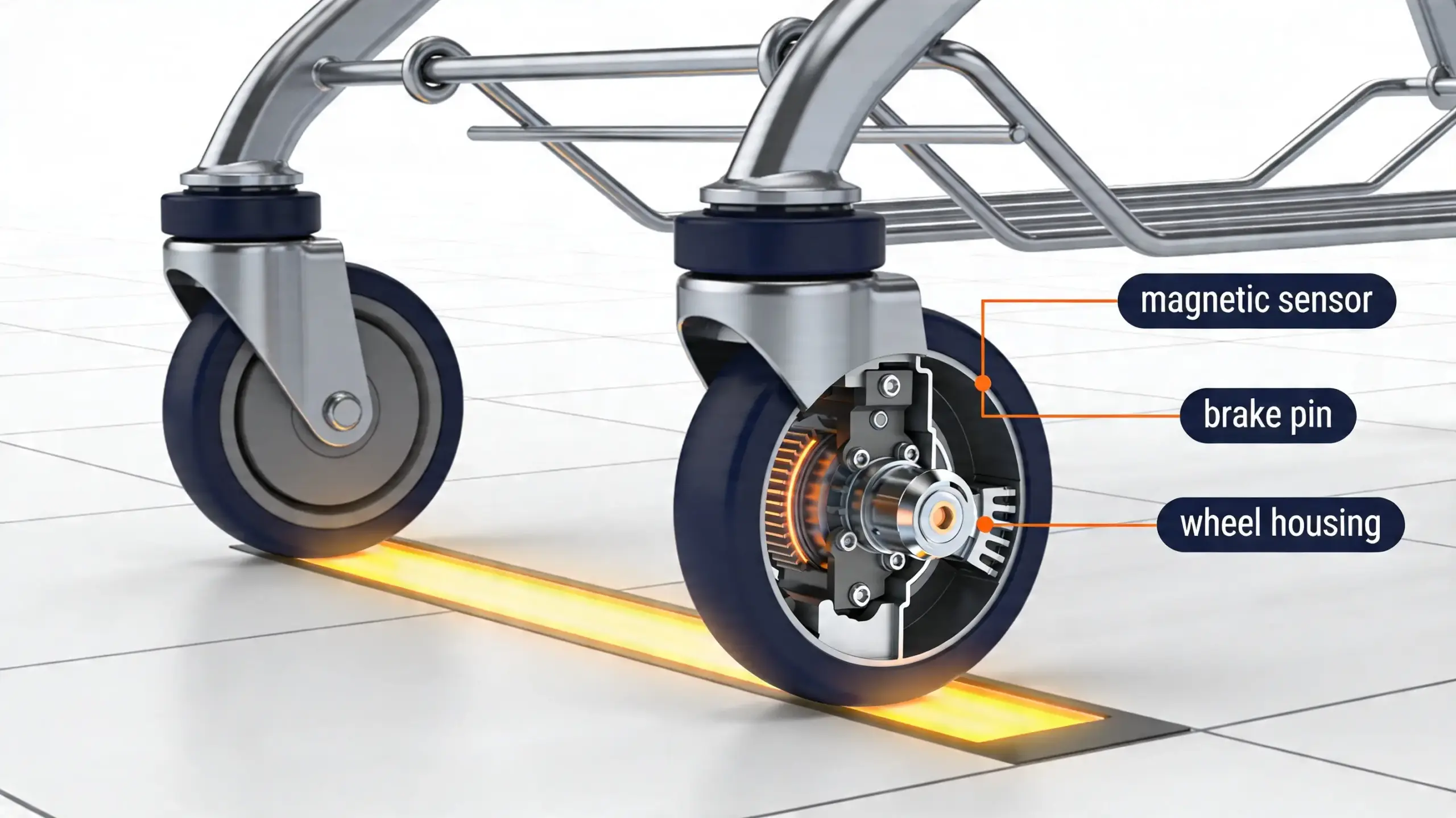
Modern anti-theft caster systems address this problem at the wheel level:
How perimeter-locking systems work:
- A thin signal wire is buried in the pavement around the store perimeter (parking lot boundary)
2. The locking caster wheel contains a receiver, control module, and mechanical brake
- When the cart crosses the perimeter wire, the caster receives the signal and engages the wheel brake
- One locked wheel creates enough resistance to make the cart unmovable — the shopper cannot push it off the property
- Store staff use a remote control or master key to release the brake and return the cart to service
Leading system types:
| System | Mechanism | Battery Life | Cost per Wheel |
|---|---|---|---|
| Gatekeeper/CartControl | Magnetic brake, buried wire | 5–7 years | $18–30 |
| Purchek | Coin-deposit lock (no battery) | N/A (mechanical) | $8–15 |
| Boot-style locks | Attachable wheel lock (staff-applied) | N/A (manual) | $5–10 per boot |
ROI for retailers:
A typical grocery store loses 15–25% of its cart fleet annually to theft and damage. At $150 per cart replacement cost, a 200-cart store loses $4,500–$7,500 per year. A perimeter locking system for 200 carts costs approximately $6,000–$12,000 installed. Most retailers achieve ROI within 12–18 months.
Maintenance & Replacement Schedules
Shopping cart casters operate in one of the harshest environments for small wheels — outdoor parking lots with gravel, sand, water, temperature extremes, and UV exposure, combined with heavy indoor use on hard floors.
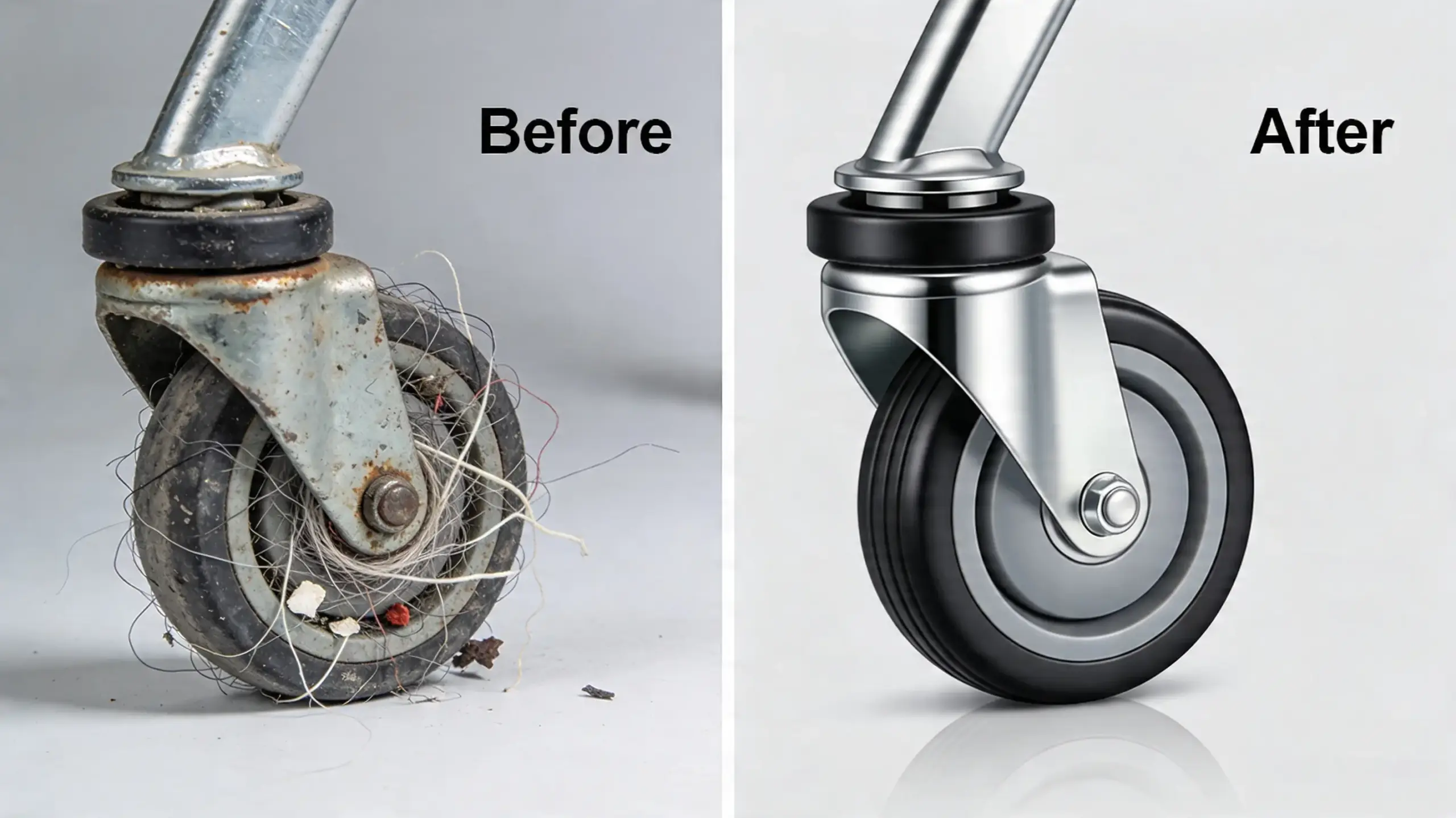
Monthly inspection checklist:
- ☐ Wheel condition: Check for flat spots, cracking, missing chunks, and embedded debris (wire, rocks, bottle caps). Wire wrapped around the axle is the #1 cause of cart wobble.
- ☐ Swivel action: Each caster should swivel smoothly through 360°. Grinding, clicking, or stiff spots indicate bearing damage or debris in the swivel raceway.
- ☐ Mounting bolts: Check that the top plate is securely fastened to the cart frame. Loose mounting creates rattling and accelerates wear on both the caster and the cart frame.
- ☐ Wheel trueness: Spin each wheel — it should rotate evenly without wobble. Wobbling wheels are either bent (axle damage) or have flat spots from being dragged with the brake engaged.
Replacement triggers:
Replace individual casters when:
- Wheel diameter is worn below 85% of original (e.g., 100mm wheel worn to 85mm or less)
- Flat spots are visible or audible (thump-thump while rolling)
- Swivel bearing is damaged (caster does not swivel freely)
- Axle is bent (wheel wobbles during rotation)
- Anti-theft mechanism no longer functions (for locking wheel systems)
Typical replacement intervals:
| Environment | Standard Rubber Wheel | Premium PU Wheel |
|---|---|---|
| Indoor-only (department stores) | 3–4 years | 5–7 years |
| Mixed indoor/outdoor (grocery) | 1.5–2.5 years | 3–4 years |
| Parking lot heavy use (clubs) | 1–2 years | 2–3 years |
| Coastal/wet (salt air, rain) | 1–1.5 years | 2–2.5 years |
Cost-saving tip: Replace casters in sets of four per cart rather than individual wheels. Mixed old and new casters on the same cart create uneven rolling behavior — the new wheel has a larger diameter and different rolling resistance than the worn wheels, causing the cart to pull to one side.
OEM Sourcing — What Retailers Should Know
For chain retailers managing thousands of carts across multiple locations, OEM caster specifications and sourcing strategy directly impact maintenance budgets:
Key OEM specification decisions:
1. Wheel material investment level
- Standard (gray rubber): Lowest unit cost, acceptable performance, 1.5–2.5 year life
- Mid-range (TPE/TPR): 20% cost premium, 30% longer life, quieter rolling
- Premium (cast PU): 50% cost premium, 100% longer life, best rolling performance
For high-volume grocery chains, the premium PU option often delivers the lowest 5-year total cost despite the higher purchase price, because replacement frequency drops by half and labor costs for swapping casters are substantial.
2. Bearing type
- Plain bearing (bushing): Lowest cost, adequate for standard grocery use
- Ball bearing: 40% cost premium, dramatically smoother rolling and longer swivel life
- Sealed ball bearing: 60% premium, best for outdoor/wet environments — keeps water and debris out of the bearing
3. Corrosion protection
- Zinc plating: Standard protection, adequate for indoor use
- Chrome plating: Better aesthetics and moderate corrosion resistance
- Stainless steel: Maximum corrosion resistance for coastal locations and outdoor cart corrals — 3× cost premium but eliminates bracket failures from rust
Minimum order considerations:
Most caster manufacturers require minimum order quantities (MOQ) for custom shopping cart specifications:
- Standard catalog casters: MOQ 100–500 pieces
- Custom specifications (material, size, branding): MOQ 1,000–5,000 pieces
- Anti-theft integrated casters: System-specific, sold through licensed installers
Frequently Asked Questions
Q: What size wheels do shopping carts use?
Most standard grocery store shopping carts use 100mm (4-inch) or 125mm (5-inch) diameter casters. The trend is moving toward 125mm wheels because they roll more smoothly over parking lot cracks, curb transitions, and floor thresholds. Club/warehouse carts (Costco, Sam’s Club) often use 125mm or larger wheels due to higher loads.
Q: Why do shopping cart wheels wobble?
The most common cause is hair, wire, or plastic wrap wound around the wheel axle. This creates uneven rotation and lateral play. The second most common cause is flat spots from wheels being dragged while locked or from prolonged stationary loading. Disassemble the caster, clean the axle, and check for bearing damage.
Q: How much does it cost to replace shopping cart casters?
Standard replacement casters cost $3–8 per wheel for basic rubber, $8–15 for premium PU. Labor adds $5–10 per cart if done in-house. For a full fleet replacement (200 carts × 4 wheels), budget $2,400–$6,400 for standard rubber or $6,400–$12,000 for premium PU — excluding labor.
Q: Are locking shopping cart wheels worth the investment?
For stores in urban areas or neighborhoods with high cart theft rates, yes. The system typically pays for itself within 12–18 months through reduced cart replacement costs and lower cart retrieval expenses.
Q: Can I mix different caster brands on one cart?
Technically possible, but not recommended. Different manufacturers use slightly different plate dimensions, swivel radiuses, and wheel diameters — even when labeled as the same size. Mismatched casters cause uneven rolling, pulling, and accelerated wear. Standardize on one supplier per cart fleet.
Key Takeaways
- Standard shopping carts use 100mm or 125mm swivel casters with a 4-bolt top plate mounting pattern.
- Anti-theft locking caster systems achieve ROI within 12–18 months for most grocery retailers by reducing cart theft and retrieval costs.
- Wire and debris wrapped around the axle is the #1 cause of shopping cart wobble — monthly inspection and cleaning prevents most cart complaints.
- Premium PU wheels cost 50% more than standard rubber but last twice as long, often delivering lower 5-year total cost for high-volume retailers.
- Replace all four casters on a cart simultaneously — mixing old and new wheels creates pulling and uneven rolling.
CTA Section
H2: OEM Shopping Cart Casters from Inford
Inford supplies shopping cart casters to retail chains across 30+ countries. Available in standard rubber, TPR, and premium PU — with plain, ball, or sealed bearing options. MOQ from 500 pieces with custom branding available.
→ Shopping Cart Casters | → Shopping Cart Solution | → Request OEM Quote