

Rigid caster vs swivel caster selection should start with the way the equipment actually moves. Rigid casters keep a fixed wheel direction for straight tracking and load stability. Swivel casters rotate to support turning, positioning, and tight-space movement. Many carts and machines use both types together because the best layout often depends on the path, not on one caster type alone.
This guide compares rigid and swivel casters by movement control, load handling, turning radius, floor conditions, maintenance, and common layout choices. For load calculation before choosing either type, see Inford’s caster wheel load capacity guide.
Rigid Casters: Straight Tracking and Load Stability
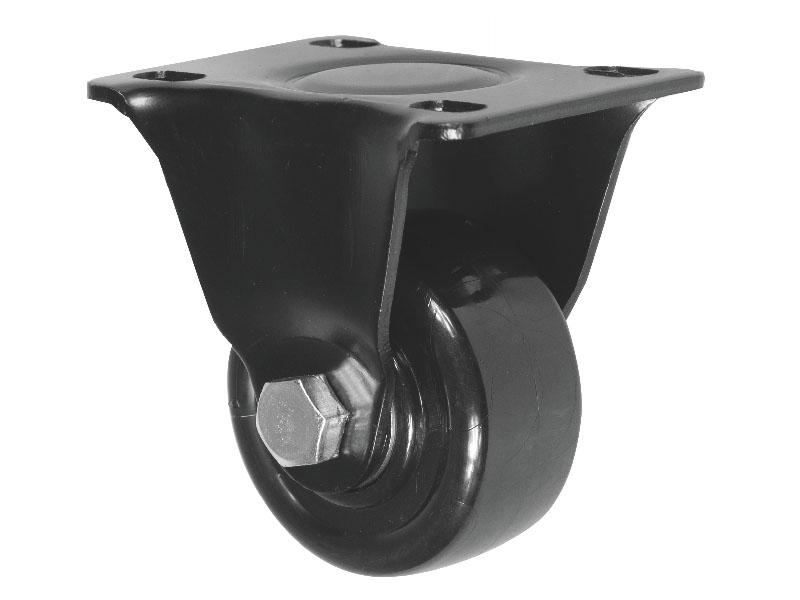
Rigid casters have a fixed wheel orientation, so they move forward and backward along a controlled path. This structure is useful when equipment must track straight, carry a stable load, or move along aisles, rails, production lines, or predictable warehouse routes. A rigid caster is not designed for side-to-side maneuvering by itself. It works best when the operator can approach turns with enough space or when rigid casters are paired with swivel casters in a planned layout. The rigid caster below shows a fixed-direction structure for applications where straight movement matters.
Rigid Caster with Nylon Wheels
Key Characteristics
- Fixed direction: Rigid casters support straight tracking and reduce unwanted wheel direction changes.
- Load stability: The fixed fork can be useful for heavy loads when the movement path is predictable.
- Lower turning flexibility: A rigid caster is not ideal where the equipment must pivot frequently in a tight area.
- Layout dependency: Rigid casters often perform best as part of a mixed layout with swivel casters.
Industrial Applications
Manufacturing Plants: Rigid casters find their niche in manufacturing plants where heavy machinery and equipment require steadfast mobility along predetermined paths. Their stability enhances safety and operational efficiency in these industrial settings. Heavy-duty Equipment: Equipment such as carts carrying massive loads in warehouses or construction sites benefit from the unwavering support provided by rigid casters. The fixed directionality ensures controlled movements, even when transporting bulky materials.Swivel Casters: Turning Control and Positioning
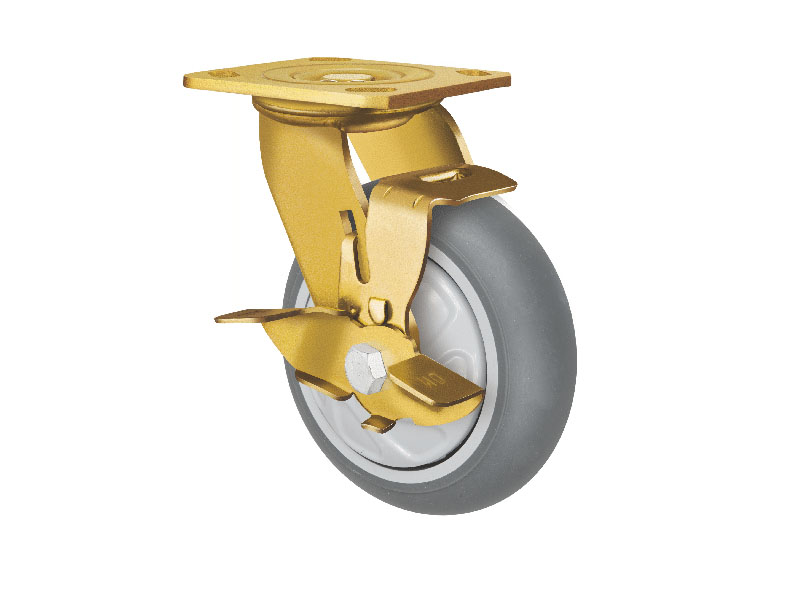
Swivel casters rotate around a vertical swivel section, allowing the wheel to change direction as the equipment turns. This is useful for carts, racks, medical equipment, display fixtures, and workstations that need to move through narrow aisles or reposition frequently. Swivel casters can improve maneuverability, but they also introduce more moving parts. The swivel section, bearing, brake, and mounting hardware should be checked against the load, floor, and duty cycle. For braking needs, review Inford’s swivel caster with brake guide.
250Kg Heavy Duty Swivel Caster
Key Characteristics
- 360-degree movement: Swivel casters support directional changes and tight turning.
- Better positioning: They are useful when equipment must be aligned, parked, or moved around obstacles.
- More maintenance points: The swivel raceway, brake, and fasteners should be inspected regularly.
- Stability tradeoff: Heavy or tall loads may need layout planning, brakes, or directional locks.
Industrial Applications
Retail Environments: Swivel casters are useful for shopping carts, display racks, and fixtures that move through aisles and crowded spaces. Hospital Settings: Medical carts and equipment often need precise positioning in corridors, patient rooms, and treatment areas. Push hand trolleys: For hand-pushed carts, the caster layout should balance steering control and straight tracking. See the caster wheels for push hand trolleys guide for related selection context.Comparative Analysis: Strengths and Tradeoffs
Understanding rigid and swivel caster tradeoffs helps match the caster layout to the real movement path.Rigid Casters
Stability in straight paths: Rigid casters are useful when the equipment must move in a predictable direction, especially over longer straight routes. Limitations in tight spaces: The fixed direction can make tight turns difficult unless the caster layout includes swivel casters or enough turning space.Swivel Casters
Turning in confined areas: Swivel casters help equipment change direction, reposition, and move around obstacles. Stability planning: For heavy, tall, or uneven loads, swivel casters may need brakes, directional locks, wider spacing, or a mixed rigid-swivel layout to improve control.
Custom Caster & Wheel Solutions
Choosing the Right Caster for the Job
The decision between rigid and swivel casters should be based on movement path, load behavior, space, floor condition, and maintenance access.Consideration of Specific Requirements
- Workspace layout: Choose rigid casters when straight travel is the main requirement. Choose swivel casters when turns, positioning, or aisle movement are frequent.
- Load weight and distribution: Heavy loads may require higher-capacity casters, stronger mounting, and careful layout planning. For demanding loads, compare options in Inford’s high load capacity caster wheels guide.
- Wheel and bearing selection: Wheel material and bearing type can change rolling resistance, noise, floor protection, and maintenance. For bearing selection, use the plain bearing vs ball bearing casters guide.
- Floor condition: Smooth floors, uneven surfaces, thresholds, and debris all affect whether tracking, turning, or shock resistance matters more.
Cost and Maintenance Factors
- Rigid casters have fewer steering components but can be harder to reposition in tight spaces.
- Swivel casters improve maneuverability but need more attention around the swivel section, brake, and fasteners.
- A mixed layout often reduces the weaknesses of each type when the equipment needs both straight travel and turning.
Conclusion
The choice between rigid and swivel casters is not a one-size-fits-all decision. Rigid casters are best for straight tracking and predictable movement, while swivel casters are best for turning and positioning. Many practical caster systems use both. Before selecting a final caster layout, confirm the load, movement path, floor surface, wheel material, bearing type, mounting strength, and brake requirements. This creates a safer and more useful caster selection than choosing rigid or swivel by name alone.Rigid Caster vs Swivel Caster: Quick Comparison
| Selection point | Rigid caster | Swivel caster |
|---|---|---|
| Movement path | Straight tracking | Turning and positioning |
| Best fit | Aisles, carts, machinery, fixed travel routes | Tight spaces, frequent direction changes, repositioning |
| Strength | Stable direction and simpler structure | Flexible movement and steering control |
| Limitation | Limited turning ability | More moving parts to inspect |
| Common layout | Often paired with swivel casters | Often paired with rigid casters or brakes |
Common Caster Layouts
- Four swivel casters: useful for maximum maneuverability, but may be harder to keep tracking straight under some loads.
- Two rigid plus two swivel casters: a common layout for carts that need straight travel and controlled turning.
- Rigid casters with swivel brakes: useful when the equipment must move, turn, and then remain parked.
- Directional-lock swivel casters: useful when a swivel caster must sometimes behave like a rigid caster.
Selection Checklist
- Map the route: straight aisle, tight corner, ramp, threshold, or mixed path.
- Calculate total load and uneven load distribution.
- Decide whether operators need turning control, straight tracking, or both.
- Check whether brakes or directional locks are required.
- Match wheel material and bearing type to floor, load, noise, and maintenance needs.
- Inspect mounting strength, fasteners, and frame rigidity before installation.
FAQ About Rigid and Swivel Casters
Are rigid casters better for heavy loads?
Rigid casters can help with straight tracking and stability, but load capacity depends on the complete caster: wheel, bracket, axle, bearing, mounting, and load distribution.
Can I use only swivel casters?
Yes, if maximum maneuverability is needed. However, equipment with only swivel casters may be harder to keep tracking straight, especially under heavier loads or longer travel paths.
What layout works for most carts?
A common layout is two rigid casters and two swivel casters because it combines straight-line control with turning ability. The final layout should still match the route, floor, and load.